Play the video
The video plays from YouTube and belongs to its author.
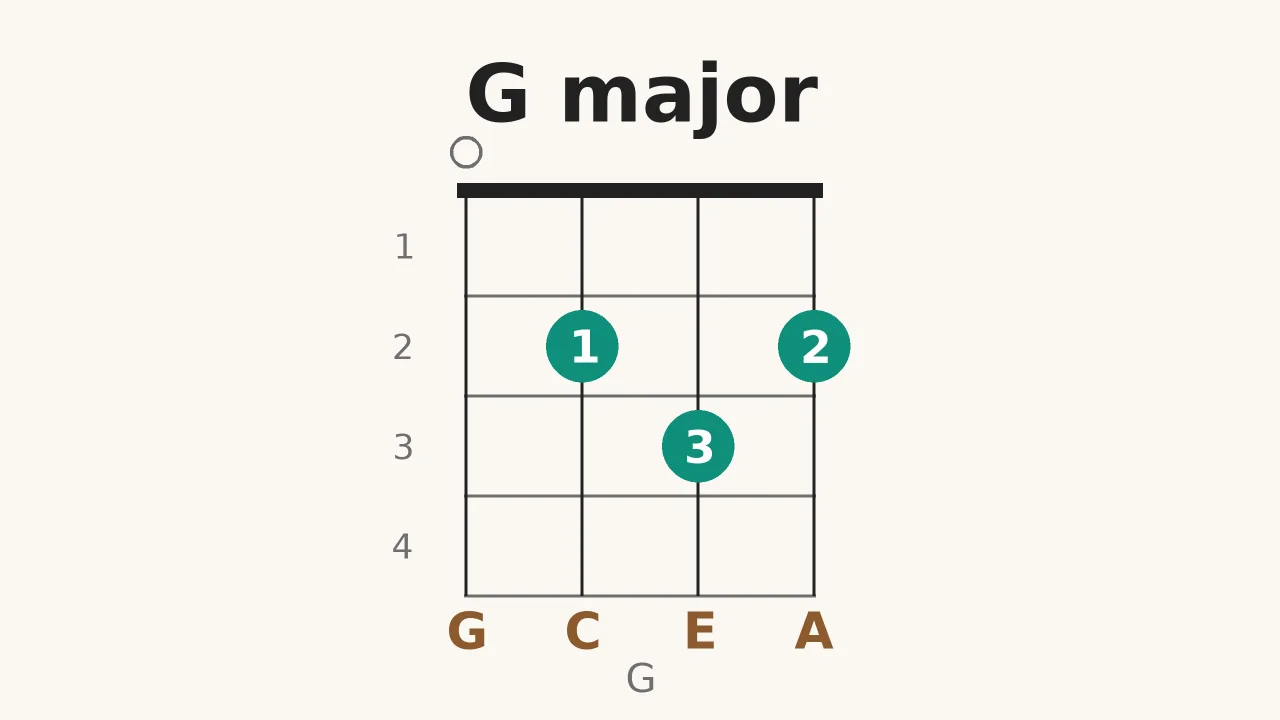
The other triangle
G major uses three fingers at once: finger 1 on the C string at fret 2, finger 3 on the E string at fret 2, and finger 2 on the A string at fret 3. The G string stays open.
You already know a shape very close to this one. G7 uses the same three fingers, but finger 1 sits on the E string at fret 1 instead of the C string at fret 2, so the little triangle points the other way. Swap between the two and watch that single finger move.
They sound different too. G is bright and finished: a song could stop on it. G7 sounds unfinished, as if it were leaning back towards C.
In this video, JustinGuitar shows the G shape and a few alternatives; the first fingering is the one to learn now.
Check every string
Pluck G, C, E, A one at a time. All four should ring. A dull E string is the usual complaint here, and the fix is in the tip below.
C to G
From C, finger 3 leaves the A string and all three fingers land together. G is not built one finger at a time. Place it slowly ten times first, then play four downs on C and four on G, changing on the beat.
Quick check
1 more question in the app Get the app