Let your ears take the lead
Tuning by ear takes more practice than using a tuner, but it's a useful skill to develop.
In this lesson, you'll learn to compare two notes, hear when their pitches differ, and adjust a string until they match.
Don't worry about getting it perfect yet. The goal is to start training your ears to recognize when your ukulele is in tune.
One note to start from
Tune the A string first, from something you trust: the reference tone below, a piano, a tuning app. Everything else is then measured against it.
The three checks
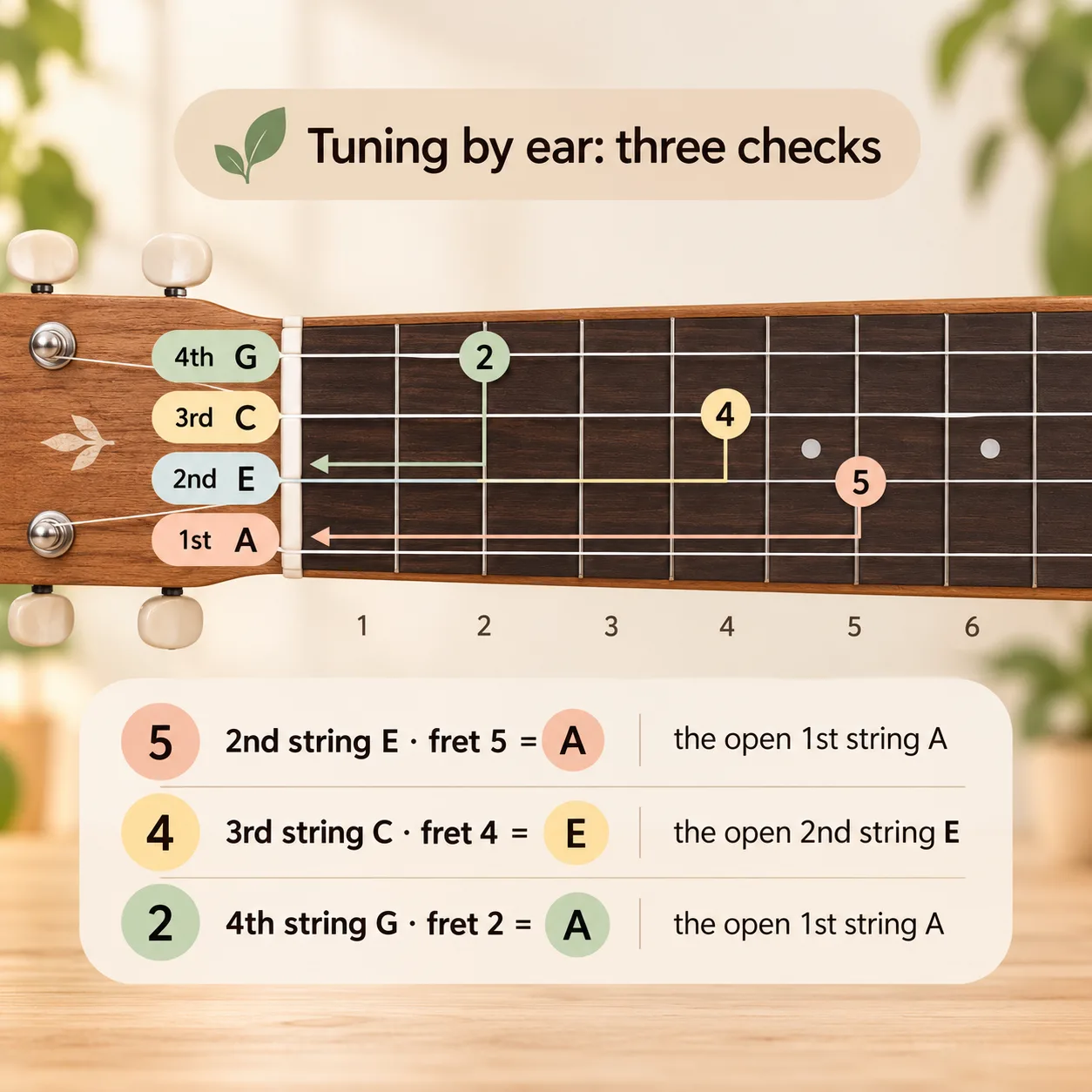
- The E string at the 5th fret must sound the same as the open A string.
- The C string at the 4th fret must sound the same as the open E string.
- The G string at the 2nd fret must sound the same as the open A string - both are A4, because in re-entrant tuning the G sits above the C.
Listening for it
Play the two notes together, then one after the other, then together again, and turn the peg slowly while they ring. Two notes that are nearly the same pulse against each other; the pulse slows as you get closer and disappears when they match. Work in small movements and always arrive from below.
While you are learning, check the result with a clip-on tuner afterwards. Your ear will catch up faster if it is told where it was wrong.
Quick check
1 more question in the app Get the app
Want to see it? Tuning by ear with a teacher, ten minutes.
 Play the video
The video plays from YouTube and belongs to its author.