Harriet Music Get the Ukulele app

Lesson 3 of 5 8 minutes

Ukulele Chord Progression: C, G, Am, F

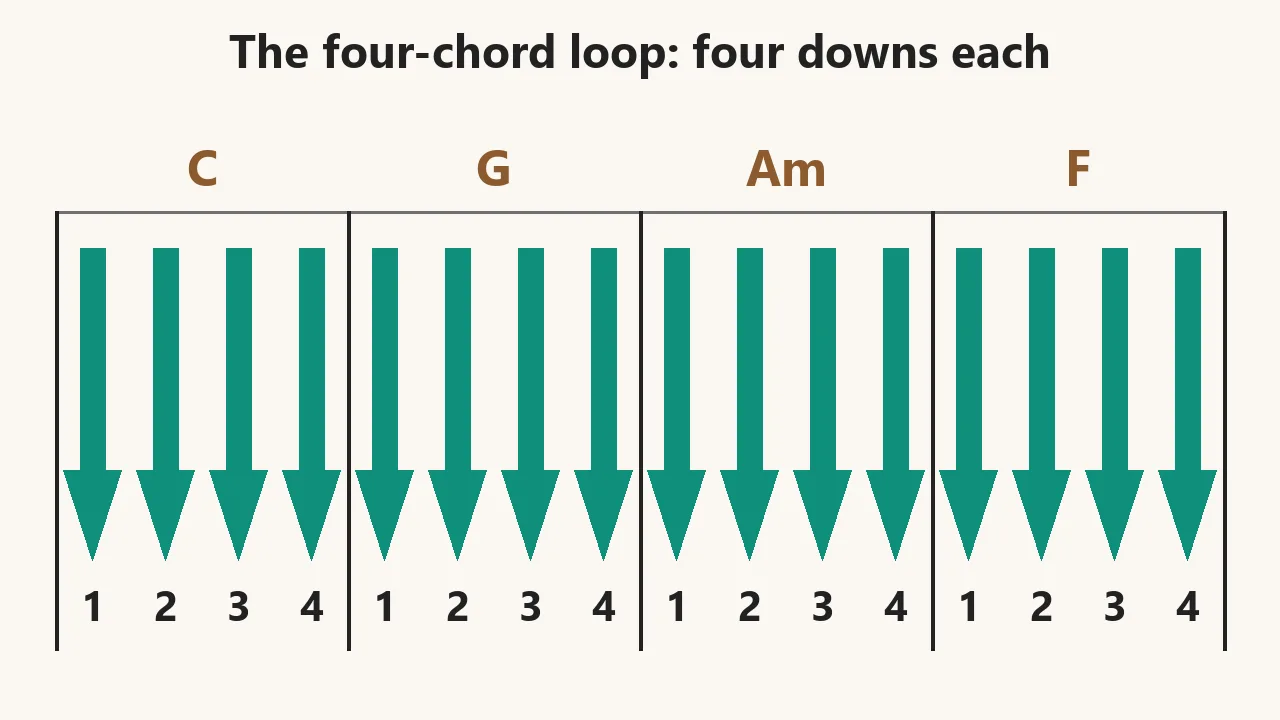
Harriet In this lesson you will play four down strums per chord through C to G to Am to F at a comfortable tempo.

  1. 1. Meet your ukulele
    1. Lesson 1: Welcome: what you'll play
    2. Lesson 2: Meet your ukulele
    3. Lesson 3: Find the parts of your ukulele
    4. Lesson 4: How to hold the ukulele
    5. Lesson 5: Tuning with a tuner: G C E A
    6. Lesson 6: Tuning by ear
  2. 2. First sounds
    1. Lesson 1: The basic strum
    2. Lesson 2: Rhythm and timing: counting the beat
    3. Lesson 3: Fret hand: finger numbers and clean notes
    4. Lesson 4: Read your first chord diagram
    5. Lesson 5: Play your first chord: C major
    6. Lesson 6: Play along with C
    7. Lesson 7: Training your fingers
  3. 3. Your first chord changes
    1. Lesson 1: Add F major
    2. Lesson 2: Add G7
    3. Lesson 3: One-minute changes
    4. Lesson 4: Change chords without stopping
    5. Lesson 5: Play your first three-chord song
  4. 4. Strumming patterns and song charts
    1. Lesson 1: Add the up strum
    2. Lesson 2: Your first down-up pattern
    3. Lesson 3: Read a strumming chart
    4. Lesson 4: Follow a song chord chart
    5. Lesson 5: The island strum
    6. Lesson 6: Play a song with a new strum
  5. 5. More chords, more songs
    1. Lesson 1: Add A minor
    2. Lesson 2: Add G major
    3. Lesson 3: The C-G-Am-F progression
    4. Lesson 4: Make the four-chord loop flow
    5. Lesson 5: Song: Let It Be
Each arrow is one down strum, the numbers are the count, each box is one chord: C, G, Am, F, then back to C. Change on the next 1.

The loop hundreds of songs use

C, G, Am, F, one bar each, then round again. This is the most used chord loop in popular music, and you now know every chord in it. Once it sits under your fingers you will start hearing it everywhere.

The three changes

Three changes carry you through the loop, and a fourth brings you home.

  • C to G: every finger moves, so place the whole shape at once.
  • G to Am: the hand lifts off completely and finger 2 lands alone on the G string.
  • Am to F: finger 2 stays exactly where it is and finger 1 joins it on the E string.
  • F back to C: both fingers leave and finger 3 goes to the A string on its own.

Keep the beat honest

Set a metronome to 60, play four down strums per chord and count out loud: 1 2 3 4. Change on the next 1. A chord that arrives a little late is fine at this stage. A beat that stops is not. Keep the hand swinging and let the chord catch up.

Quick check

Which finger stays down from Am to F?
Show the answer

Finger 2. Finger 2 stays on the G string at fret 2 and finger 1 simply joins it on the E string.

1 more question in the app Get the app

Practise in the free Ukulele app