Play the video
The video plays from YouTube and belongs to its author.
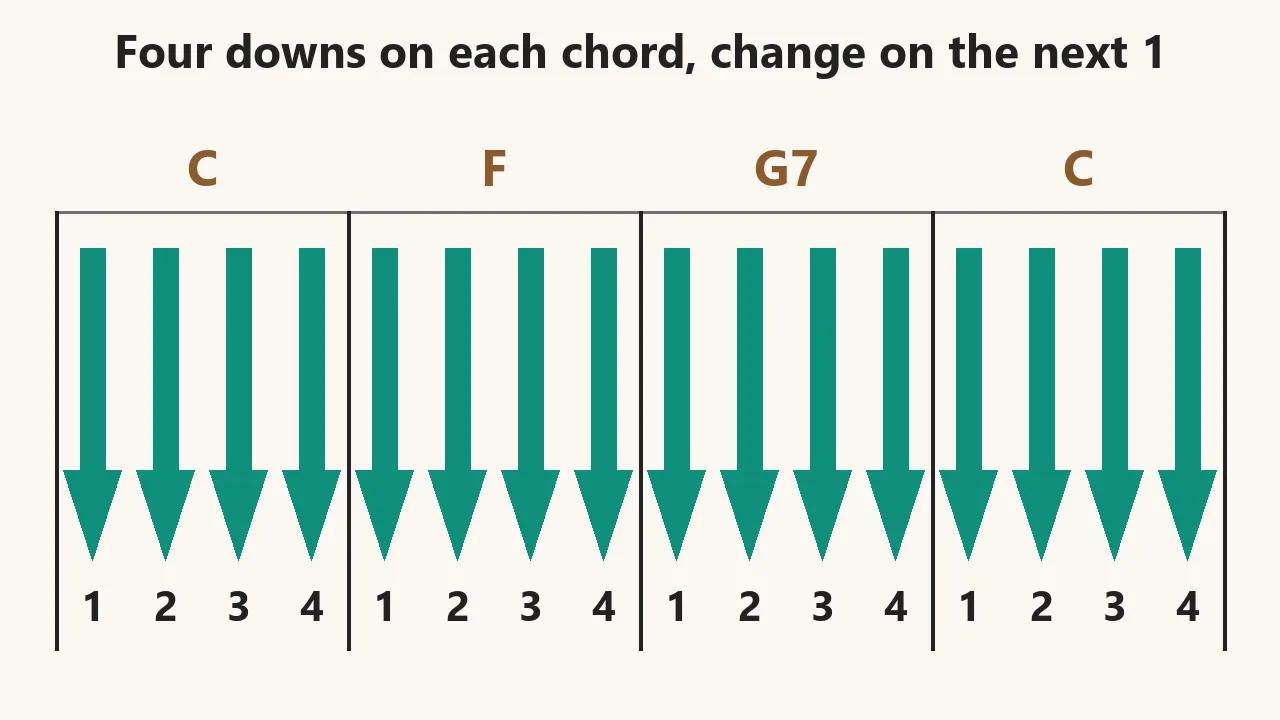
Reading the chart
The picture above is a strum chart, and you will see one in most lessons from now on. Read it left to right. The name above each box is the chord you hold, each arrow is one down strum, and the numbers are what you count aloud. The vertical lines separate the bars: one chord, four strums, then the next box.
The progression
Your three chords now make a loop: C, F, G7, C. Give each chord four down strums and count 1 2 3 4 aloud while you play. The new chord arrives on the next 1, never in the middle of a bar. Count louder than feels necessary; the count is what holds the whole thing together.
The strumming hand never stops
The beat keeps running while the fretting hand moves. A chord that lands slightly late is fine, and you can catch up on the next beat. A beat that stops is not fine, because the music falls over. Help yourself by taking the shortest route: going from F to G7, finger 1 stays exactly where it is on the E string at fret 1, and only fingers 2 and 3 travel.
Use the metronome
Start the metronome on the practice card below at 60 bpm. Play the loop until every change lands on 1 with no gap. Only then move up to 70. If changes keep arriving late, the tempo is too fast, not your hands.
In this video, Jim D'Ville plays the progression at a steady count. Watch how the change arrives on the next 1, not after a pause.
Quick check
1 more question in the app Get the app