Harriet Music Get the Ukulele app

Lesson 5 of 6 8 minutes

How to Tune a Ukulele With a Tuner: G C E A

Harriet In this lesson you will tune all four strings with a clip-on tuner and remember the string names.

  1. 1. Meet your ukulele
    1. Lesson 1: Welcome: what you'll play
    2. Lesson 2: Meet your ukulele
    3. Lesson 3: Find the parts of your ukulele
    4. Lesson 4: How to hold the ukulele
    5. Lesson 5: Tuning with a tuner: G C E A
    6. Lesson 6: Tuning by ear
  2. 2. First sounds
    1. Lesson 1: The basic strum
    2. Lesson 2: Rhythm and timing: counting the beat
    3. Lesson 3: Fret hand: finger numbers and clean notes
    4. Lesson 4: Read your first chord diagram
    5. Lesson 5: Play your first chord: C major
    6. Lesson 6: Play along with C
    7. Lesson 7: Training your fingers
  3. 3. Your first chord changes
    1. Lesson 1: Add F major
    2. Lesson 2: Add G7
    3. Lesson 3: One-minute changes
    4. Lesson 4: Change chords without stopping
    5. Lesson 5: Play your first three-chord song
  4. 4. Strumming patterns and song charts
    1. Lesson 1: Add the up strum
    2. Lesson 2: Your first down-up pattern
    3. Lesson 3: Read a strumming chart
    4. Lesson 4: Follow a song chord chart
    5. Lesson 5: The island strum
    6. Lesson 6: Play a song with a new strum
  5. 5. More chords, more songs
    1. Lesson 1: Add A minor
    2. Lesson 2: Add G major
    3. Lesson 3: The C-G-Am-F progression
    4. Lesson 4: Make the four-chord loop flow
    5. Lesson 5: Song: Let It Be
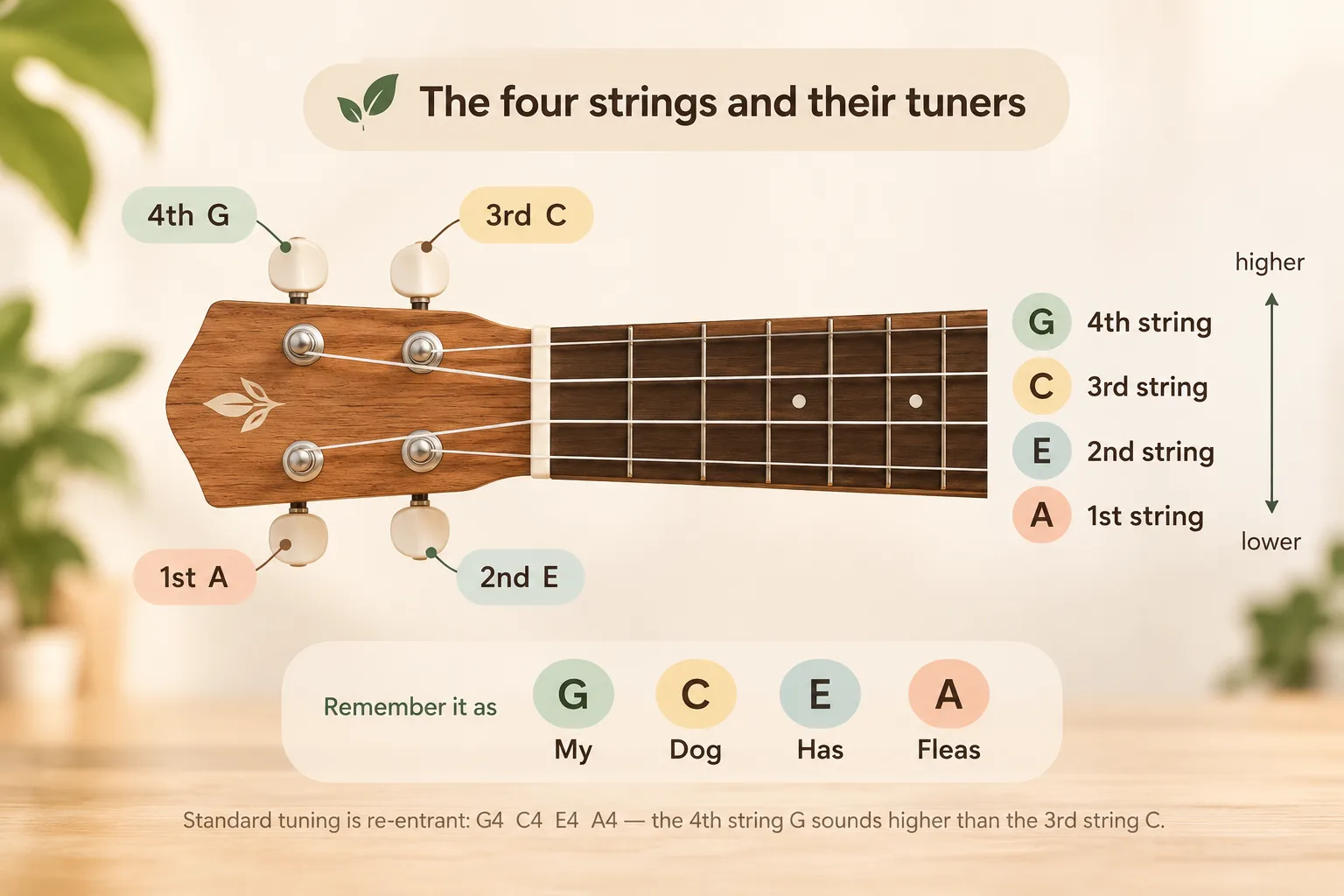
G C E A, from the string nearest the ceiling to the one nearest the floor - and which tuner turns which string.

The strings and their names

Held in playing position the strings run G C E A, from the one nearest the ceiling to the one nearest the floor. They are numbered the other way round: the A string, nearest the floor, is string 1, then E is 2, C is 3, and the G you started from is string 4.

The tuner

A clip-on tuner grips the headstock and reads the vibration through the wood, so it works in a noisy room, where a microphone would not.

How to tune

  1. Clip the tuner on the headstock and switch it on.
  2. Pluck one string and let it ring.
  3. Read the note. A needle to the left, or a flat sign, means too low; to the right, or sharp, means too high.
  4. Turn that string's peg slowly, a little at a time, and always finish by tuning up to the note. If you sail past it, loosen well below and come back up.
  5. Do all four, then go round again: tightening one string changes the pull on the whole instrument and drags the others slightly out.

New strings stretch for the first few days, so expect to tune several times in a session.
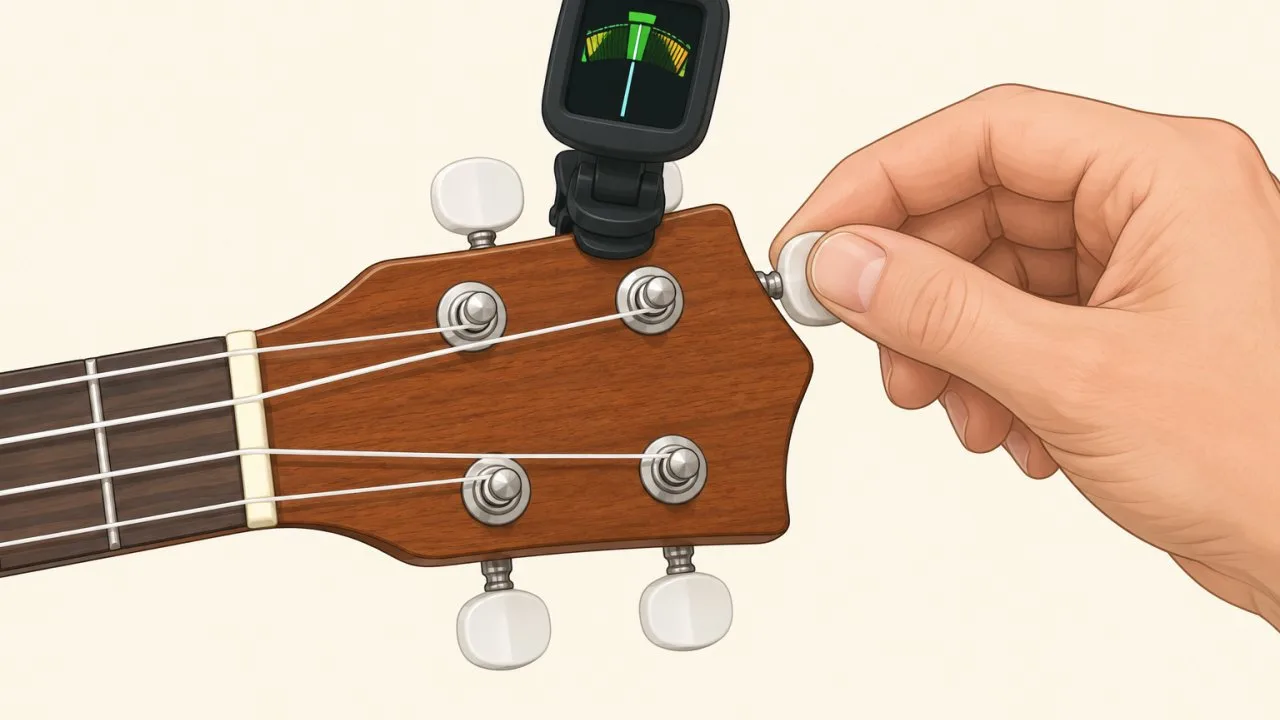
  1. Clip the tuner onto the headstock and switch it on.
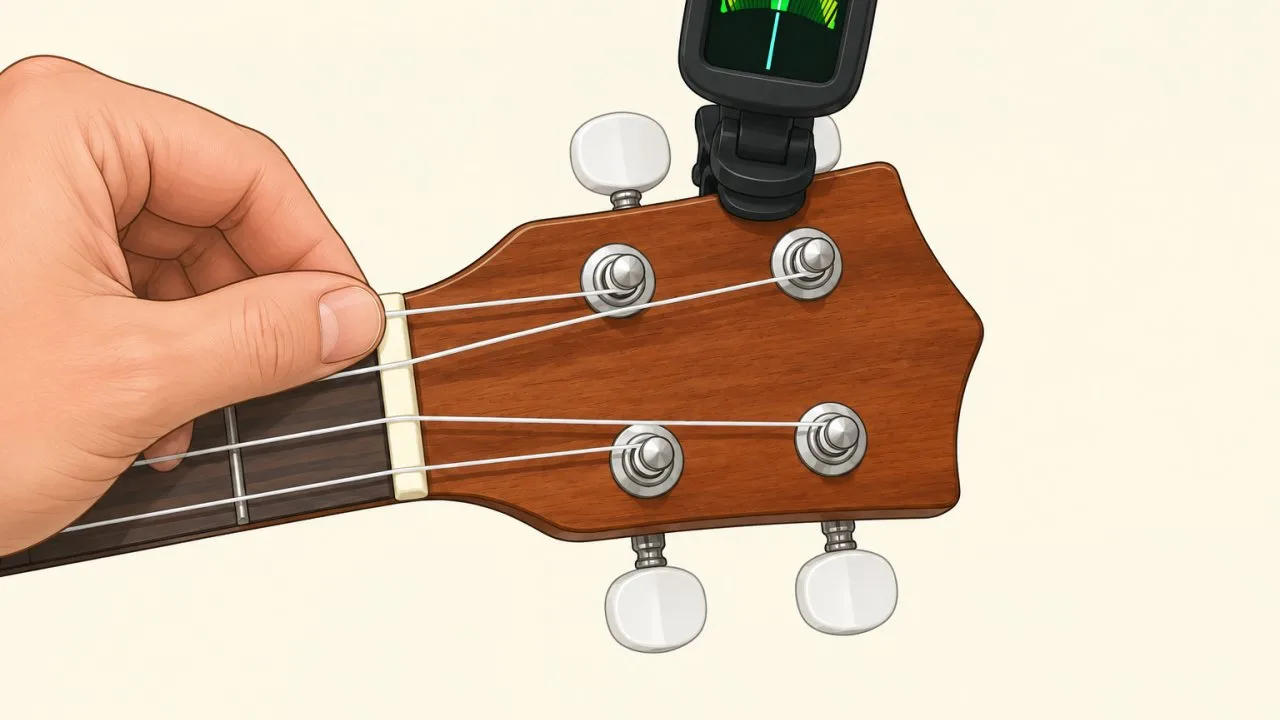
    Clip the tuner onto the headstock and switch it on.
  2. Pluck one string and let it ring; the tuner shows the note it hears.
    Pluck one string and let it ring; the tuner shows the note it hears.
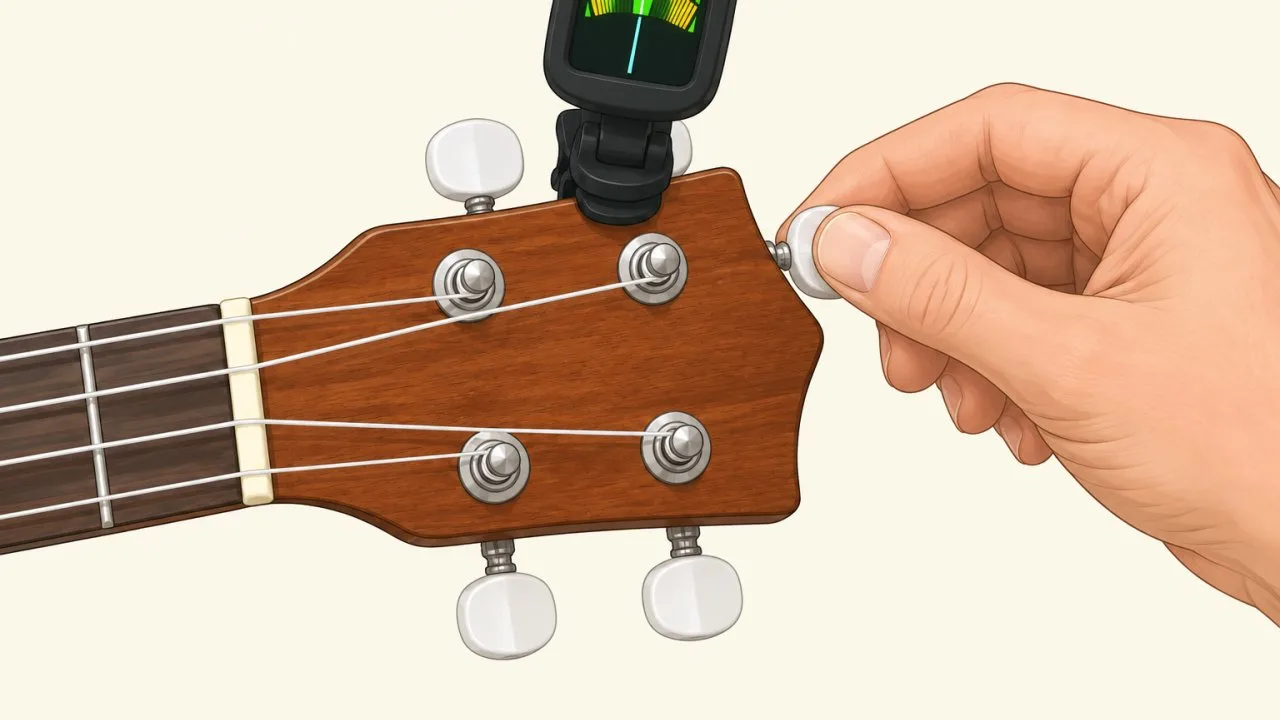
  3. Turn the peg of that string slowly until the display centres on the right note, tuning up to it.
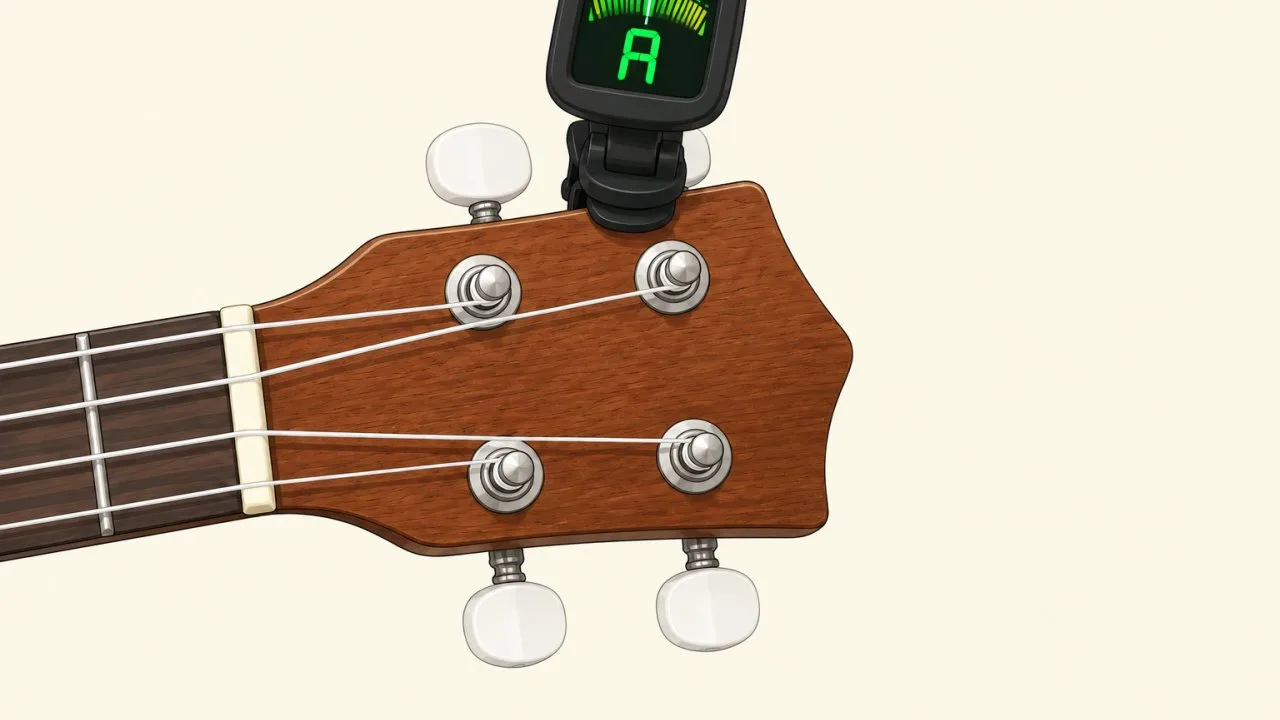
    Turn the peg of that string slowly until the display centres on the right note, tuning up to it.
  4. Repeat for the other three strings, then check all four again.
    Repeat for the other three strings, then check all four again.
4th string G (G4, 392 Hz)Reference tone for the 4th string, G.
3rd string C (C4, 262 Hz)Reference tone for the 3rd string, C.
2nd string E (E4, 330 Hz)Reference tone for the 2nd string, E.
1st string A (A4, 440 Hz)Reference tone for the 1st string, A.
All four strings in order: G C E AReference tones for all four strings, in order: G, C, E, A.

Quick check

Which string is the highest in pitch?
Show the answer

A. A4 at 440 Hz is the highest of the four. The C string, C4, is the lowest.

1 more question in the app Get the app

Want to see it? Tuning with a clip-on tuner, on camera.

Play the video

The video plays from YouTube and belongs to its author.

Practise in the free Ukulele app