Welcome: start with one sound
You do not need to read music or know any chords yet. In this lesson you will identify the kind of ukulele this course uses, hear the difference between two pitches, and gently pluck an open string.
Have your ukulele nearby if you have one. If you do not, follow the pictures and listening examples; return to the hands-on task later.
Four sizes, one starting point
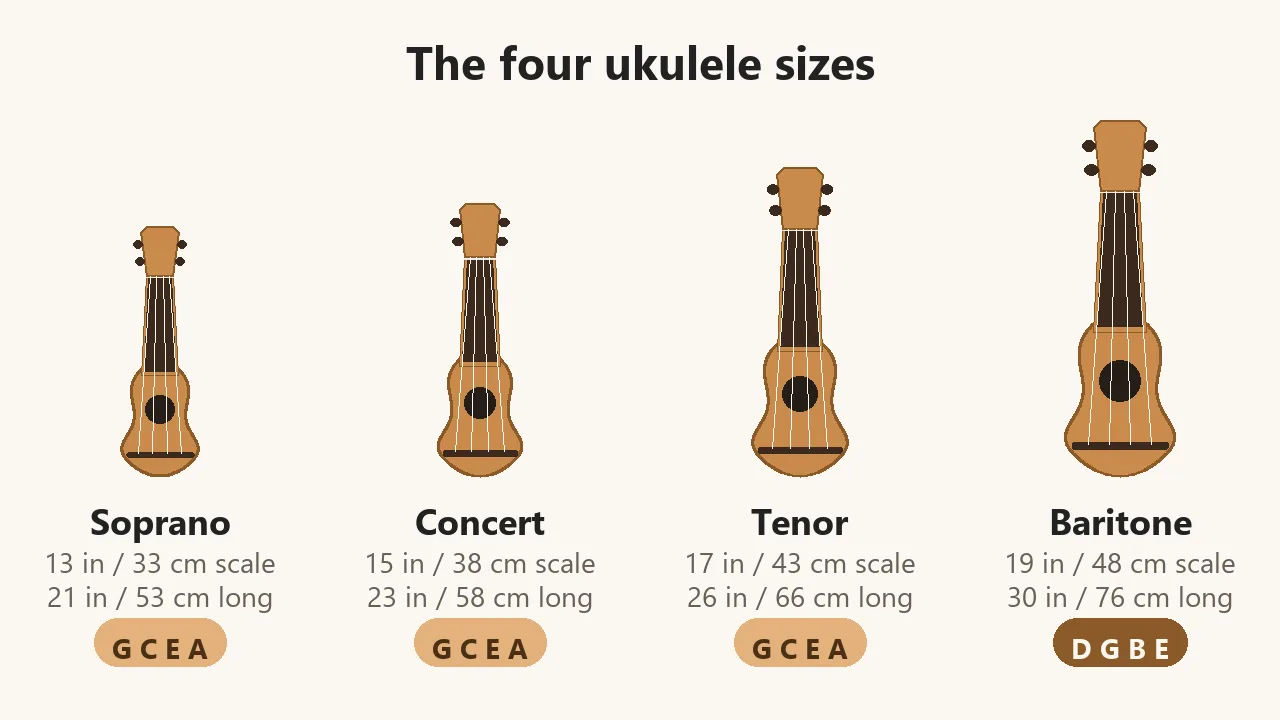
The four common sizes are soprano, concert, tenor and baritone, from smaller to larger. Size affects the space between frets and how the instrument feels to hold. There is no single best size for every beginner.
This course uses G-C-E-A tuning, common on soprano, concert and tenor ukuleles. A standard baritone is usually tuned D-G-B-E, so the chord names in this course will not match that tuning.
A quick look at your ukulele
For now, find just three things: the body, the larger hollow part; the neck, the long part under the strings; and the tuners, the pegs at the headstock. There is no need to memorise all the names yet.
Gently plucking a string makes it vibrate. On an acoustic ukulele, the body helps make that vibration audible. Leave the tuners alone for this first exploration.
Listen: pitch is not volume
Pitch means how high or low a sound is. Volume means how loud or soft it is. A high note can be quiet, and a low note can be loud.
Play these two recorded ukulele notes. The second has a higher pitch than the first. They are listening examples, not a request to tune your instrument yet.
Try: one open string
An open string is a string played without pressing it against a fret. No chord shape is needed.
Sit comfortably. Rest the body against your torso and support it on your lap with your forearm and fretting hand. Keep your shoulders relaxed and avoid squeezing the neck. Your fretting hand can support the instrument without pressing the strings.
Gently pluck one string with your thumb. Listen as the sound fades. Touch that string lightly to stop it, then try again. It does not need to match the recordings: we will tune together in a later lesson.
Quick check
2 more questions in the app Get the app
Optional: see the sizes on camera
The existing video below offers another look at ukulele sizes and sounds. You can finish the lesson without watching it.
Next: explore the parts of your ukulele in more detail. You do not need to memorise every part today.
 Play the video
The video plays from YouTube and belongs to its author.