Harriet Music Get the Banjo app

Lesson 4 of 6 9 minutes

Banjo Hammer-Ons and Pull-Offs for Beginners

Harriet In this lesson you will sound a fourth-string 0h2 hammer-on and a third-string 2p0 pull-off with controlled timing.

  1. 1. Meet Your Banjo
    1. Lesson 1: Meet the Five-String Banjo
    2. Lesson 2: Find Your Playing Posture
    3. Lesson 3: Hold Your Banjo Comfortably
    4. Lesson 4: Tune to Open G
    5. Lesson 5: Pick Your First Open Strings
    6. Lesson 6: Hear High and Low Strings
  2. 2. Pulse and First Notes
    1. Lesson 1: Keep a Steady Beat
    2. Lesson 2: Pick with Thumb and Fingers
    3. Lesson 3: Fret a Note Cleanly
    4. Lesson 4: Find Your First Melody Notes
    5. Lesson 5: Count Beats and Offbeats
    6. Lesson 6: Leave Space with Rests
    7. Lesson 7: Play a Short Musical Phrase
  3. 3. Your First Chords
    1. Lesson 1: Strum the Open G Chord
    2. Lesson 2: Find the D7 Chord
    3. Lesson 3: Change Between G and D7
    4. Lesson 4: Add the C Chord
    5. Lesson 5: Keep Time Through Chord Changes
    6. Lesson 6: Accompany a Three-Chord Song
  4. 4. Rolls and Reading Tab
    1. Lesson 1: Fit Your Fingerpicks
    2. Lesson 2: Position Your Picking Hand
    3. Lesson 3: Read Strings and Frets
    4. Lesson 4: Read Rhythm in Banjo Tab
    5. Lesson 5: Play an Alternating Thumb Roll
    6. Lesson 6: Build a Forward Roll
    7. Lesson 7: Play a Forward-Reverse Roll
    8. Lesson 8: Change Chords While Rolling
  5. 5. Your First Bluegrass Tunes
    1. Lesson 1: Connect the Tune’s Phrases
    2. Lesson 2: Bring Out the Melody
    3. Lesson 3: Play a Smooth Slide
    4. Lesson 4: Add Hammer-Ons and Pull-Offs
    5. Lesson 5: Learn Cripple Creek
    6. Lesson 6: Play with the Recording, Then Alone

Sound the second note with the fretting hand

You can already fret cleanly and keep contact through a slide in Play a Smooth Slide. A hammer-on and a pull-off also give two notes from one initial picking stroke, but the finger action changes.
In this short video, Jim Pankey demonstrates a hammer-on: pluck the open fourth string, then land the middle finger at fret 2 while the string rings.

Play the video

The video plays from YouTube and belongs to its author.

Hammer on: 0h2

Pluck open string 4 with your thumb. Bring your middle fingertip down firmly and precisely just behind fret 2, so the landing sounds the second note. Keep the finger curved and use a small movement rather than a hard strike.
In 0h2, the h tells you to hammer on; do not pick the 2 again. Try without a beat first. If the second note is weak, check the fingertip landing and fret position before adding force.
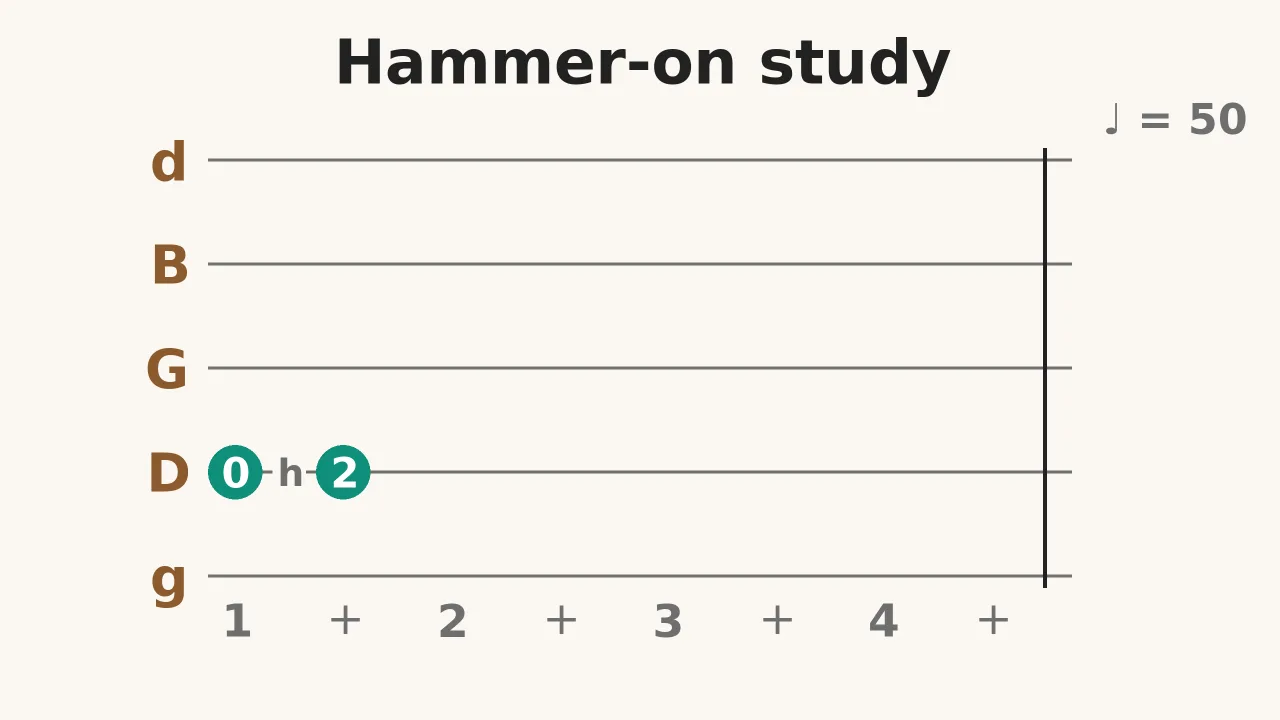
String 4: pick open on “1”, hammer to fret 2 on “+”. Let it ring through beats 2–4, then reset.

Pull off: 2p0

Reopen John Moore’s video in Play a Smooth Slide. From around 2:11, he demonstrates a pull-off on string 3, fret 2 to open. Listen for the open note after the fretting finger leaves.
Fret string 3 at 2 with your middle finger and pluck with your thumb. Give the string a small sideways release with that fretting fingertip, then clear it so the open string can ring. Simply lifting straight off can leave a weak second note. Avoid a large tug that catches a neighbouring string.
The p in 2p0 means pull off: the fretting finger, not another picking stroke, sounds the open note.
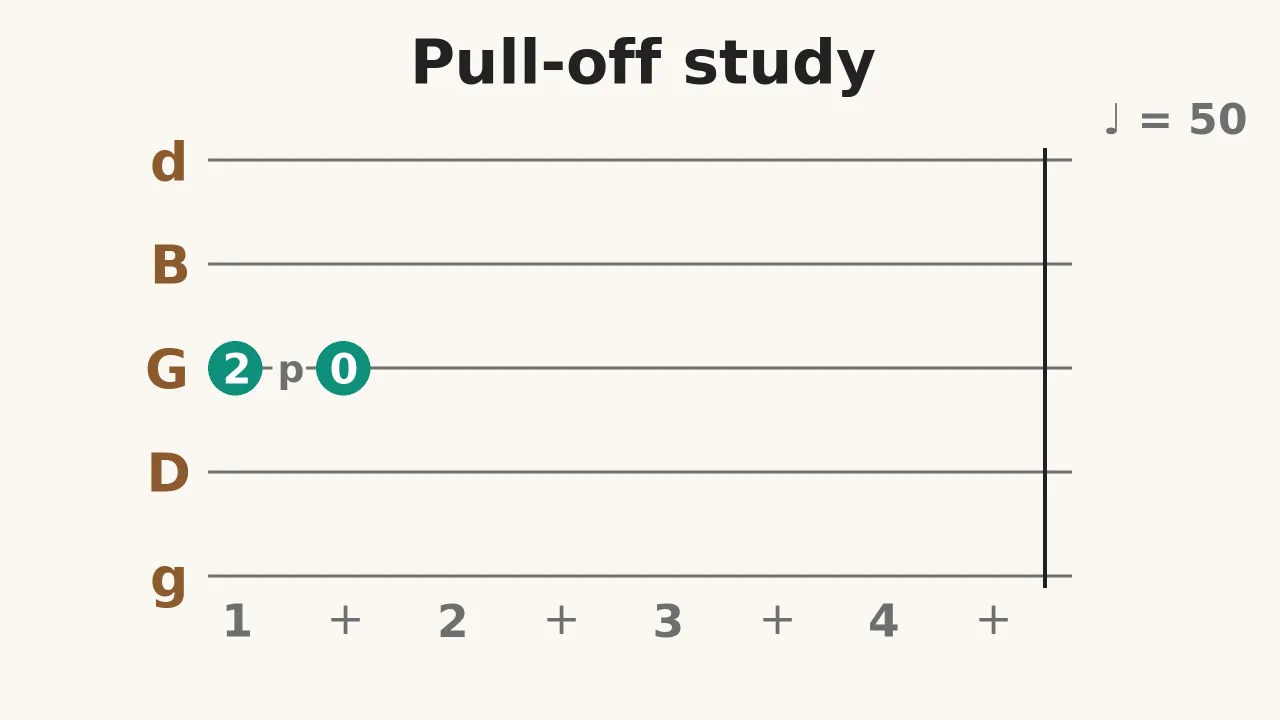
String 3: pick fret 2 on “1”, pull off to open on “+”. Keep the release small and clear the string.

In the app: a practice. Get the app

Keep both starts deliberate

The fretting-hand action should not make the second note early. In these slow studies it arrives on “+” after beat 1, as in the slide study. You will fit these techniques into tune endings in Learn Cripple Creek; this isolation rhythm is not the complete ending lick.
Quick check

Your pull-off’s open note is weak. What should you try first?
Show the answer

Pause and check a small sideways release that clears the string. A controlled release helps sound the open note without an extra picking stroke or a large tug.

Practise in the free Banjo app