Harriet Music Get the Banjo app

Lesson 2 of 6 7 minutes

Bring Out the Melody When You Play Banjo

Harriet In this lesson you will make selected melody notes easier to hear while keeping the surrounding pattern even.

  1. 1. Meet Your Banjo
    1. Lesson 1: Meet the Five-String Banjo
    2. Lesson 2: Find Your Playing Posture
    3. Lesson 3: Hold Your Banjo Comfortably
    4. Lesson 4: Tune to Open G
    5. Lesson 5: Pick Your First Open Strings
    6. Lesson 6: Hear High and Low Strings
  2. 2. Pulse and First Notes
    1. Lesson 1: Keep a Steady Beat
    2. Lesson 2: Pick with Thumb and Fingers
    3. Lesson 3: Fret a Note Cleanly
    4. Lesson 4: Find Your First Melody Notes
    5. Lesson 5: Count Beats and Offbeats
    6. Lesson 6: Leave Space with Rests
    7. Lesson 7: Play a Short Musical Phrase
  3. 3. Your First Chords
    1. Lesson 1: Strum the Open G Chord
    2. Lesson 2: Find the D7 Chord
    3. Lesson 3: Change Between G and D7
    4. Lesson 4: Add the C Chord
    5. Lesson 5: Keep Time Through Chord Changes
    6. Lesson 6: Accompany a Three-Chord Song
  4. 4. Rolls and Reading Tab
    1. Lesson 1: Fit Your Fingerpicks
    2. Lesson 2: Position Your Picking Hand
    3. Lesson 3: Read Strings and Frets
    4. Lesson 4: Read Rhythm in Banjo Tab
    5. Lesson 5: Play an Alternating Thumb Roll
    6. Lesson 6: Build a Forward Roll
    7. Lesson 7: Play a Forward-Reverse Roll
    8. Lesson 8: Change Chords While Rolling
  5. 5. Your First Bluegrass Tunes
    1. Lesson 1: Connect the Tune’s Phrases
    2. Lesson 2: Bring Out the Melody
    3. Lesson 3: Play a Smooth Slide
    4. Lesson 4: Add Hammer-Ons and Pull-Offs
    5. Lesson 5: Learn Cripple Creek
    6. Lesson 6: Play with the Recording, Then Alone

Listen for a line, not just a roll

In a bluegrass tune, the melody sits inside a stream of roll notes. Hum Bar A of the phrase from Play a Short Musical Phrase, D4–E4–G4–E4. That singable line is what you want the listener to follow through any picking pattern.
Melody notes carry that line; other notes can support and fill it. Bringing out the melody is a matter of relative balance. Try making the supporting notes gentler before making the targets stronger. Keep every note start in time.

A small balance experiment

Use the familiar first-string 0–2–5–2, with one note on each of four beats at 50. This is an original practice study, not the tune’s melody. For the experiment, choose the notes on beats 1 and 3 as targets and make beats 2 and 4 quieter.
First play all four notes with an even volume. Then play the same sequence and timing with that target-and-support balance. The difference should come from controlled contact, not a jab, a locked hand or a faster note.
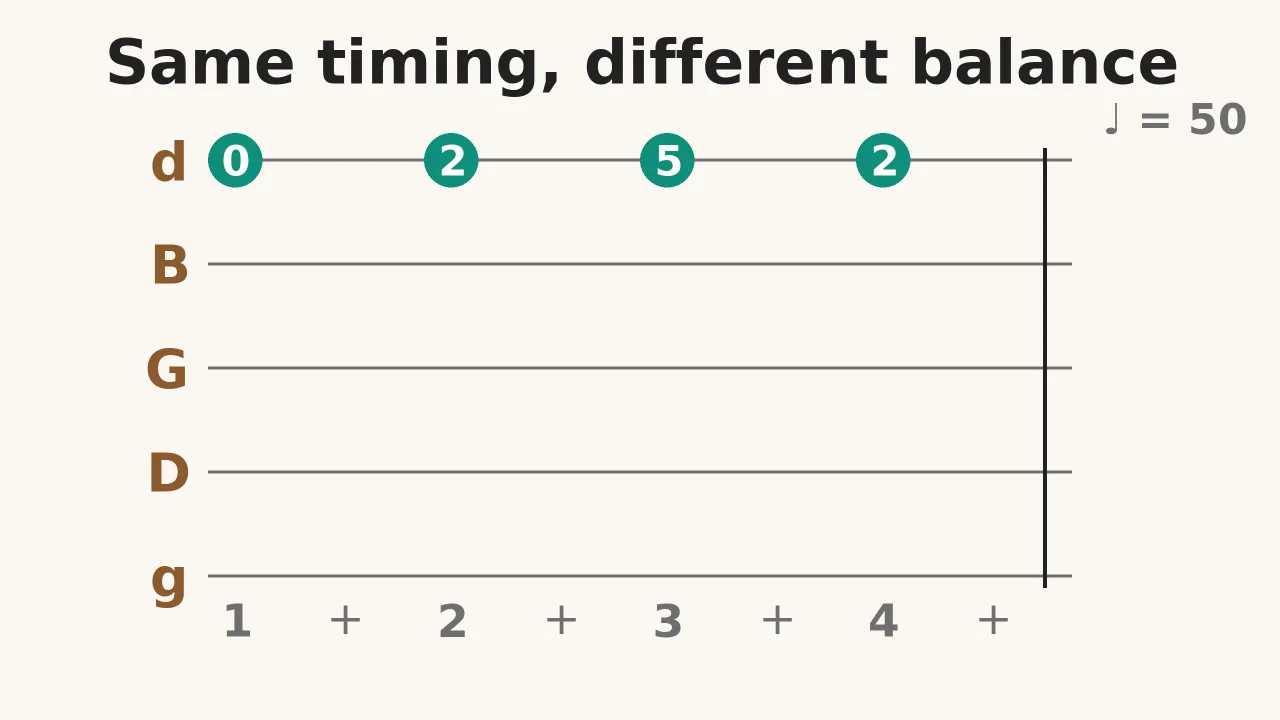
Original balance study: make the 0 on beat 1 and 5 on beat 3 clearer; keep 2 on beats 2 and 4 gentler.
Pitch-order reminder for the study only. This clip does not demonstrate the loud–soft balance.

Take the idea back to a phrase

Return to the two-bar phrase from Play a Short Musical Phrase. Hum it, then play slowly enough to listen while you pick. Let the notes you hear as the line stand a little clearer, and keep the surrounding notes light. In Learn Cripple Creek, later in this section, use the same listening rather than assuming that every thumb note, high note or numbered beat must be melody.
If you cannot yet hear a clear line, return to the listening step. You can still practise controlled balance with the original study while your ear develops.

Quick check

Every note becomes louder when you try to emphasize the melody. What should you try next?
Show the answer

Keep targets comfortable and make supporting notes gentler. A relative reduction in supporting-note volume can reveal the line without excess force.

1 more question in the app Get the app

Practise in the free Banjo app