Harriet Music Get the Banjo app

Lesson 6 of 8 8 minutes

Banjo Forward Roll: Thumb, Index, Middle

Harriet In this lesson you will play a counted eight-note forward-roll example while keeping all note starts even.

  1. 1. Meet Your Banjo
    1. Lesson 1: Meet the Five-String Banjo
    2. Lesson 2: Find Your Playing Posture
    3. Lesson 3: Hold Your Banjo Comfortably
    4. Lesson 4: Tune to Open G
    5. Lesson 5: Pick Your First Open Strings
    6. Lesson 6: Hear High and Low Strings
  2. 2. Pulse and First Notes
    1. Lesson 1: Keep a Steady Beat
    2. Lesson 2: Pick with Thumb and Fingers
    3. Lesson 3: Fret a Note Cleanly
    4. Lesson 4: Find Your First Melody Notes
    5. Lesson 5: Count Beats and Offbeats
    6. Lesson 6: Leave Space with Rests
    7. Lesson 7: Play a Short Musical Phrase
  3. 3. Your First Chords
    1. Lesson 1: Strum the Open G Chord
    2. Lesson 2: Find the D7 Chord
    3. Lesson 3: Change Between G and D7
    4. Lesson 4: Add the C Chord
    5. Lesson 5: Keep Time Through Chord Changes
    6. Lesson 6: Accompany a Three-Chord Song
  4. 4. Rolls and Reading Tab
    1. Lesson 1: Fit Your Fingerpicks
    2. Lesson 2: Position Your Picking Hand
    3. Lesson 3: Read Strings and Frets
    4. Lesson 4: Read Rhythm in Banjo Tab
    5. Lesson 5: Play an Alternating Thumb Roll
    6. Lesson 6: Build a Forward Roll
    7. Lesson 7: Play a Forward-Reverse Roll
    8. Lesson 8: Change Chords While Rolling
  5. 5. Your First Bluegrass Tunes
    1. Lesson 1: Connect the Tune’s Phrases
    2. Lesson 2: Bring Out the Melody
    3. Lesson 3: Play a Smooth Slide
    4. Lesson 4: Add Hammer-Ons and Pull-Offs
    5. Lesson 5: Learn Cripple Creek
    6. Lesson 6: Play with the Recording, Then Alone

Watch the forward movement

You know the alternating-thumb route. This John Moore video introduces the forward movement at about 0:56–1:43: thumb, index, middle on strings 3, 2, 1. Watch those three fingers in order. The video repeats a three-note movement; our counted eight-note version below also uses string 5.

Play the video

The video plays from YouTube and belongs to its author.

Fit the movement into four beats

First try T–I–M on 3–2–1 with a pause between attempts. Then use this complete bar:
Fingers: T–I–M–T–I–M–T–M
Strings: 3–2–1–5–2–1–5–1
Here T is thumb, I index, M middle. All strings are open. The first six notes form two forward T–I–M movements; the last two are T–M on 5–1. This is one forward-roll variation, not the only possible one.
Keep counting 1 + 2 + 3 + 4 +. Three fingers do not mean three notes squeezed into a beat: each of the eight notes gets one equal slot. Do not restart T–I–M at every click or accent every thumb note just because it starts a finger group.
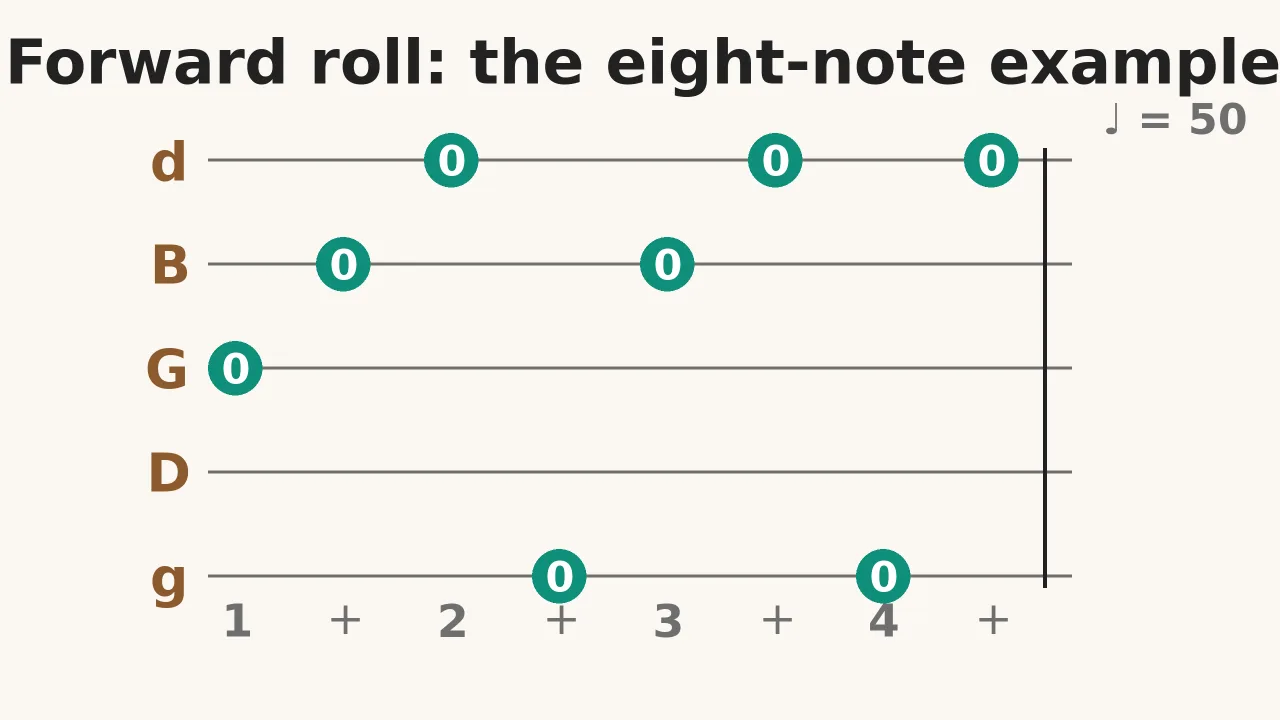
Eight equal slots: 3–2–1–5–2–1–5–1, with fingers T–I–M–T–I–M–T–M.
Synthesized guide to the complete eight-note example at 50 beats per minute.G3 · B3 · D4 · G4 · B3 · D4 · G4 · D4

Finish the bar before restarting

Give the final thumb on 5, middle on 1 the same time as every other pair. Then return to thumb on 3 at the next bar’s 1.
If the three-finger groups pull the pulse out of shape, speak the whole eight-slot count while pointing to the tab. Rehearse its last two notes into the first note of the next bar before trying another complete loop.

Quick check

Which two picking fingers complete this eight-note forward-roll example?
Show the answer

Thumb, middle. After T–I–M–T–I–M, the bar ends T–M on strings 5 and 1.

1 more question in the app Get the app

Practise in the free Banjo app