Harriet Music Get the Banjo app

Lesson 3 of 8 7 minutes

How to Read Banjo Tab: Strings and Frets

Harriet In this lesson you will use tab lines and fret numbers to find individual notes on your banjo.

  1. 1. Meet Your Banjo
    1. Lesson 1: Meet the Five-String Banjo
    2. Lesson 2: Find Your Playing Posture
    3. Lesson 3: Hold Your Banjo Comfortably
    4. Lesson 4: Tune to Open G
    5. Lesson 5: Pick Your First Open Strings
    6. Lesson 6: Hear High and Low Strings
  2. 2. Pulse and First Notes
    1. Lesson 1: Keep a Steady Beat
    2. Lesson 2: Pick with Thumb and Fingers
    3. Lesson 3: Fret a Note Cleanly
    4. Lesson 4: Find Your First Melody Notes
    5. Lesson 5: Count Beats and Offbeats
    6. Lesson 6: Leave Space with Rests
    7. Lesson 7: Play a Short Musical Phrase
  3. 3. Your First Chords
    1. Lesson 1: Strum the Open G Chord
    2. Lesson 2: Find the D7 Chord
    3. Lesson 3: Change Between G and D7
    4. Lesson 4: Add the C Chord
    5. Lesson 5: Keep Time Through Chord Changes
    6. Lesson 6: Accompany a Three-Chord Song
  4. 4. Rolls and Reading Tab
    1. Lesson 1: Fit Your Fingerpicks
    2. Lesson 2: Position Your Picking Hand
    3. Lesson 3: Read Strings and Frets
    4. Lesson 4: Read Rhythm in Banjo Tab
    5. Lesson 5: Play an Alternating Thumb Roll
    6. Lesson 6: Build a Forward Roll
    7. Lesson 7: Play a Forward-Reverse Roll
    8. Lesson 8: Change Chords While Rolling
  5. 5. Your First Bluegrass Tunes
    1. Lesson 1: Connect the Tune’s Phrases
    2. Lesson 2: Bring Out the Melody
    3. Lesson 3: Play a Smooth Slide
    4. Lesson 4: Add Hammer-Ons and Pull-Offs
    5. Lesson 5: Learn Cripple Creek
    6. Lesson 6: Play with the Recording, Then Alone

Watch the map being read

You can already find first-string frets 0, 2 and 5. In this Guitar Compass lesson, Geoff Hohwald explains tab lines and fret numbers. Watch the opening through about 1:37; save the later finger labels, ornaments and roll examples for later lessons.

Play the video

The video plays from YouTube and belongs to its author.

Line first, number second

Tablature, usually called tab, is a map of string positions. Read from left to right. The five lines here run from top to bottom:
d — string 1; B — string 2; G — string 3; D — string 4; g — short string 5.
The top line means string 1, not the highest sounding pitch: the short fifth string is higher but appears at the bottom. The capital and small letters distinguish the two D and two G strings.
A number on a line tells you which fret to play on that string. 0 means open. It does not name a finger. A dash keeps the drawing spaced out; it does not tell you to mute a ringing note. We will add timing in Read Rhythm in Banjo Tab.
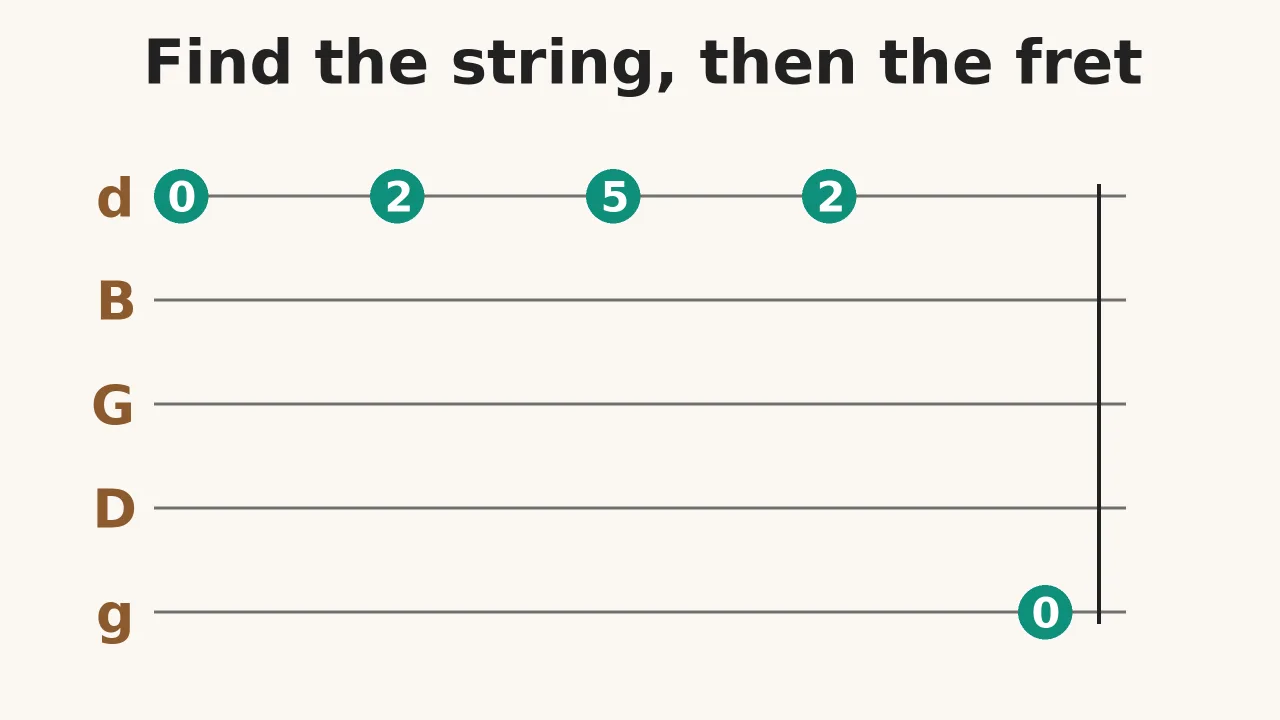
Read the four numbers on the top d line, then the final 0 on the bottom g line. Pause freely between notes.

Follow this example

The first four events are string 1: open, fret 2, fret 5, fret 2. The last event is open string 5, shown on the bottom line. Use your picking middle finger for string 1 and thumb for string 5.
Before playing a symbol, say both parts of its address, such as “string 1, fret 2.” If you lose your place, return to the line label and locate the next number rather than guessing.

Quick check

A 2 appears on the B line. What should you play?
Show the answer

String 2 at fret 2. The B line identifies string 2; the number gives its fret, not the picking finger.

1 more question in the app Get the app
Practise in the free Banjo app