Harriet Music Get the Banjo app

Lesson 3 of 6 5 minutes

How to Hold a Banjo: Balance the Pot and Neck

Harriet In this lesson you will support your banjo steadily while keeping your fretting hand and wrist relaxed.

  1. 1. Meet Your Banjo
    1. Lesson 1: Meet the Five-String Banjo
    2. Lesson 2: Find Your Playing Posture
    3. Lesson 3: Hold Your Banjo Comfortably
    4. Lesson 4: Tune to Open G
    5. Lesson 5: Pick Your First Open Strings
    6. Lesson 6: Hear High and Low Strings
  2. 2. Pulse and First Notes
    1. Lesson 1: Keep a Steady Beat
    2. Lesson 2: Pick with Thumb and Fingers
    3. Lesson 3: Fret a Note Cleanly
    4. Lesson 4: Find Your First Melody Notes
    5. Lesson 5: Count Beats and Offbeats
    6. Lesson 6: Leave Space with Rests
    7. Lesson 7: Play a Short Musical Phrase
  3. 3. Your First Chords
    1. Lesson 1: Strum the Open G Chord
    2. Lesson 2: Find the D7 Chord
    3. Lesson 3: Change Between G and D7
    4. Lesson 4: Add the C Chord
    5. Lesson 5: Keep Time Through Chord Changes
    6. Lesson 6: Accompany a Three-Chord Song
  4. 4. Rolls and Reading Tab
    1. Lesson 1: Fit Your Fingerpicks
    2. Lesson 2: Position Your Picking Hand
    3. Lesson 3: Read Strings and Frets
    4. Lesson 4: Read Rhythm in Banjo Tab
    5. Lesson 5: Play an Alternating Thumb Roll
    6. Lesson 6: Build a Forward Roll
    7. Lesson 7: Play a Forward-Reverse Roll
    8. Lesson 8: Change Chords While Rolling
  5. 5. Your First Bluegrass Tunes
    1. Lesson 1: Connect the Tune’s Phrases
    2. Lesson 2: Bring Out the Melody
    3. Lesson 3: Play a Smooth Slide
    4. Lesson 4: Add Hammer-Ons and Pull-Offs
    5. Lesson 5: Learn Cripple Creek
    6. Lesson 6: Play with the Recording, Then Alone

Give the banjo a steady base

Begin in the balanced seat you found in Find Your Playing Posture. Rest the pot securely on your lap, close to your body. It may sit on a thigh or in the space between your legs: choose a position that stays steady and lets your arms reach comfortably.
A correctly attached, properly fitted banjo strap can help carry the weight and keep the neck from dropping, even when seated. If yours is loose or its attachment is uncertain, set the banjo down and have it fitted before relying on it. Do not attach it to a tuning peg.

Free the fretting hand

Let the neck rise gently to a comfortable angle. Your fretting forearm and hand should approach it without a sharply bent wrist or a raised shoulder. Keep the picking forearm resting lightly at the pot rather than squeezing the instrument against you.
Your fretting hand will move along the neck. If it has to clamp hard just to stop the neck falling, adjust the pot position or strap support first. Keep a hand on the instrument throughout this check.
For a right-handed banjo, the left hand frets and the right hand picks; a left-handed setup reverses those roles. Use the same comfort checks on either side.
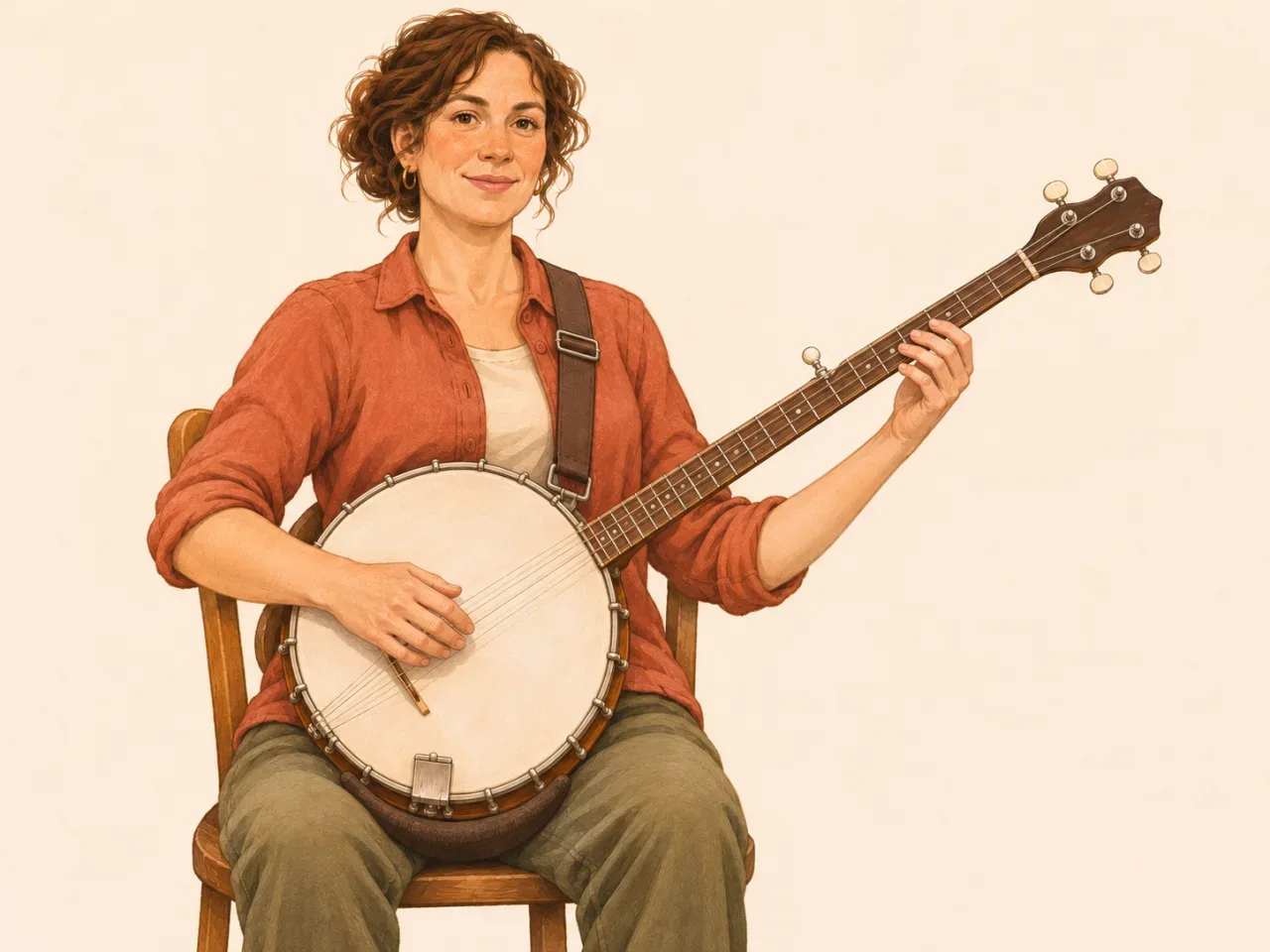
Let the lap support the pot while the wrist stays easy.

Quick check

The neck starts to drop when you ease your fretting-hand grip. What should you do?
Show the answer

Steady it and adjust its lap or strap support. The instrument needs a better base of support so the fretting hand can move freely.

1 more question in the app Get the app
Practise in the free Banjo app