Harriet Music Get the Banjo app

Lesson 4 of 6 12 minutes

How to Tune a Banjo to Open G With a Tuner

Harriet In this lesson you will use a tuner to bring all five open strings to standard open G tuning.

  1. 1. Meet Your Banjo
    1. Lesson 1: Meet the Five-String Banjo
    2. Lesson 2: Find Your Playing Posture
    3. Lesson 3: Hold Your Banjo Comfortably
    4. Lesson 4: Tune to Open G
    5. Lesson 5: Pick Your First Open Strings
    6. Lesson 6: Hear High and Low Strings
  2. 2. Pulse and First Notes
    1. Lesson 1: Keep a Steady Beat
    2. Lesson 2: Pick with Thumb and Fingers
    3. Lesson 3: Fret a Note Cleanly
    4. Lesson 4: Find Your First Melody Notes
    5. Lesson 5: Count Beats and Offbeats
    6. Lesson 6: Leave Space with Rests
    7. Lesson 7: Play a Short Musical Phrase
  3. 3. Your First Chords
    1. Lesson 1: Strum the Open G Chord
    2. Lesson 2: Find the D7 Chord
    3. Lesson 3: Change Between G and D7
    4. Lesson 4: Add the C Chord
    5. Lesson 5: Keep Time Through Chord Changes
    6. Lesson 6: Accompany a Three-Chord Song
  4. 4. Rolls and Reading Tab
    1. Lesson 1: Fit Your Fingerpicks
    2. Lesson 2: Position Your Picking Hand
    3. Lesson 3: Read Strings and Frets
    4. Lesson 4: Read Rhythm in Banjo Tab
    5. Lesson 5: Play an Alternating Thumb Roll
    6. Lesson 6: Build a Forward Roll
    7. Lesson 7: Play a Forward-Reverse Roll
    8. Lesson 8: Change Chords While Rolling
  5. 5. Your First Bluegrass Tunes
    1. Lesson 1: Connect the Tune’s Phrases
    2. Lesson 2: Bring Out the Melody
    3. Lesson 3: Play a Smooth Slide
    4. Lesson 4: Add Hammer-Ons and Pull-Offs
    5. Lesson 5: Learn Cripple Creek
    6. Lesson 6: Play with the Recording, Then Alone

Watch one string at a time

Start with the banjo securely supported as in Hold Your Banjo Comfortably. In this Deering Banjo Company lesson, Bob Hamilton tunes all five strings. Watch how he plucks one string, reads the tuner and makes a small adjustment. His clip-on tuner uses vibration; the app’s tuner uses your microphone.

Play the video

The video plays from YouTube and belongs to its author.

Know the target before turning

An open string sounds without pressing a fret. String 5 is the short string. At the head, count across from it towards the opposite edge: 5, 4, 3, 2, 1. In a typical playing position, string 1 is nearest the floor. These numbers stay the same on a left-handed banjo.
Tune to these pitches:

  • 1: D4 — the higher D
  • 2: B3
  • 3: G3 — the middle string
  • 4: D3 — the lower D
  • 5: G4 — the short, highest open string
    The number after the letter identifies the octave, or pitch register. D3 and D4 share a letter but are not the same pitch. In banjo shorthand, g D G B d runs from string 5 to 1; the small g identifies the short string.
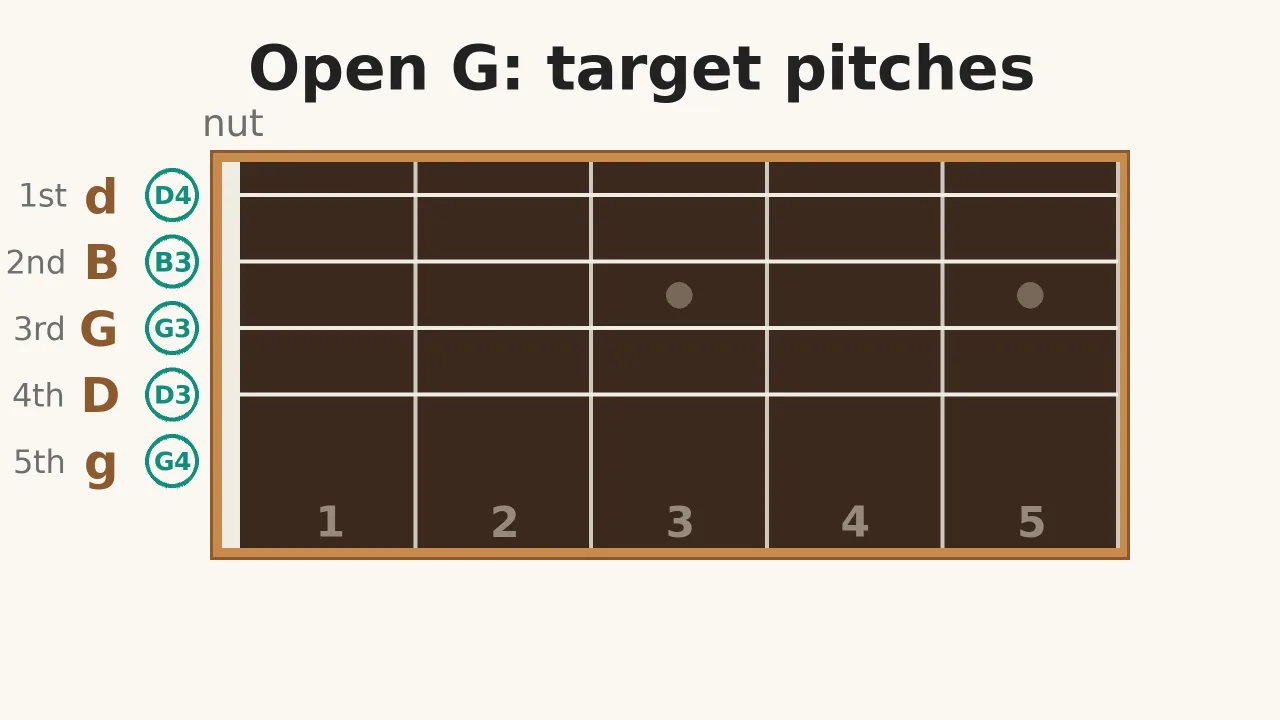
The top line is string 1 (d); the bottom is string 5 (g). Rings mean open strings.

Read the note and the indicator

Flat means below the target pitch; sharp means above it. First check the displayed note, then look for the centred indication. A centred reading on the wrong note does not mean the string is correctly tuned.
For a string already close to its target, tightening raises pitch and loosening lowers it. Peg layouts vary: do not copy a turning direction from a picture. If the reading moves away from the target, stop and reassess rather than continuing blindly.
Pluck gently with your bare thumb and let one string ring; quiet the others with a light touch. Keep the video and reference sound paused while the microphone listens.

Try the tuning routine

Use the inline tuner below. Select each string to hear its synthesized reference pitch, stop the reference, then let the microphone read your string. Work in a quiet room with the phone near enough to hear a gentle pluck.

In the app: the tuner and a practice. Get the app

Quick check

Your fourth string reads a centred D4. What needs checking?
Show the answer

It should be D3, so the register is wrong. The fourth string is the lower D, D3; the first string is D4.

1 more question in the app Get the app
Practise in the free Banjo app