Harriet Music Get the Banjo app

Lesson 1 of 6 7 minutes

How to Strum an Open G Chord on the Banjo

Harriet In this lesson you will brush the open strings to sound G and keep one downstroke on each beat.

  1. 1. Meet Your Banjo
    1. Lesson 1: Meet the Five-String Banjo
    2. Lesson 2: Find Your Playing Posture
    3. Lesson 3: Hold Your Banjo Comfortably
    4. Lesson 4: Tune to Open G
    5. Lesson 5: Pick Your First Open Strings
    6. Lesson 6: Hear High and Low Strings
  2. 2. Pulse and First Notes
    1. Lesson 1: Keep a Steady Beat
    2. Lesson 2: Pick with Thumb and Fingers
    3. Lesson 3: Fret a Note Cleanly
    4. Lesson 4: Find Your First Melody Notes
    5. Lesson 5: Count Beats and Offbeats
    6. Lesson 6: Leave Space with Rests
    7. Lesson 7: Play a Short Musical Phrase
  3. 3. Your First Chords
    1. Lesson 1: Strum the Open G Chord
    2. Lesson 2: Find the D7 Chord
    3. Lesson 3: Change Between G and D7
    4. Lesson 4: Add the C Chord
    5. Lesson 5: Keep Time Through Chord Changes
    6. Lesson 6: Accompany a Three-Chord Song
  4. 4. Rolls and Reading Tab
    1. Lesson 1: Fit Your Fingerpicks
    2. Lesson 2: Position Your Picking Hand
    3. Lesson 3: Read Strings and Frets
    4. Lesson 4: Read Rhythm in Banjo Tab
    5. Lesson 5: Play an Alternating Thumb Roll
    6. Lesson 6: Build a Forward Roll
    7. Lesson 7: Play a Forward-Reverse Roll
    8. Lesson 8: Change Chords While Rolling
  5. 5. Your First Bluegrass Tunes
    1. Lesson 1: Connect the Tune’s Phrases
    2. Lesson 2: Bring Out the Melody
    3. Lesson 3: Play a Smooth Slide
    4. Lesson 4: Add Hammer-Ons and Pull-Offs
    5. Lesson 5: Learn Cripple Creek
    6. Lesson 6: Play with the Recording, Then Alone

Hear your first chord

You can tune the open strings and keep a steady pulse. A chord combines notes sounded together. In this Deering Banjo Company lesson, Bob Hamilton demonstrates open G: watch the thumb brush at 0:44, through about 1:20. Stop there for now; we will learn D7 in Find the D7 Chord. If you watch on, his D7 is a two-finger shape (x0210); this course uses x0214, adding the little finger on string 1 at fret 4.

Play the video

The video plays from YouTube and belongs to its author.

No fretting needed

In standard open G tuning, the five open strings already form G. Keep your fretting fingers clear so none of the strings is shortened or accidentally muted. In the chord view, o means open: sound the string without pressing a fret.
Use your bare thumb for a light brush across the string set towards the floor in your usual playing position. Let the thumb pass through rather than hooking underneath the strings. Keep the forearm and wrist easy; avoid driving the thumb into the head. Return the hand quietly before the next downstroke.
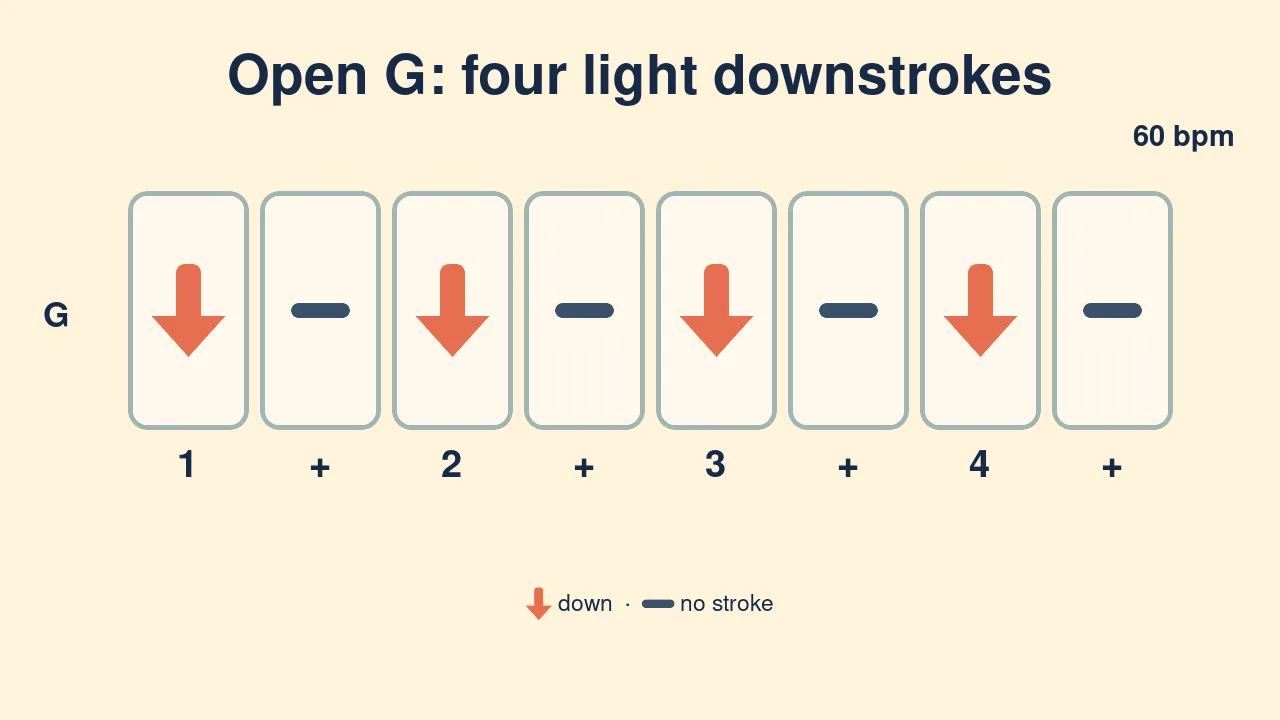
One down arrow on each numbered beat; return the hand quietly between strokes.

In the app: a practice. Get the app

Quick check

Your thumb catches the strings and the chord sounds harsh. What should you try first?
Show the answer

Use a smaller, lighter brush and keep the wrist easy. A light release lets the open strings ring without digging in or adding unnecessary tension.

Practise in the free Banjo app