Harriet Music Get the Banjo app

Lesson 4 of 8 7 minutes

How to Read Rhythm in Banjo Tab With the Count

Harriet In this lesson you will use the count line under tab to time notes on beats and halfway offbeats.

  1. 1. Meet Your Banjo
    1. Lesson 1: Meet the Five-String Banjo
    2. Lesson 2: Find Your Playing Posture
    3. Lesson 3: Hold Your Banjo Comfortably
    4. Lesson 4: Tune to Open G
    5. Lesson 5: Pick Your First Open Strings
    6. Lesson 6: Hear High and Low Strings
  2. 2. Pulse and First Notes
    1. Lesson 1: Keep a Steady Beat
    2. Lesson 2: Pick with Thumb and Fingers
    3. Lesson 3: Fret a Note Cleanly
    4. Lesson 4: Find Your First Melody Notes
    5. Lesson 5: Count Beats and Offbeats
    6. Lesson 6: Leave Space with Rests
    7. Lesson 7: Play a Short Musical Phrase
  3. 3. Your First Chords
    1. Lesson 1: Strum the Open G Chord
    2. Lesson 2: Find the D7 Chord
    3. Lesson 3: Change Between G and D7
    4. Lesson 4: Add the C Chord
    5. Lesson 5: Keep Time Through Chord Changes
    6. Lesson 6: Accompany a Three-Chord Song
  4. 4. Rolls and Reading Tab
    1. Lesson 1: Fit Your Fingerpicks
    2. Lesson 2: Position Your Picking Hand
    3. Lesson 3: Read Strings and Frets
    4. Lesson 4: Read Rhythm in Banjo Tab
    5. Lesson 5: Play an Alternating Thumb Roll
    6. Lesson 6: Build a Forward Roll
    7. Lesson 7: Play a Forward-Reverse Roll
    8. Lesson 8: Change Chords While Rolling
  5. 5. Your First Bluegrass Tunes
    1. Lesson 1: Connect the Tune’s Phrases
    2. Lesson 2: Bring Out the Melody
    3. Lesson 3: Play a Smooth Slide
    4. Lesson 4: Add Hammer-Ons and Pull-Offs
    5. Lesson 5: Learn Cripple Creek
    6. Lesson 6: Play with the Recording, Then Alone

Give the numbers a place in time

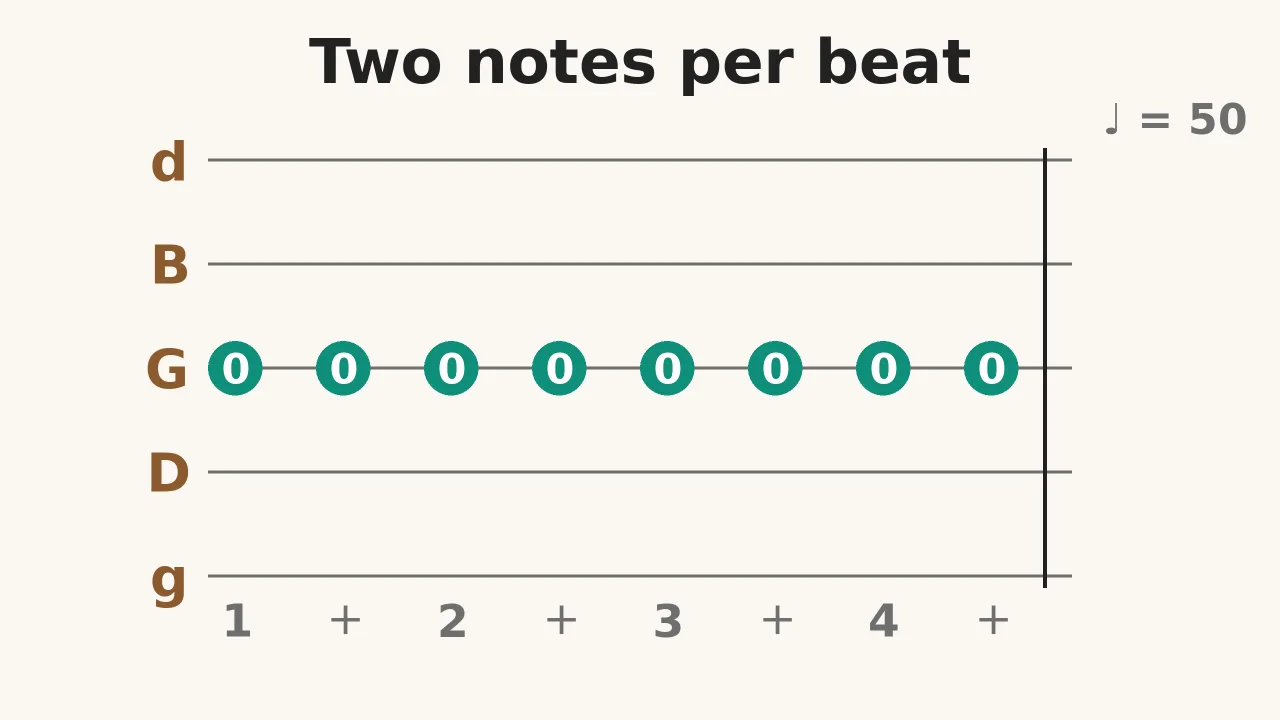
You can read strings and frets, and count 1 and 2 and 3 and 4 and. Now line up each tab number with that count. In these examples, + means and, and every number or + marks one equally spaced slot.
The fret number tells you where to play; its position above the count tells you when to start. Fret 0 does not mean zero time, and fret 2 does not mean two beats. A vertical bar line marks the group boundary.
At 50 beats per minute, numbered beats stay with the metronome clicks. Each + falls halfway between them.
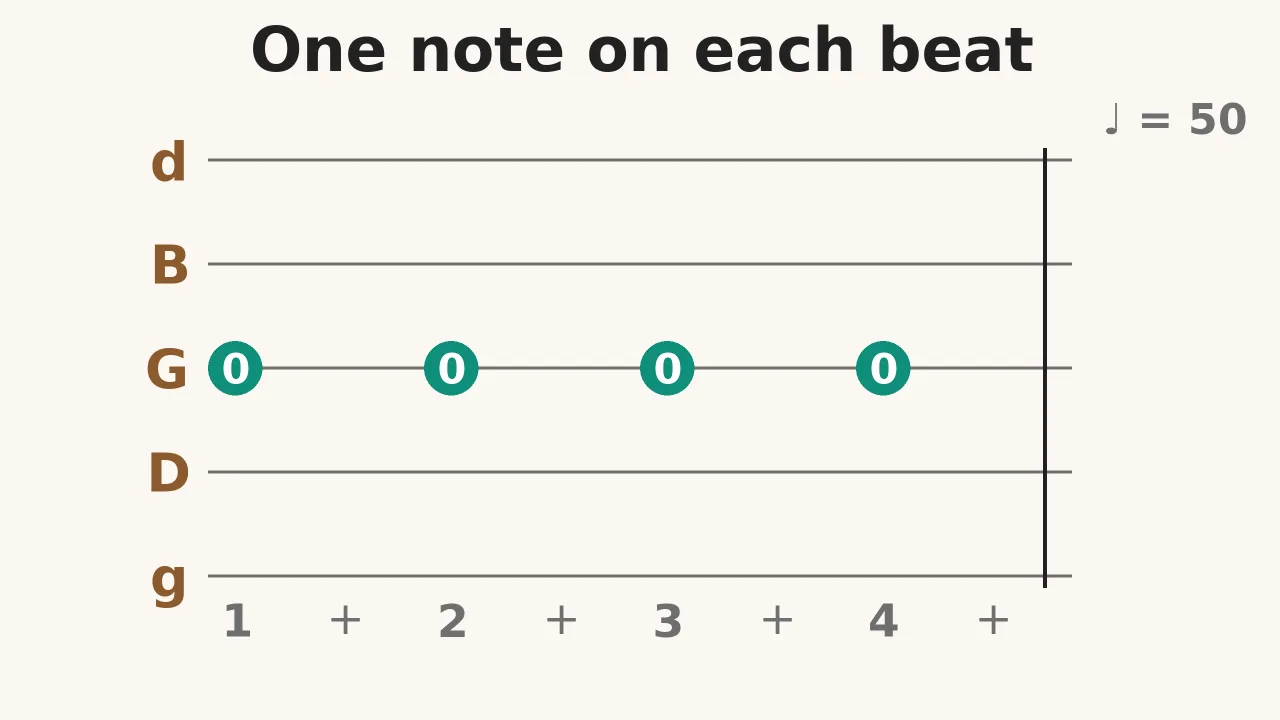
Four note starts: each 0 sits above a numbered beat. Keep counting the halfway + positions without another pluck.
Eight note starts: play on every number and +, while the four numbered beats keep the same speed.

A dash is not a mute sign

Dashes keep this tab grid aligned. If there is no new number at a slot, do not start a new note there; a previous note may keep ringing. A planned silence needs its own instruction, as in Leave Space with Rests.
Read the count aloud before playing. Here every number is on the G line, string 3, and every fret is 0, open. Use a small thumb release so the new task is timing rather than finding a new pitch.

In the app: a practice. Get the app

Quick check

A 0 sits above the + between beats 2 and 3. When should the open note start?
Show the answer

Halfway between clicks 2 and 3. The printed + identifies the halfway offbeat; 0 specifies an open string.

1 more question in the app Get the app
Practise in the free Banjo app