Harriet Music Get the Banjo app

Lesson 5 of 8 9 minutes

Banjo Alternating Thumb Roll for Beginners

Harriet In this lesson you will play an eight-note alternating-thumb roll with even spacing and relaxed fingers.

  1. 1. Meet Your Banjo
    1. Lesson 1: Meet the Five-String Banjo
    2. Lesson 2: Find Your Playing Posture
    3. Lesson 3: Hold Your Banjo Comfortably
    4. Lesson 4: Tune to Open G
    5. Lesson 5: Pick Your First Open Strings
    6. Lesson 6: Hear High and Low Strings
  2. 2. Pulse and First Notes
    1. Lesson 1: Keep a Steady Beat
    2. Lesson 2: Pick with Thumb and Fingers
    3. Lesson 3: Fret a Note Cleanly
    4. Lesson 4: Find Your First Melody Notes
    5. Lesson 5: Count Beats and Offbeats
    6. Lesson 6: Leave Space with Rests
    7. Lesson 7: Play a Short Musical Phrase
  3. 3. Your First Chords
    1. Lesson 1: Strum the Open G Chord
    2. Lesson 2: Find the D7 Chord
    3. Lesson 3: Change Between G and D7
    4. Lesson 4: Add the C Chord
    5. Lesson 5: Keep Time Through Chord Changes
    6. Lesson 6: Accompany a Three-Chord Song
  4. 4. Rolls and Reading Tab
    1. Lesson 1: Fit Your Fingerpicks
    2. Lesson 2: Position Your Picking Hand
    3. Lesson 3: Read Strings and Frets
    4. Lesson 4: Read Rhythm in Banjo Tab
    5. Lesson 5: Play an Alternating Thumb Roll
    6. Lesson 6: Build a Forward Roll
    7. Lesson 7: Play a Forward-Reverse Roll
    8. Lesson 8: Change Chords While Rolling
  5. 5. Your First Bluegrass Tunes
    1. Lesson 1: Connect the Tune’s Phrases
    2. Lesson 2: Bring Out the Melody
    3. Lesson 3: Play a Smooth Slide
    4. Lesson 4: Add Hammer-Ons and Pull-Offs
    5. Lesson 5: Learn Cripple Creek
    6. Lesson 6: Play with the Recording, Then Alone

Watch the thumb take turns

You can fit your picks, position the hand and read a counted tab. This markwardle lesson demonstrates an alternating-thumb roll with the string sequence we will use. Keep the light, comfortable support from Position Your Picking Hand; you do not need to force two fingers onto the head.

Play the video

The video plays from YouTube and belongs to its author.

Two halves, one steady bar

A roll is a repeating picking pattern. Here the thumb takes turns with a finger. Write T = thumb, I = index, M = middle.
Fingers: T–I–T–M | T–I–T–M
Strings: 3–2–5–1 | 4–2–5–1
The first four notes fill 1 + 2 +; the second four fill 3 + 4 +. The first thumb note changes from string 3 to string 4 in the second half. The thumb also visits the short fifth string, so it does not stay on one bass string.
All notes are open. Keep the fretting fingers clear and give each note start equal space.
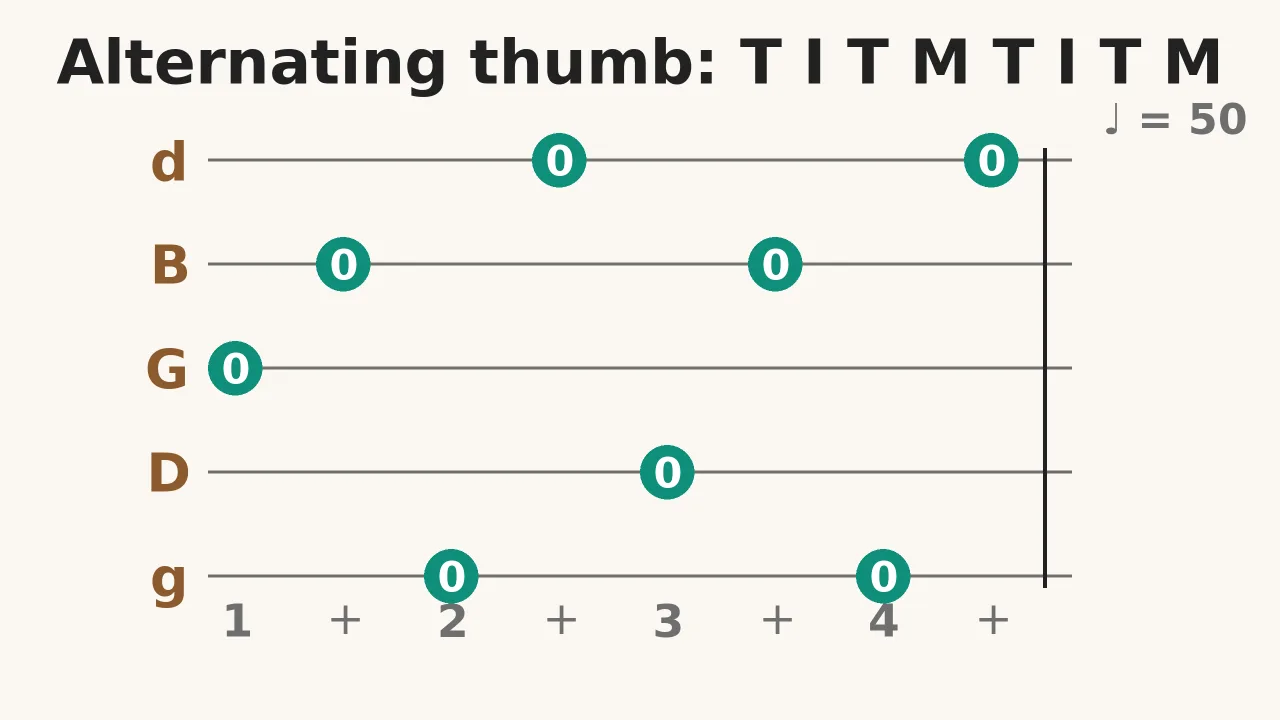
Read eight open-string notes: 3–2–5–1, then 4–2–5–1. The last + leads straight into the next bar’s 1.
Synthesized guide for one complete bar at 50 beats per minute.G3 · B3 · G4 · D4 · D3 · B3 · G4 · D4

Join without a jump

First play each four-note half with pauses between attempts. Then connect them: the middle finger finishes the first half on string 1, and the thumb starts the second half on string 4.
At the end of the whole bar, middle on string 1 returns to thumb on string 3. Do not add a pause at that boundary. If a string is missed, reduce the task to the troublesome pair and restore its small, relaxed motion before looping again.

Quick check

In this example, which string does the thumb play on beat 3, at the start of the second half?
Show the answer

String 4. The complete string sequence is 3–2–5–1, then 4–2–5–1; beat 3 starts with thumb on string 4.

Practise in the free Banjo app