Harriet Music Get the Banjo app

Lesson 5 of 6 7 minutes

Banjo Chord Changes in Time: G, C and D7

Harriet In this lesson you will change among G, C and D7 at bar boundaries while keeping a steady four-beat pulse.

  1. 1. Meet Your Banjo
    1. Lesson 1: Meet the Five-String Banjo
    2. Lesson 2: Find Your Playing Posture
    3. Lesson 3: Hold Your Banjo Comfortably
    4. Lesson 4: Tune to Open G
    5. Lesson 5: Pick Your First Open Strings
    6. Lesson 6: Hear High and Low Strings
  2. 2. Pulse and First Notes
    1. Lesson 1: Keep a Steady Beat
    2. Lesson 2: Pick with Thumb and Fingers
    3. Lesson 3: Fret a Note Cleanly
    4. Lesson 4: Find Your First Melody Notes
    5. Lesson 5: Count Beats and Offbeats
    6. Lesson 6: Leave Space with Rests
    7. Lesson 7: Play a Short Musical Phrase
  3. 3. Your First Chords
    1. Lesson 1: Strum the Open G Chord
    2. Lesson 2: Find the D7 Chord
    3. Lesson 3: Change Between G and D7
    4. Lesson 4: Add the C Chord
    5. Lesson 5: Keep Time Through Chord Changes
    6. Lesson 6: Accompany a Three-Chord Song
  4. 4. Rolls and Reading Tab
    1. Lesson 1: Fit Your Fingerpicks
    2. Lesson 2: Position Your Picking Hand
    3. Lesson 3: Read Strings and Frets
    4. Lesson 4: Read Rhythm in Banjo Tab
    5. Lesson 5: Play an Alternating Thumb Roll
    6. Lesson 6: Build a Forward Roll
    7. Lesson 7: Play a Forward-Reverse Roll
    8. Lesson 8: Change Chords While Rolling
  5. 5. Your First Bluegrass Tunes
    1. Lesson 1: Connect the Tune’s Phrases
    2. Lesson 2: Bring Out the Melody
    3. Lesson 3: Play a Smooth Slide
    4. Lesson 4: Add Hammer-Ons and Pull-Offs
    5. Lesson 5: Learn Cripple Creek
    6. Lesson 6: Play with the Recording, Then Alone

Count through the change

You can form G, C and D7. Keep the click at 50 beats per minute and give each chord one four-beat bar:

Bar 1 2 3 4
Chord G C D7 G

Read the next chord before you need it. The first C stroke lands on bar 2’s 1, D7 on bar 3’s 1, and G returns on bar 4’s 1. At the end, loop back to the first G bar without adding time.

Start with space to prepare

Use one downstroke on beat 1 of each bar, as in Change Between G and D7. Keep counting 2, 3, 4 while preparing the next shape. Moving the fingers may stop or change the ringing chord; do not squeeze harder in an attempt to keep it ringing through preparation.
C and D7 share the index contact at string 2, fret 1. Leave it lightly in place if comfortable while moving the other fingers to the taught targets. D7 still needs its first string at fret 4 and its fifth string excluded.
If a stroke is missed, keep the count. Rejoin at the next planned stroke once ready rather than fitting a late extra stroke into the gap.

Add a stroke on each number

When chord arrivals stay steady, try four light downstrokes per bar, on 1, 2, 3, 4. Keep the same tempo. Let the final stroke release, move with as little unnecessary motion as possible, and land the new chord on the next 1. A short break in the ringing sound is normal while learning.
If the four strokes make changes rushed, return to one stroke per bar. That simpler version is a useful accompaniment, not a failed attempt.
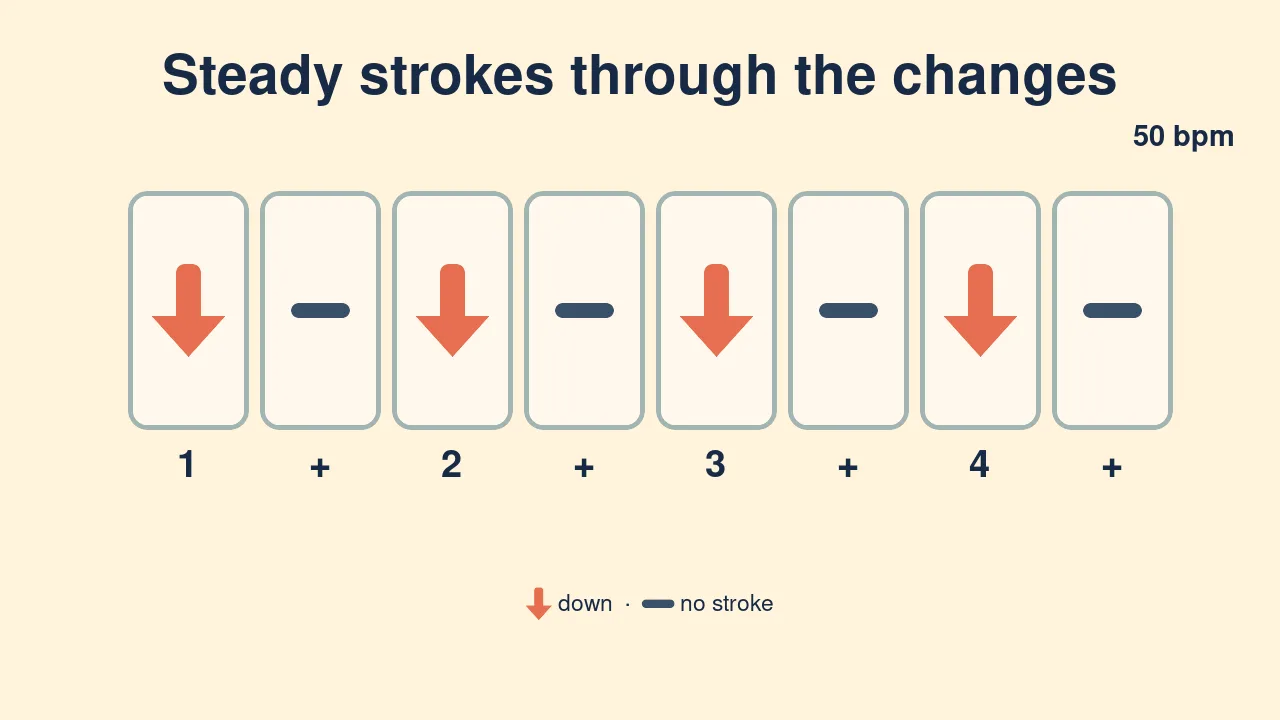
Optional next version: a light downstroke on every numbered beat, with the new chord ready for the next 1.

Quick check

You are not ready for a planned stroke and miss it. What keeps the accompaniment in time?
Show the answer

Keep counting and rejoin at the next planned stroke when ready. The pulse continues; an extra late stroke can shift the timing of everything after it.

1 more question in the app Get the app
Practise in the free Banjo app