Harriet Music Get the Mandolin app

Lesson 6 of 7 18 minutes

Mandolin Strumming Accents: Beats 1, 2 and 4

Harriet In this lesson you will strum four downs per bar on G with accents first on beat 1, then on beats 2 and 4, without changing the tempo.

  1. 1. Meet Your Mandolin
    1. Lesson 1: Meet the Mandolin
    2. Lesson 2: Parts of the Mandolin
    3. Lesson 3: Hold Your Mandolin
    4. Lesson 4: Choose and Hold Your Pick
    5. Lesson 5: Position Your Picking Hand
    6. Lesson 6: Learn the String Names
    7. Lesson 7: Tune Your Mandolin
  2. 2. Your First Notes
    1. Lesson 1: Play the Open Strings
    2. Lesson 2: Find the Frets
    3. Lesson 3: Fret Your First Notes
    4. Lesson 4: Get a Clean Sound
    5. Lesson 5: Use Your Fretting Fingers
    6. Lesson 6: Play Down and Upstrokes
    7. Lesson 7: Change Strings Cleanly
    8. Lesson 8: Coordinate Both Hands
    9. Lesson 9: Play Your First Melody
  3. 3. Read Tabs and Rhythm
    1. Lesson 1: Read Mandolin Tablature
    2. Lesson 2: Play Notes from Tab
    3. Lesson 3: Feel the Steady Beat
    4. Lesson 4: Count Notes and Rests
    5. Lesson 5: Practice with a Metronome
    6. Lesson 6: Read Simple Rhythmic Patterns
  4. 4. Your First Chords
    1. Lesson 1: Understand Mandolin Chords
    2. Lesson 2: Read Chord Diagrams
    3. Lesson 3: Play an Easy G Chord
    4. Lesson 4: Play an Easy C Chord
    5. Lesson 5: Switch Between G and C
    6. Lesson 6: Play an Easy D Chord
    7. Lesson 7: Strum Your First Chords
    8. Lesson 8: Change Chords in Time
    9. Lesson 9: Play a Three Chord Song
  5. 5. Strumming and Rhythm
    1. Lesson 1: Build Your Strumming Motion
    2. Lesson 2: Play Continuous Down Up Strums
    3. Lesson 3: Play Eighth Note Rhythms
    4. Lesson 4: Learn Common Strumming Patterns
    5. Lesson 5: Strum in Three Quarter Time
    6. Lesson 6: Accent the Right Beats
    7. Lesson 7: Accompany a Simple Song
  6. 6. Your First Tunes
    1. Lesson 1: Play Short Musical Phrases
    2. Lesson 2: Learn a Tune by Ear
    3. Lesson 3: Connect Musical Phrases
    4. Lesson 4: Play a Simple Folk Tune
    5. Lesson 5: Play Easy Cripple Creek
    6. Lesson 6: Practice at Different Speeds
    7. Lesson 7: Play a Complete Tune
    8. Lesson 8: Try Your First Tremolo

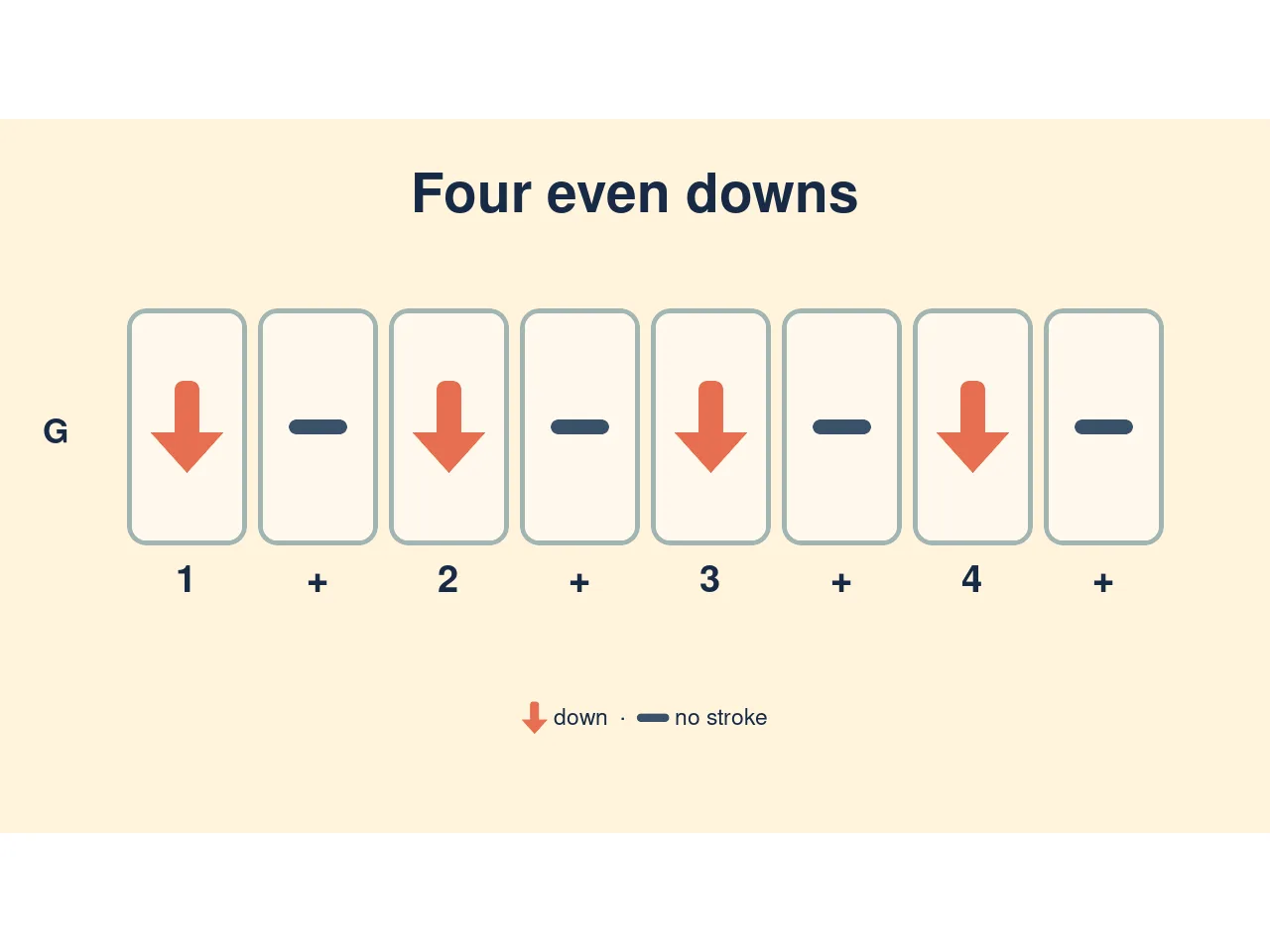
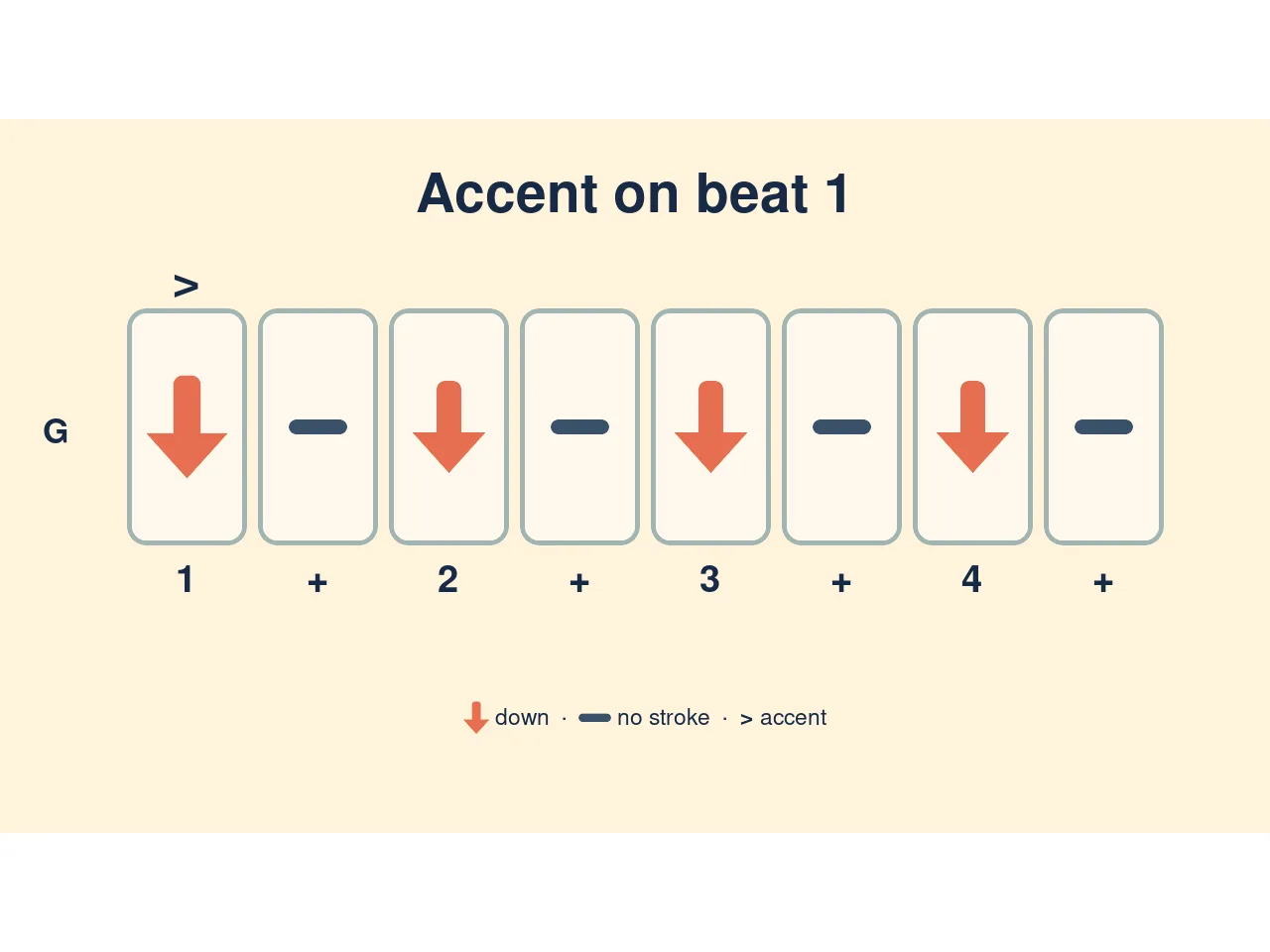
Even or accented

Four downs, all with the same weight.
Before Four downs, all with the same weight.
The same four downs, beat 1 a little stronger: the > marks the accent.
After The same four downs, beat 1 a little stronger: the > marks the accent.

What an accent is

In Strum in Three Quarter Time the ONE of each bar was a little fuller: that was already an accent. Now you choose which beats get it, in 4/4.

An accent gives one strum a little more weight than the others. It is not a hit as hard as possible: the other strums simply stay softer and controlled.

The tempo does not change. Accented or not, every strum stays on its click.

Accents on 2 and 4

Moving the accents changes the character of the same pattern. With accents on 2 and 4 the strum gets a lighter, bouncing feel that many folk and bluegrass songs use.
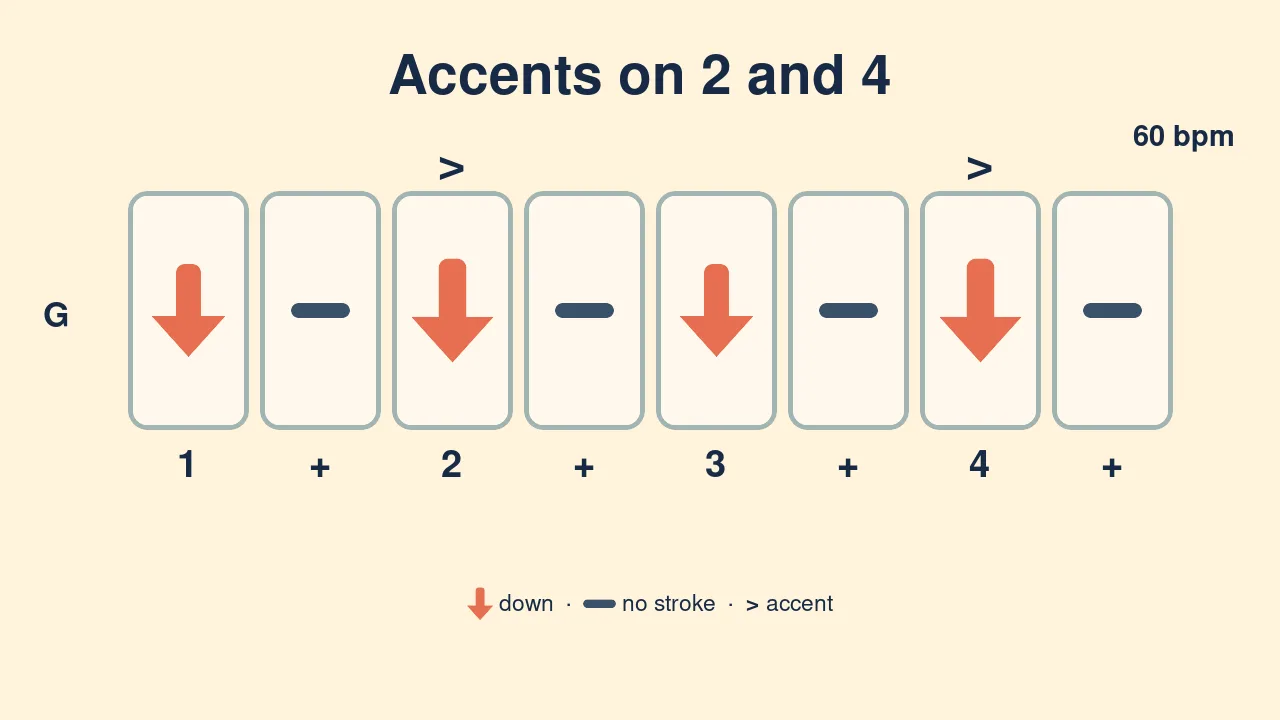
Accents on beats 2 and 4: one TWO three FOUR.
Two bars accented on 1, then two bars accented on 2 and 4: listen to which beats stand out.

Making the accent

  • For the accented strum, let the hand travel a little farther and come through the strings a little fuller.
  • Keep the wrist and the grip relaxed: the extra comes from the motion, not from squeezing.
  • Play the other strums lighter, so the accent stands out without being loud.

In this video, MandoLessons connects pick direction with accenting beats: as you watch, listen for which notes stand out and how steady the tempo stays.

Play the video

The video plays from YouTube and belongs to its author.

Quick check

What is an accent in strumming?
Show the answer

Giving one strum a little more emphasis than the others. An accent is a little more weight on a beat; the others stay softer.

2 more questions in the app Get the app

Practise in the free Mandolin app