Harriet Music Get the Mandolin app

Lesson 3 of 6 12 minutes

Mandolin Rhythm: Feel and Count the Steady Beat

Harriet In this lesson you will recognise a steady beat, count it aloud in fours and pick one open note on each beat in time.

  1. 1. Meet Your Mandolin
    1. Lesson 1: Meet the Mandolin
    2. Lesson 2: Parts of the Mandolin
    3. Lesson 3: Hold Your Mandolin
    4. Lesson 4: Choose and Hold Your Pick
    5. Lesson 5: Position Your Picking Hand
    6. Lesson 6: Learn the String Names
    7. Lesson 7: Tune Your Mandolin
  2. 2. Your First Notes
    1. Lesson 1: Play the Open Strings
    2. Lesson 2: Find the Frets
    3. Lesson 3: Fret Your First Notes
    4. Lesson 4: Get a Clean Sound
    5. Lesson 5: Use Your Fretting Fingers
    6. Lesson 6: Play Down and Upstrokes
    7. Lesson 7: Change Strings Cleanly
    8. Lesson 8: Coordinate Both Hands
    9. Lesson 9: Play Your First Melody
  3. 3. Read Tabs and Rhythm
    1. Lesson 1: Read Mandolin Tablature
    2. Lesson 2: Play Notes from Tab
    3. Lesson 3: Feel the Steady Beat
    4. Lesson 4: Count Notes and Rests
    5. Lesson 5: Practice with a Metronome
    6. Lesson 6: Read Simple Rhythmic Patterns
  4. 4. Your First Chords
    1. Lesson 1: Understand Mandolin Chords
    2. Lesson 2: Read Chord Diagrams
    3. Lesson 3: Play an Easy G Chord
    4. Lesson 4: Play an Easy C Chord
    5. Lesson 5: Switch Between G and C
    6. Lesson 6: Play an Easy D Chord
    7. Lesson 7: Strum Your First Chords
    8. Lesson 8: Change Chords in Time
    9. Lesson 9: Play a Three Chord Song
  5. 5. Strumming and Rhythm
    1. Lesson 1: Build Your Strumming Motion
    2. Lesson 2: Play Continuous Down Up Strums
    3. Lesson 3: Play Eighth Note Rhythms
    4. Lesson 4: Learn Common Strumming Patterns
    5. Lesson 5: Strum in Three Quarter Time
    6. Lesson 6: Accent the Right Beats
    7. Lesson 7: Accompany a Simple Song
  6. 6. Your First Tunes
    1. Lesson 1: Play Short Musical Phrases
    2. Lesson 2: Learn a Tune by Ear
    3. Lesson 3: Connect Musical Phrases
    4. Lesson 4: Play a Simple Folk Tune
    5. Lesson 5: Play Easy Cripple Creek
    6. Lesson 6: Practice at Different Speeds
    7. Lesson 7: Play a Complete Tune
    8. Lesson 8: Try Your First Tremolo

What a beat is

In Play Notes from Tab you played notes in order, taking as long as you needed between them. Now each note gets its place in time.

Think of someone walking at an easy pace: left, right, left, right, every step the same distance apart in time. Music has the same kind of steady pulse, called the beat.

  • The beat keeps going under every note, and under every silence too.
  • Most tunes group beats in fours: 1, 2, 3, 4, 1, 2, 3, 4.
  • When you tap your foot to a song, you are tapping its beat.

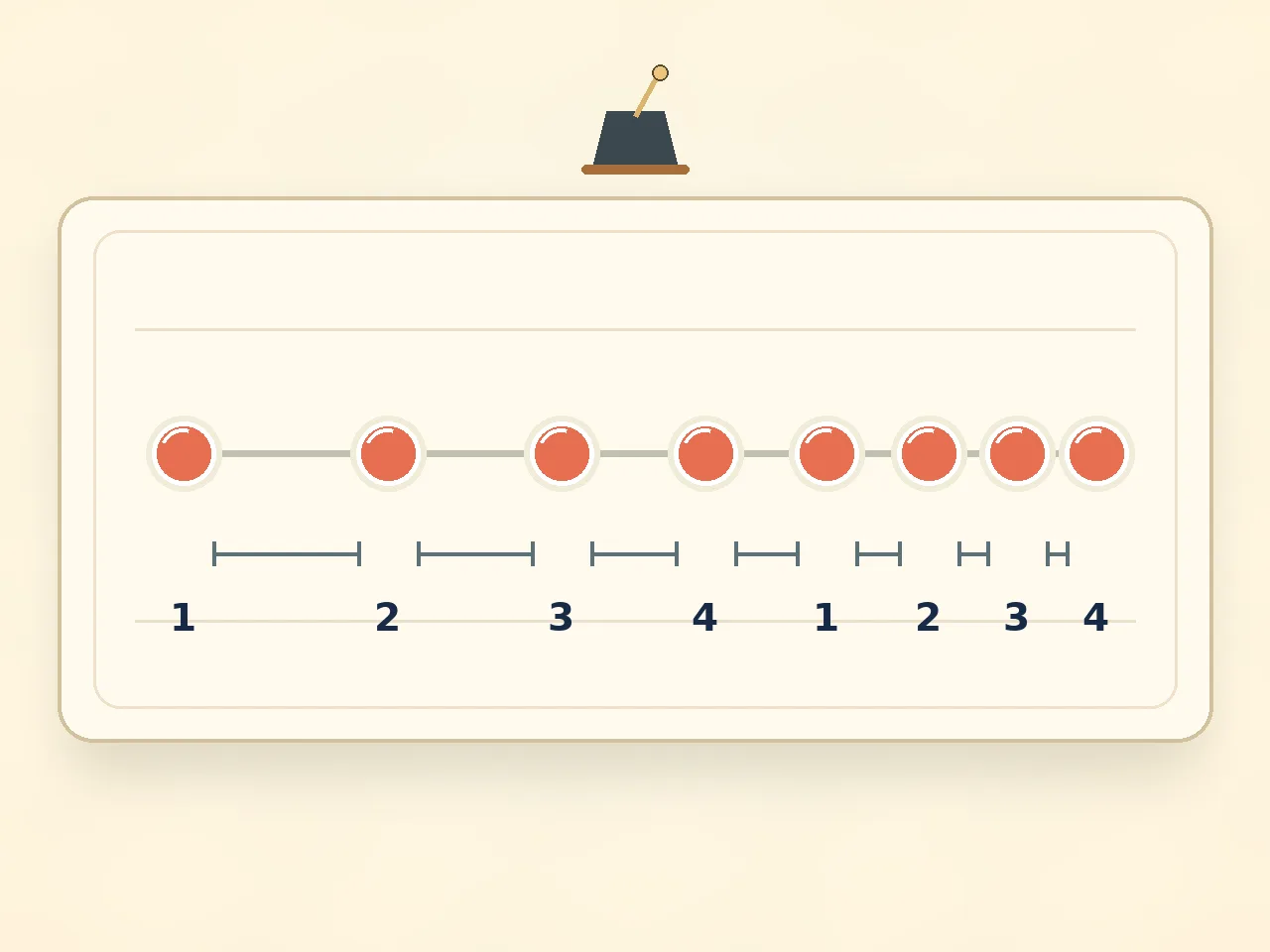
Steady is about even gaps, not speed
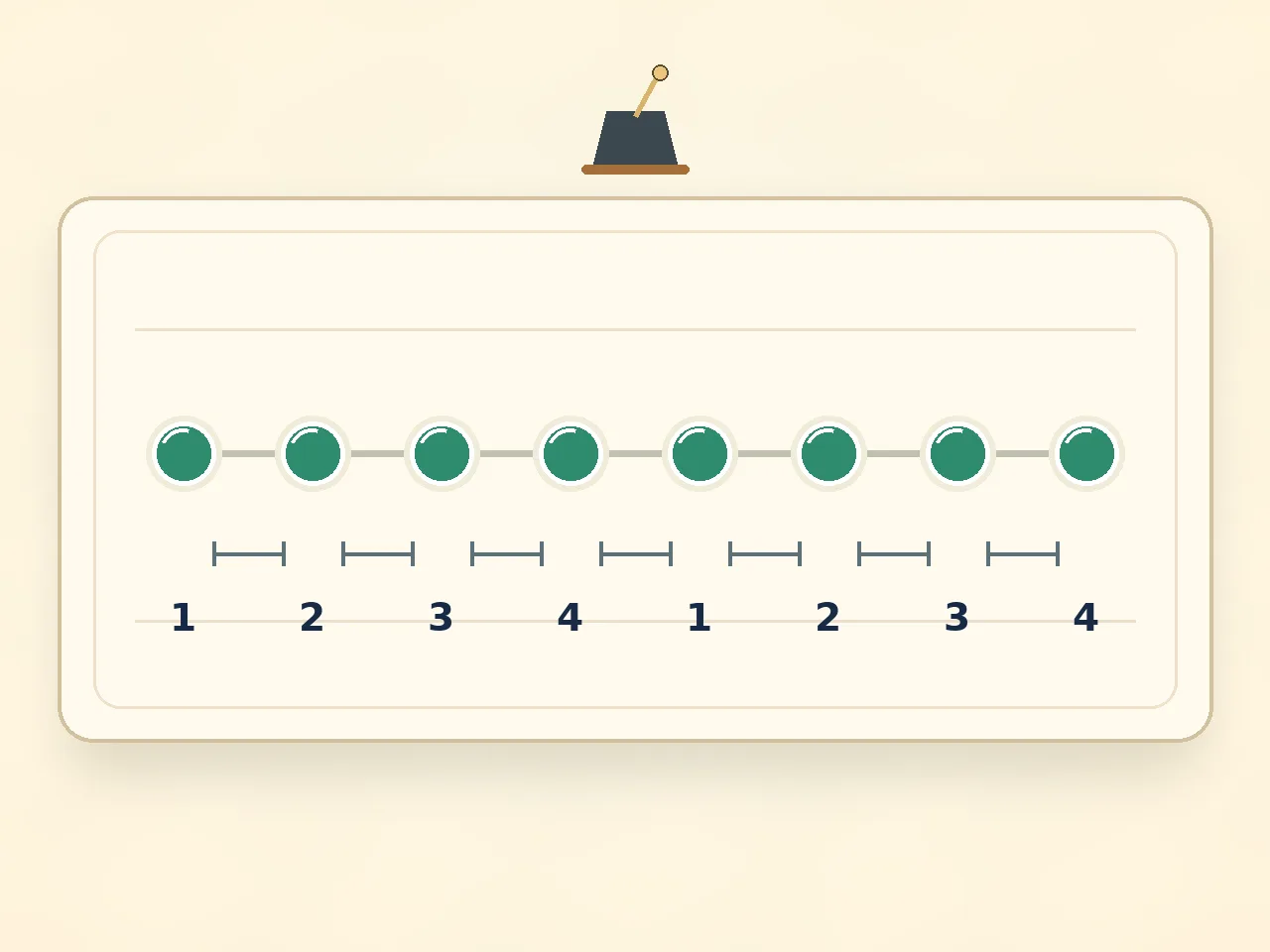
Steady: every gap is the same, slow or fast.
Do this Steady: every gap is the same, slow or fast.
Rushing: the gaps shrink and the beat speeds up.
Avoid this Rushing: the gaps shrink and the beat speeds up.

Listen, then count

Playing in time is not about playing quickly. A slow beat played evenly is far more musical than a fast one that wobbles.

Listen to the clicks below: four of them, equally spaced. Then listen to the counting and join in aloud.

Four clicks, evenly spaced. Play it a few times and tap your foot with each click.
Counting the beat aloud: two cycles of four. Count with it.

Quick check

What makes a beat steady?
Show the answer

The time between beats stays the same. A steady beat has equal gaps; it can be slow or fast.

1 more question in the app Get the app

Practise in the free Mandolin app