Harriet Music Get the Mandolin app

Lesson 1 of 8 12 minutes

Mandolin Phrasing: Play a Short Musical Phrase

Harriet In this lesson you will play a short two-bar phrase with a clear beginning, a steady written rhythm and an ending that rings its full length.

  1. 1. Meet Your Mandolin
    1. Lesson 1: Meet the Mandolin
    2. Lesson 2: Parts of the Mandolin
    3. Lesson 3: Hold Your Mandolin
    4. Lesson 4: Choose and Hold Your Pick
    5. Lesson 5: Position Your Picking Hand
    6. Lesson 6: Learn the String Names
    7. Lesson 7: Tune Your Mandolin
  2. 2. Your First Notes
    1. Lesson 1: Play the Open Strings
    2. Lesson 2: Find the Frets
    3. Lesson 3: Fret Your First Notes
    4. Lesson 4: Get a Clean Sound
    5. Lesson 5: Use Your Fretting Fingers
    6. Lesson 6: Play Down and Upstrokes
    7. Lesson 7: Change Strings Cleanly
    8. Lesson 8: Coordinate Both Hands
    9. Lesson 9: Play Your First Melody
  3. 3. Read Tabs and Rhythm
    1. Lesson 1: Read Mandolin Tablature
    2. Lesson 2: Play Notes from Tab
    3. Lesson 3: Feel the Steady Beat
    4. Lesson 4: Count Notes and Rests
    5. Lesson 5: Practice with a Metronome
    6. Lesson 6: Read Simple Rhythmic Patterns
  4. 4. Your First Chords
    1. Lesson 1: Understand Mandolin Chords
    2. Lesson 2: Read Chord Diagrams
    3. Lesson 3: Play an Easy G Chord
    4. Lesson 4: Play an Easy C Chord
    5. Lesson 5: Switch Between G and C
    6. Lesson 6: Play an Easy D Chord
    7. Lesson 7: Strum Your First Chords
    8. Lesson 8: Change Chords in Time
    9. Lesson 9: Play a Three Chord Song
  5. 5. Strumming and Rhythm
    1. Lesson 1: Build Your Strumming Motion
    2. Lesson 2: Play Continuous Down Up Strums
    3. Lesson 3: Play Eighth Note Rhythms
    4. Lesson 4: Learn Common Strumming Patterns
    5. Lesson 5: Strum in Three Quarter Time
    6. Lesson 6: Accent the Right Beats
    7. Lesson 7: Accompany a Simple Song
  6. 6. Your First Tunes
    1. Lesson 1: Play Short Musical Phrases
    2. Lesson 2: Learn a Tune by Ear
    3. Lesson 3: Connect Musical Phrases
    4. Lesson 4: Play a Simple Folk Tune
    5. Lesson 5: Play Easy Cripple Creek
    6. Lesson 6: Practice at Different Speeds
    7. Lesson 7: Play a Complete Tune
    8. Lesson 8: Try Your First Tremolo

A phrase is a musical sentence

In Accompany a Simple Song you played chords under a song. Now you play the tune itself, one note at a time. A tune is not one long stream of notes. It is built from short phrases, each one an idea you could hum in one breath.

  • A phrase has a beginning: the first note lands clearly on a beat.
  • It moves: the notes climb, fall or turn.
  • It has an ending: a note that is held, so the ear knows the idea is over.

You already read a melody in tab (Play a Melody from Tab) and count quarter and half notes (Count Notes and Rests). Here you put both together on one short phrase, on the A course only.
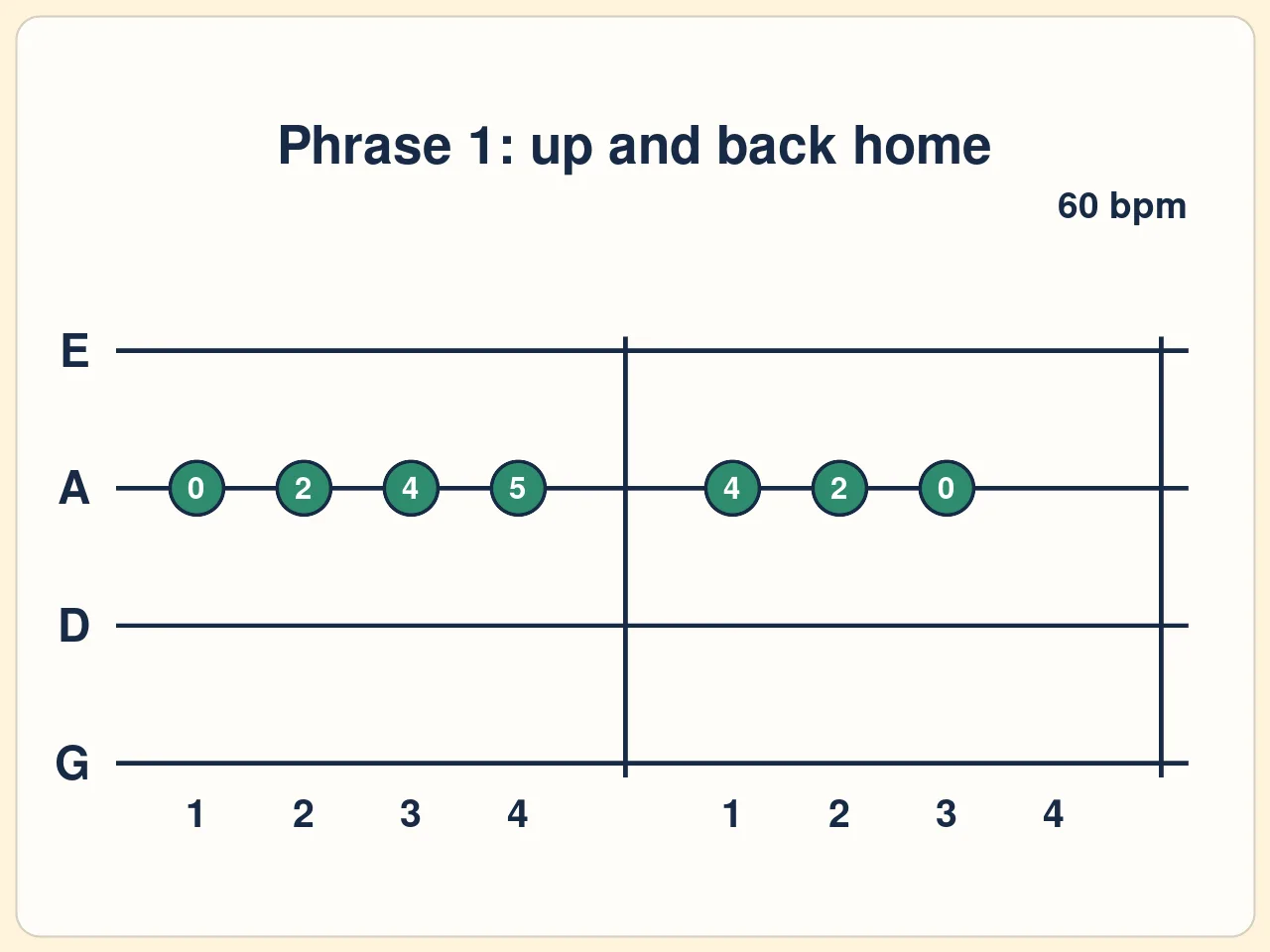
Phrase 1, two bars on the A course: climb A B C# D, turn back, and hold the open A for beats 3 and 4. Fret 2 with finger 1, fret 4 with finger 2, fret 5 with finger 3.
The seven pitches of Phrase 1, each the same length, one after another. Every note gets equal weight and the last A stops as soon as it starts: correct notes, no shape.A4 · B4 · C#5 · D5 · C#5 · B4 · A4

What gives the phrase its shape

The clip has the right notes, yet it sounds like a list. Three things turn it into a phrase:

  • A deliberate start. Count "1 2 3 4" out loud first, then land the open A exactly on the next 1.
  • Written lengths. Six quarter notes, one beat each, evenly spaced. Do not hurry the climb.
  • A held ending. The last open A is a half note: let it ring through beats 3 and 4 before you stop it. That held note is what tells the ear "finished".

Finished, or asking for more?

Phrase 1 ends on the open A, where it began, so it sounds complete, like a sentence ending with a full stop. A phrase can also stop on a note that leaves the ear waiting, like a question. Play the version below and listen to the difference.
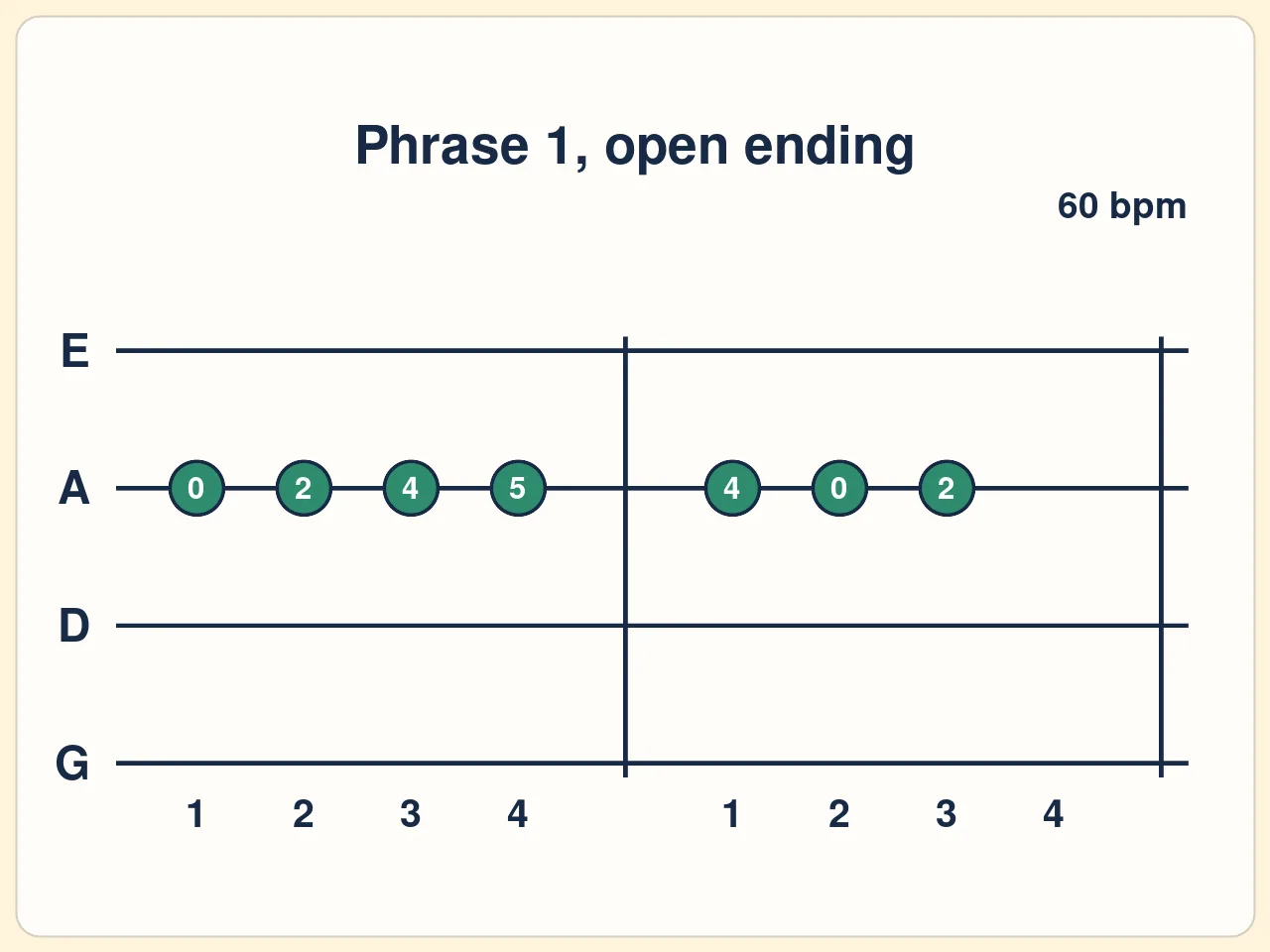
Same start, different ending: the turn back stops on B (fret 2) instead of the open A. The held B sounds unfinished, as if more music should follow.

In the app: a self-check exercise. Get the app

Quick check

In Phrase 1, how long does the final open A ring?
Show the answer

Two beats. It is a half note on beats 3 and 4 of bar 2; holding it is what makes the phrase end.

1 more question in the app Get the app
Practise in the free Mandolin app