
Harriet Music Get the Mandolin app

Lesson 8 of 9 25 minutes

Mandolin Chord Changes in Time at 60 BPM

Harriet In this lesson you will change between G, C and D on beat 1 of each bar at 60 BPM, without stopping the pulse.

  1. 1. Meet Your Mandolin
    1. Lesson 1: Meet the Mandolin
    2. Lesson 2: Parts of the Mandolin
    3. Lesson 3: Hold Your Mandolin
    4. Lesson 4: Choose and Hold Your Pick
    5. Lesson 5: Position Your Picking Hand
    6. Lesson 6: Learn the String Names
    7. Lesson 7: Tune Your Mandolin
  2. 2. Your First Notes
    1. Lesson 1: Play the Open Strings
    2. Lesson 2: Find the Frets
    3. Lesson 3: Fret Your First Notes
    4. Lesson 4: Get a Clean Sound
    5. Lesson 5: Use Your Fretting Fingers
    6. Lesson 6: Play Down and Upstrokes
    7. Lesson 7: Change Strings Cleanly
    8. Lesson 8: Coordinate Both Hands
    9. Lesson 9: Play Your First Melody
  3. 3. Read Tabs and Rhythm
    1. Lesson 1: Read Mandolin Tablature
    2. Lesson 2: Play Notes from Tab
    3. Lesson 3: Feel the Steady Beat
    4. Lesson 4: Count Notes and Rests
    5. Lesson 5: Practice with a Metronome
    6. Lesson 6: Read Simple Rhythmic Patterns
  4. 4. Your First Chords
    1. Lesson 1: Understand Mandolin Chords
    2. Lesson 2: Read Chord Diagrams
    3. Lesson 3: Play an Easy G Chord
    4. Lesson 4: Play an Easy C Chord
    5. Lesson 5: Switch Between G and C
    6. Lesson 6: Play an Easy D Chord
    7. Lesson 7: Strum Your First Chords
    8. Lesson 8: Change Chords in Time
    9. Lesson 9: Play a Three Chord Song
  5. 5. Strumming and Rhythm
    1. Lesson 1: Build Your Strumming Motion
    2. Lesson 2: Play Continuous Down Up Strums
    3. Lesson 3: Play Eighth Note Rhythms
    4. Lesson 4: Learn Common Strumming Patterns
    5. Lesson 5: Strum in Three Quarter Time
    6. Lesson 6: Accent the Right Beats
    7. Lesson 7: Accompany a Simple Song
  6. 6. Your First Tunes
    1. Lesson 1: Play Short Musical Phrases
    2. Lesson 2: Learn a Tune by Ear
    3. Lesson 3: Connect Musical Phrases
    4. Lesson 4: Play a Simple Folk Tune
    5. Lesson 5: Play Easy Cripple Creek
    6. Lesson 6: Practice at Different Speeds
    7. Lesson 7: Play a Complete Tune
    8. Lesson 8: Try Your First Tremolo

Your three chords

  • G: 0 0 2 3, index on A at fret 2, middle on E at fret 3.
  • C: 0 2 3 0, index on D at fret 2, middle on A at fret 3.
  • D: 2 0 0 2, index on G at fret 2, middle on E at fret 2.

G to C is the shape move from Switch Between G and C: the same shape, one course over. From C to D, both fingers move to the outer courses at fret 2: picture the D shape before you go.
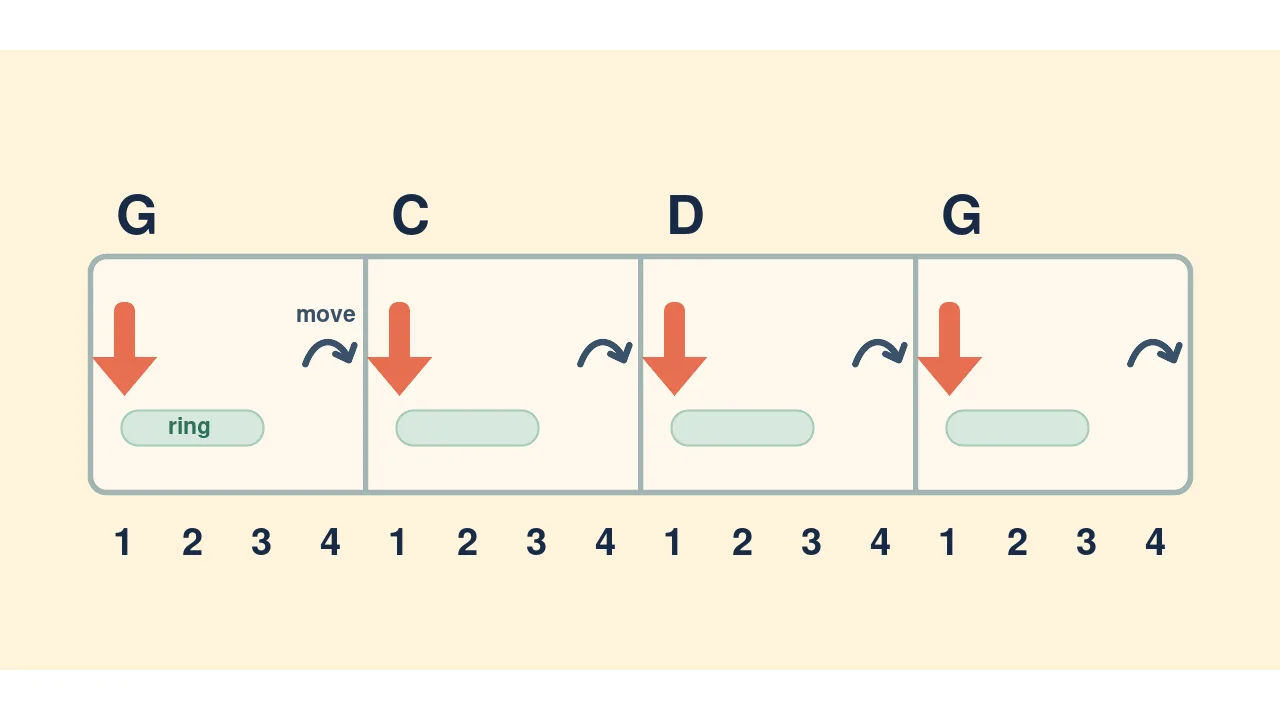
One chord per bar: strum on beat 1, let it ring on 2 and 3, move your fingers on 4, land the next chord on the next 1.

Strum, ring, move

Each strum is the single relaxed downstroke from Strum Your First Chords, now placed on the beat.

  • Count 1 2 3 4 with the metronome, one bar per chord.
  • Strum once on 1 and let the chord ring.
  • On 2 and 3, keep the chord and look ahead to the next shape.
  • On 4, ease the pressure and move.
  • Land the new chord and strum it on the next 1. The beat never waits: if a finger is late, strum anyway and fix it in the next bar.

In this video, MandoLessons works on switching between chords: as you watch, notice when the fretting hand starts to move towards the next shape.

Play the video

The video plays from YouTube and belongs to its author.

Quick check

With one strum per bar, when do you start moving to the next chord?
Show the answer

On beat 4. Let the chord ring on 1, 2 and 3, move on 4, and land on the next 1.

1 more question in the app Get the app

Practise in the free Mandolin app