Harriet Music Get the Mandolin app

Lesson 7 of 9 6 minutes

Mandolin String Crossing: Pick One Course Cleanly

Harriet In this lesson you will move the pick between adjacent courses and sound only the intended string pair.

  1. 1. Meet Your Mandolin
    1. Lesson 1: Meet the Mandolin
    2. Lesson 2: Parts of the Mandolin
    3. Lesson 3: Hold Your Mandolin
    4. Lesson 4: Choose and Hold Your Pick
    5. Lesson 5: Position Your Picking Hand
    6. Lesson 6: Learn the String Names
    7. Lesson 7: Tune Your Mandolin
  2. 2. Your First Notes
    1. Lesson 1: Play the Open Strings
    2. Lesson 2: Find the Frets
    3. Lesson 3: Fret Your First Notes
    4. Lesson 4: Get a Clean Sound
    5. Lesson 5: Use Your Fretting Fingers
    6. Lesson 6: Play Down and Upstrokes
    7. Lesson 7: Change Strings Cleanly
    8. Lesson 8: Coordinate Both Hands
    9. Lesson 9: Play Your First Melody
  3. 3. Read Tabs and Rhythm
    1. Lesson 1: Read Mandolin Tablature
    2. Lesson 2: Play Notes from Tab
    3. Lesson 3: Feel the Steady Beat
    4. Lesson 4: Count Notes and Rests
    5. Lesson 5: Practice with a Metronome
    6. Lesson 6: Read Simple Rhythmic Patterns
  4. 4. Your First Chords
    1. Lesson 1: Understand Mandolin Chords
    2. Lesson 2: Read Chord Diagrams
    3. Lesson 3: Play an Easy G Chord
    4. Lesson 4: Play an Easy C Chord
    5. Lesson 5: Switch Between G and C
    6. Lesson 6: Play an Easy D Chord
    7. Lesson 7: Strum Your First Chords
    8. Lesson 8: Change Chords in Time
    9. Lesson 9: Play a Three Chord Song
  5. 5. Strumming and Rhythm
    1. Lesson 1: Build Your Strumming Motion
    2. Lesson 2: Play Continuous Down Up Strums
    3. Lesson 3: Play Eighth Note Rhythms
    4. Lesson 4: Learn Common Strumming Patterns
    5. Lesson 5: Strum in Three Quarter Time
    6. Lesson 6: Accent the Right Beats
    7. Lesson 7: Accompany a Simple Song
  6. 6. Your First Tunes
    1. Lesson 1: Play Short Musical Phrases
    2. Lesson 2: Learn a Tune by Ear
    3. Lesson 3: Connect Musical Phrases
    4. Lesson 4: Play a Simple Folk Tune
    5. Lesson 5: Play Easy Cripple Creek
    6. Lesson 6: Practice at Different Speeds
    7. Lesson 7: Play a Complete Tune
    8. Lesson 8: Try Your First Tremolo

Reach, then strike

Use the course names and controlled strokes from Play Down and Upstrokes. Keep the strings open.

Move far enough to reach the next pair, but keep the sounding stroke controlled. Changing courses is a repositioning movement, not a strum through the gap. Clear the strings while repositioning, then pick the target pair.
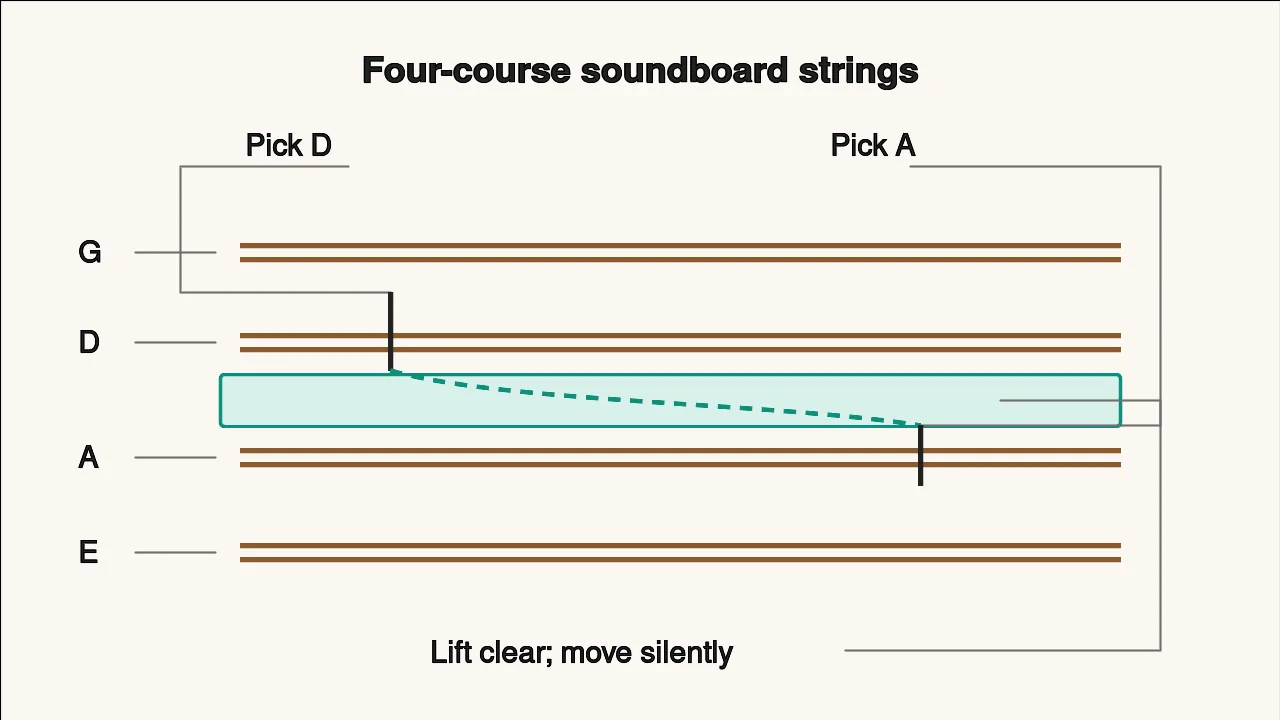
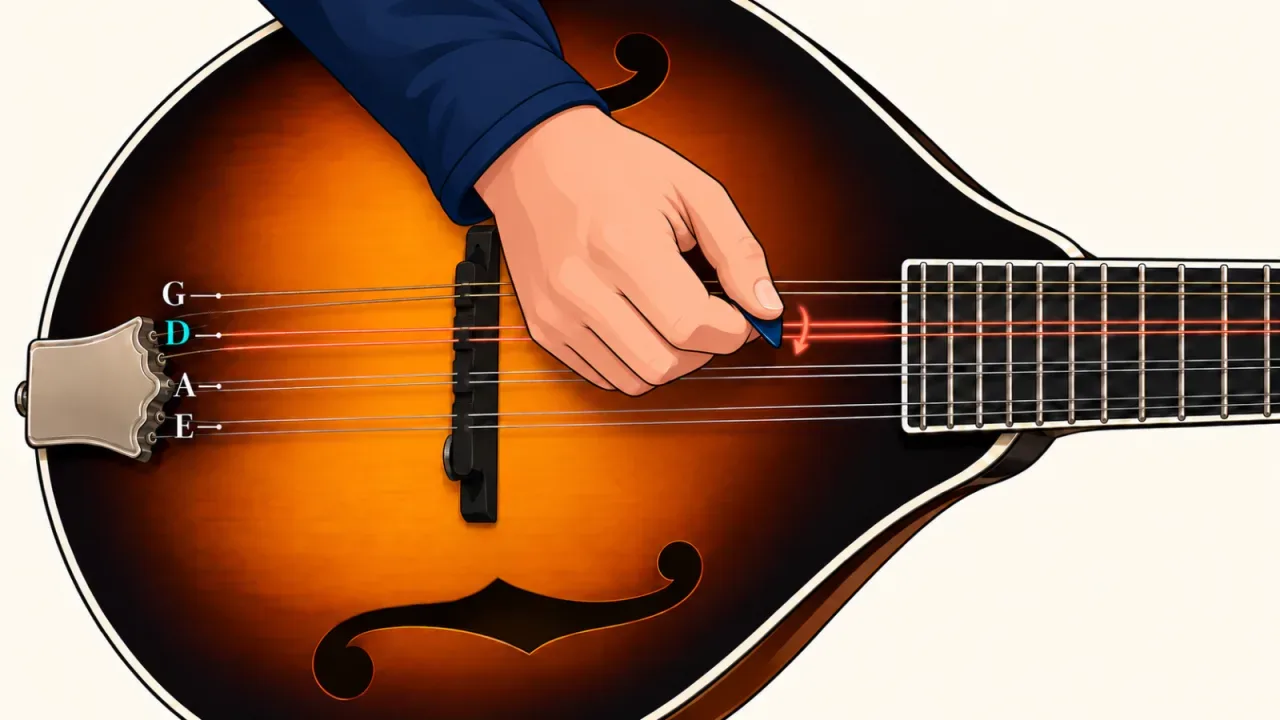
Seen as you look down at your mandolin, G nearest your face. D and A are neighbors. Each solid arrow crosses only the two closely spaced strings within its own course; the dashed path travels between the courses without contact.
  1. Pick both D strings with one gentle downstroke, then pause.
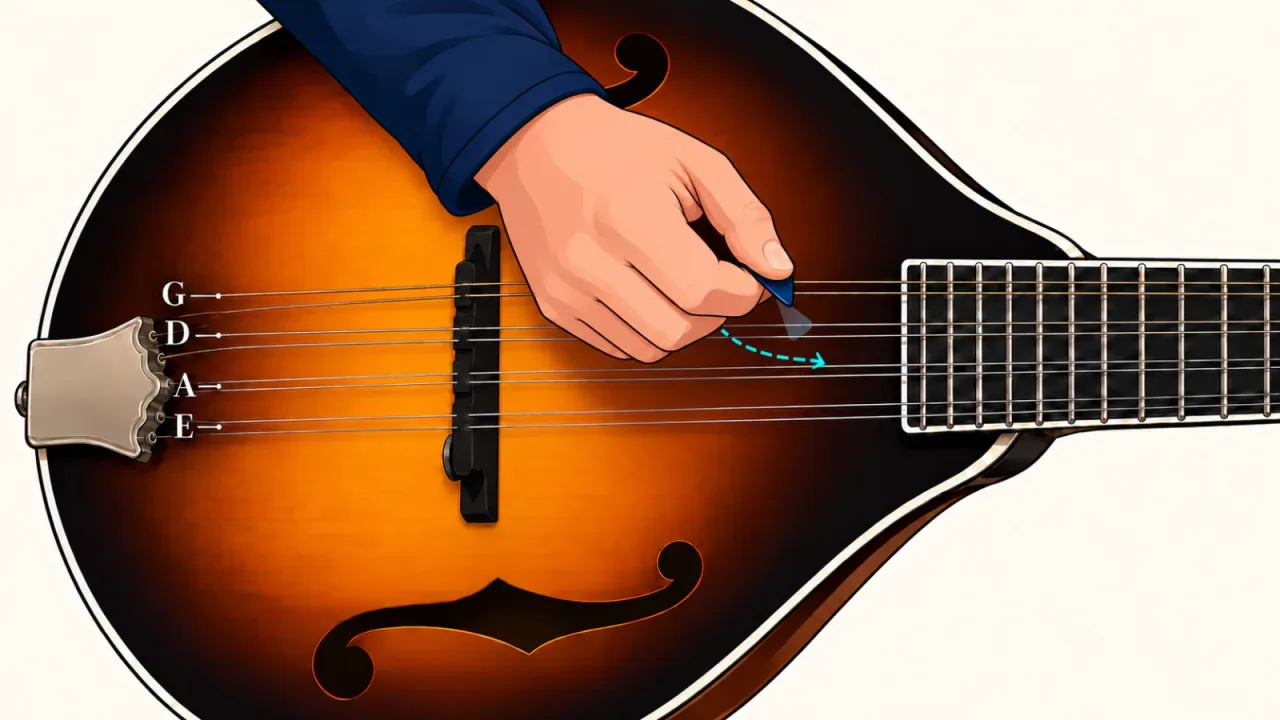
    Pick both D strings with one gentle downstroke, then pause.
  2. Clear the strings and reposition above the A pair without sounding it.
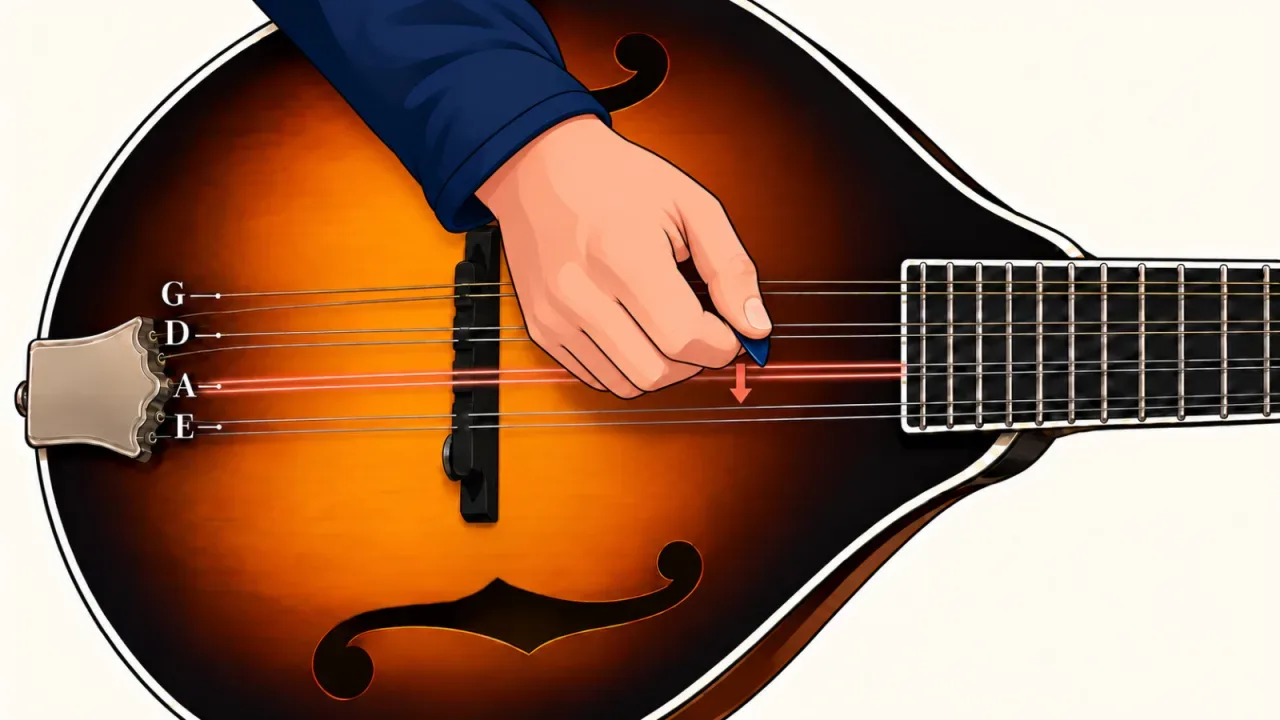
    Clear the strings and reposition above the A pair without sounding it.
  3. Pick both A strings once; pause before returning to D.

    Pick both A strings once; pause before returning to D.
Reference: open D. Compare its lower pitch with A below.
Reference: open A. Listen for the intended pitch change, not an extra neighboring note.

Quick check

You start hitting a neighboring course during repeated changes. What is the useful retry?
Show the answer

Return to isolated downstrokes with a pause. Pauses let you locate the next target and control each stroke again.

Practise in the free Mandolin app