Harriet Music Get the Djembe app

Lesson 1 of 10 8 minutes

How to Alternate Hands on the Djembe (Right, Left)

Harriet In this lesson you will alternate right and left hands smoothly while maintaining a steady pulse.

  1. 1. Meet Your Djembe
    1. Lesson 1: Meet the Djembe
    2. Lesson 2: Position Your Djembe
    3. Lesson 3: Find Your Playing Posture
    4. Lesson 4: Play Your First Bass
    5. Lesson 5: Find the Open Tone
    6. Lesson 6: Hear Bass and Tone
    7. Lesson 7: Keep a Steady Pulse
  2. 2. Your First Rhythms
    1. Lesson 1: Alternate Your Hands
    2. Lesson 2: Combine Bass and Tone
    3. Lesson 3: Learn the Slap Stroke
    4. Lesson 4: Recognize the Three Strokes
    5. Lesson 5: Read a Rhythm Grid
    6. Lesson 6: Count Beats and Offbeats
    7. Lesson 7: Play Eighth Note Patterns
    8. Lesson 8: Build Your First Phrase
    9. Lesson 9: Repeat Rhythms by Ear
    10. Lesson 10: Shape Your Accents
  3. 3. Play Your First Kuku
    1. Lesson 1: Discover the Kuku Rhythm
    2. Lesson 2: Learn Kuku Accompaniment One
    3. Lesson 3: Keep Your Kuku Pattern
    4. Lesson 4: Learn Kuku Accompaniment Two
    5. Lesson 5: Switch Between Kuku Parts
    6. Lesson 6: Recognize the Kuku Call
    7. Lesson 7: Play Along With Kuku
  4. 4. Playing Together
    1. Lesson 1: Listen and Respond
    2. Lesson 2: Practice Call and Response
    3. Lesson 3: Follow Another Djembe Part
    4. Lesson 4: Feel the Dunun Pulse
    5. Lesson 5: Play Without the Click
    6. Lesson 6: Keep Your Place
  5. 5. Traditional Rhythms
    1. Lesson 1: Discover the Djolé Rhythm
    2. Lesson 2: Learn Djolé Accompaniment
    3. Lesson 3: Follow the Djolé Call
    4. Lesson 4: Play Djolé With Others
    5. Lesson 5: Discover the Sinte Rhythm
    6. Lesson 6: Learn Sinte Accompaniment
    7. Lesson 7: Follow the Sinte Call
    8. Lesson 8: Play Sinte With Others
    9. Lesson 9: Discover the Fanga Rhythm
    10. Lesson 10: Learn Fanga Accompaniment
    11. Lesson 11: Follow the Fanga Call
    12. Lesson 12: Play Fanga With Others
    13. Lesson 13: Recognize Traditional Rhythms
  6. 6. Discover Twelve Eight Rhythms
    1. Lesson 1: Feel Three Subdivisions
    2. Lesson 2: Count in Twelve Eight
    3. Lesson 3: Play Your First Ternary Patterns
    4. Lesson 4: Discover the Soli Rhythm
    5. Lesson 5: Learn Soli Accompaniment
    6. Lesson 6: Follow the Soli Call
    7. Lesson 7: Play Soli With Others
    8. Lesson 8: Feel the Ternary Groove
  7. 7. Breaks Variations and Performance
    1. Lesson 1: Understand Musical Calls
    2. Lesson 2: Play a Simple Break
    3. Lesson 3: Return After a Break
    4. Lesson 4: Create Small Rhythmic Variations
    5. Lesson 5: Control Your Playing Tempo
    6. Lesson 6: Start and Finish Together
    7. Lesson 7: Plan an Ensemble Arrangement
    8. Lesson 8: Lead a Simple Call
    9. Lesson 9: Improvise a Short Solo
    10. Lesson 10: Perform a Complete Rhythm

Watch the hands take turns

In Project Autism’s Djembe Drumming Basics — Lesson 5, follow which hand plays next and notice the relaxed shoulders. The clip combines two sounds; for our practice below, keep just one sound while your hands take turns.

Play the video

The video plays from YouTube and belongs to its author.

One beat, then the other hand

Keep the pulse you practised in Keep a Steady Pulse. This time, share it between your hands: right — left — right — left, one bass per beat. Count 1, 2, 3, 4 and repeat without adding a pause.
The hand that has just played releases and stays relaxed, ready for its next turn. Do not hold it stiffly in the air or press it against the head while the other hand plays. You are changing hands, not changing the time between strokes.
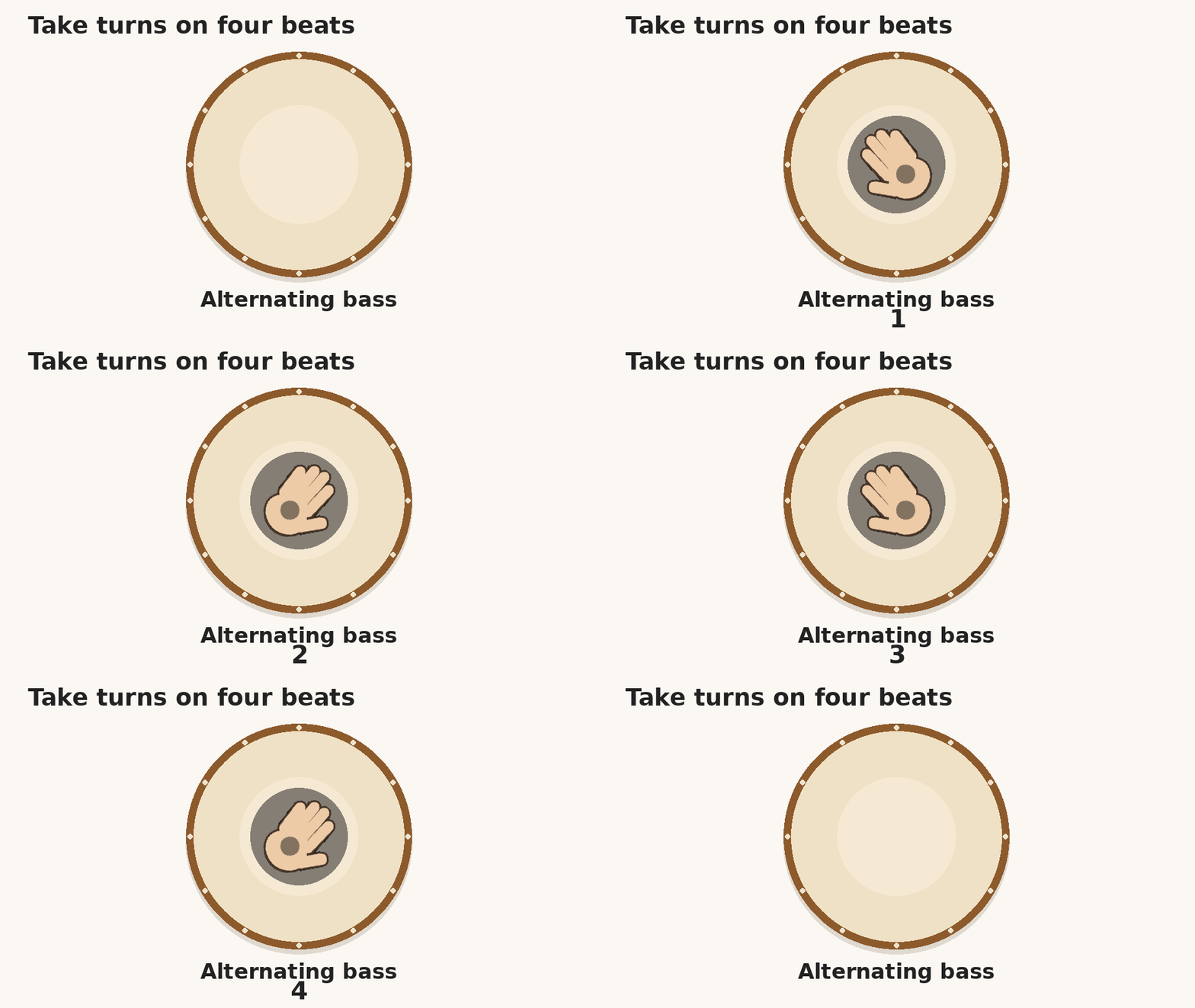
Follow right, left, right, left. R means right and L means left; every contact here is a bass near the center.
  1. Bass
  2. Bass
  3. Bass
  4. Bass
Listen to the even spacing and volume of these recorded bass samples. Use that steadiness as a reference while your hands take turns.

Balance the two sides

If one hand arrives early, resist chasing it with the other. Stop, hear four clicks and begin again with smaller movements. If one side is noticeably louder, soften that side rather than forcing the quieter hand.
For this exercise, both hands play the same sound. Once bass alternation feels comfortable, you can repeat using only open tones from Find the Open Tone. Mixing the two sounds comes next in Combine Bass and Tone.

Quick check

Start on your right hand and give each successive beat to the other hand. Which four-stroke sequence follows that rule?
Show the answer

Right — left — right — left. Right–left–right–left alternates on every beat, including the return from the last left to the next right.

1 more question in the app Get the app

Practise in the free Djembe app