Harriet Music Get the Djembe app

Lesson 9 of 13 8 minutes

Fanga Rhythm on Djembe and Its Welcome Song

Harriet In this lesson you will recognize the Fanga rhythm and understand its connection with a traditional welcome song.

  1. 1. Meet Your Djembe
    1. Lesson 1: Meet the Djembe
    2. Lesson 2: Position Your Djembe
    3. Lesson 3: Find Your Playing Posture
    4. Lesson 4: Play Your First Bass
    5. Lesson 5: Find the Open Tone
    6. Lesson 6: Hear Bass and Tone
    7. Lesson 7: Keep a Steady Pulse
  2. 2. Your First Rhythms
    1. Lesson 1: Alternate Your Hands
    2. Lesson 2: Combine Bass and Tone
    3. Lesson 3: Learn the Slap Stroke
    4. Lesson 4: Recognize the Three Strokes
    5. Lesson 5: Read a Rhythm Grid
    6. Lesson 6: Count Beats and Offbeats
    7. Lesson 7: Play Eighth Note Patterns
    8. Lesson 8: Build Your First Phrase
    9. Lesson 9: Repeat Rhythms by Ear
    10. Lesson 10: Shape Your Accents
  3. 3. Play Your First Kuku
    1. Lesson 1: Discover the Kuku Rhythm
    2. Lesson 2: Learn Kuku Accompaniment One
    3. Lesson 3: Keep Your Kuku Pattern
    4. Lesson 4: Learn Kuku Accompaniment Two
    5. Lesson 5: Switch Between Kuku Parts
    6. Lesson 6: Recognize the Kuku Call
    7. Lesson 7: Play Along With Kuku
  4. 4. Playing Together
    1. Lesson 1: Listen and Respond
    2. Lesson 2: Practice Call and Response
    3. Lesson 3: Follow Another Djembe Part
    4. Lesson 4: Feel the Dunun Pulse
    5. Lesson 5: Play Without the Click
    6. Lesson 6: Keep Your Place
  5. 5. Traditional Rhythms
    1. Lesson 1: Discover the Djolé Rhythm
    2. Lesson 2: Learn Djolé Accompaniment
    3. Lesson 3: Follow the Djolé Call
    4. Lesson 4: Play Djolé With Others
    5. Lesson 5: Discover the Sinte Rhythm
    6. Lesson 6: Learn Sinte Accompaniment
    7. Lesson 7: Follow the Sinte Call
    8. Lesson 8: Play Sinte With Others
    9. Lesson 9: Discover the Fanga Rhythm
    10. Lesson 10: Learn Fanga Accompaniment
    11. Lesson 11: Follow the Fanga Call
    12. Lesson 12: Play Fanga With Others
    13. Lesson 13: Recognize Traditional Rhythms
  6. 6. Discover Twelve Eight Rhythms
    1. Lesson 1: Feel Three Subdivisions
    2. Lesson 2: Count in Twelve Eight
    3. Lesson 3: Play Your First Ternary Patterns
    4. Lesson 4: Discover the Soli Rhythm
    5. Lesson 5: Learn Soli Accompaniment
    6. Lesson 6: Follow the Soli Call
    7. Lesson 7: Play Soli With Others
    8. Lesson 8: Feel the Ternary Groove
  7. 7. Breaks Variations and Performance
    1. Lesson 1: Understand Musical Calls
    2. Lesson 2: Play a Simple Break
    3. Lesson 3: Return After a Break
    4. Lesson 4: Create Small Rhythmic Variations
    5. Lesson 5: Control Your Playing Tempo
    6. Lesson 6: Start and Finish Together
    7. Lesson 7: Plan an Ensemble Arrangement
    8. Lesson 8: Lead a Simple Call
    9. Lesson 9: Improvise a Short Solo
    10. Lesson 10: Perform a Complete Rhythm

A rhythm that makes room for a welcome

Fanga is associated with a welcome song and dance with Liberian roots. Its life in wider West African and diaspora drumming includes teaching arrangements and performances that differ from one another. The welcome-song tradition also circulated through Babatunde Olatunji’s teaching in the United States.
Listen for how a recurring drum part supports a voice that moves through the song. You do not need to sing or learn new strokes in this lesson.

Erika Christie’s recording of the Bele Bele Rhythm Collective performing Fanga Alafia brings the song and drumming together. Listen to roughly the first minute: notice the voice above the continuing rhythmic support, and tap an even pulse when it feels clear.

Play the video

The video plays from YouTube and belongs to its author.

Three listening jobs

The song carries a vocal phrase. The pulse is the even beat you can keep tapping. An accompaniment is a repeating drum pattern arranged around that pulse. A singer can change a phrase while a drummer keeps the same part.
These roles help you listen without trying to copy every sound at once.
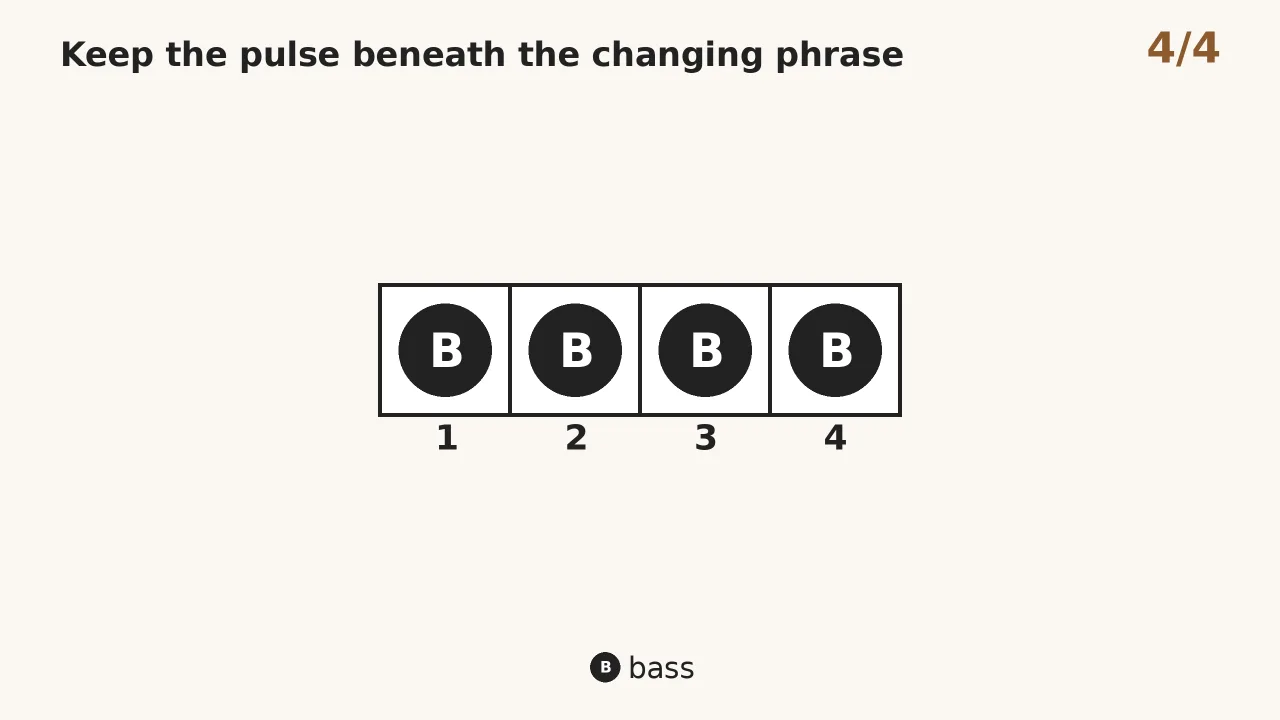
The four numbered beats are a pulse reference only, not a transcription of the performance or the Fanga accompaniment.

A consistent part for our practice

For the following lessons, we will use the first djembe part in R Clark’s published Fanga notation on Djembe.net. It gives us one documented version to learn consistently. The slow audio below is a practice rendering of that notation, not audio taken from the performance.
Hear its bass opening, a tone just before beat 2, and the tone pair inside beat 2. Another tone pair appears on beat 4. You will learn every stroke in Learn Fanga Accompaniment.

  1. Bass
  2. Rest
  3. Rest
  4. Tone
  5. Rest
  6. Tone
  7. Tone
  8. Rest
  9. Bass
  10. Rest
  11. Bass
  12. Rest
  13. Tone
  14. Tone
  15. Rest
  16. Rest
Selected Fanga teaching voice, twice at 50 BPM with a count-in.

Compare two selected examples

A is our Fanga practice voice. B is the Sinte voice you already know, at the same tempo. A begins with a bass and finishes its strokes with two tones on 4 and e, leaving & a empty. B starts with two tones and keeps a slap on the & of 4.
Use these clues to distinguish the examples. They describe our chosen parts, not every possible Fanga or Sinte arrangement.

  1. Bass
  2. Rest
  3. Rest
  4. Tone
  5. Rest
  6. Tone
  7. Tone
  8. Rest
  9. Bass
  10. Rest
  11. Bass
  12. Rest
  13. Tone
  14. Tone
  15. Rest
  16. Rest
Example A — selected Fanga voice at 50 BPM.
  1. Tone
  2. Tone
  3. Rest
  4. Slap
  5. Bass
  6. Rest
  7. Slap
  8. Rest
  9. Bass
  10. Rest
  11. Rest
  12. Slap
  13. Bass
  14. Rest
  15. Slap
  16. Rest
Example B — familiar Sinte voice at the same tempo.

Quick check

Which clue distinguishes our Fanga practice voice from the Sinte example?
Show the answer

It starts with a bass and ends its strokes with two tones on 4 and e. Compare the opening and ending at the same tempo; those stroke placements distinguish the selected parts.

1 more question in the app Get the app

Practise in the free Djembe app