Harriet Music Get the Djembe app

Lesson 2 of 6 9 minutes

Djembe Call and Response: A Musical Conversation

Harriet In this lesson you will alternate between listening and playing in a simple musical conversation.

  1. 1. Meet Your Djembe
    1. Lesson 1: Meet the Djembe
    2. Lesson 2: Position Your Djembe
    3. Lesson 3: Find Your Playing Posture
    4. Lesson 4: Play Your First Bass
    5. Lesson 5: Find the Open Tone
    6. Lesson 6: Hear Bass and Tone
    7. Lesson 7: Keep a Steady Pulse
  2. 2. Your First Rhythms
    1. Lesson 1: Alternate Your Hands
    2. Lesson 2: Combine Bass and Tone
    3. Lesson 3: Learn the Slap Stroke
    4. Lesson 4: Recognize the Three Strokes
    5. Lesson 5: Read a Rhythm Grid
    6. Lesson 6: Count Beats and Offbeats
    7. Lesson 7: Play Eighth Note Patterns
    8. Lesson 8: Build Your First Phrase
    9. Lesson 9: Repeat Rhythms by Ear
    10. Lesson 10: Shape Your Accents
  3. 3. Play Your First Kuku
    1. Lesson 1: Discover the Kuku Rhythm
    2. Lesson 2: Learn Kuku Accompaniment One
    3. Lesson 3: Keep Your Kuku Pattern
    4. Lesson 4: Learn Kuku Accompaniment Two
    5. Lesson 5: Switch Between Kuku Parts
    6. Lesson 6: Recognize the Kuku Call
    7. Lesson 7: Play Along With Kuku
  4. 4. Playing Together
    1. Lesson 1: Listen and Respond
    2. Lesson 2: Practice Call and Response
    3. Lesson 3: Follow Another Djembe Part
    4. Lesson 4: Feel the Dunun Pulse
    5. Lesson 5: Play Without the Click
    6. Lesson 6: Keep Your Place
  5. 5. Traditional Rhythms
    1. Lesson 1: Discover the Djolé Rhythm
    2. Lesson 2: Learn Djolé Accompaniment
    3. Lesson 3: Follow the Djolé Call
    4. Lesson 4: Play Djolé With Others
    5. Lesson 5: Discover the Sinte Rhythm
    6. Lesson 6: Learn Sinte Accompaniment
    7. Lesson 7: Follow the Sinte Call
    8. Lesson 8: Play Sinte With Others
    9. Lesson 9: Discover the Fanga Rhythm
    10. Lesson 10: Learn Fanga Accompaniment
    11. Lesson 11: Follow the Fanga Call
    12. Lesson 12: Play Fanga With Others
    13. Lesson 13: Recognize Traditional Rhythms
  6. 6. Discover Twelve Eight Rhythms
    1. Lesson 1: Feel Three Subdivisions
    2. Lesson 2: Count in Twelve Eight
    3. Lesson 3: Play Your First Ternary Patterns
    4. Lesson 4: Discover the Soli Rhythm
    5. Lesson 5: Learn Soli Accompaniment
    6. Lesson 6: Follow the Soli Call
    7. Lesson 7: Play Soli With Others
    8. Lesson 8: Feel the Ternary Groove
  7. 7. Breaks Variations and Performance
    1. Lesson 1: Understand Musical Calls
    2. Lesson 2: Play a Simple Break
    3. Lesson 3: Return After a Break
    4. Lesson 4: Create Small Rhythmic Variations
    5. Lesson 5: Control Your Playing Tempo
    6. Lesson 6: Start and Finish Together
    7. Lesson 7: Plan an Ensemble Arrangement
    8. Lesson 8: Lead a Simple Call
    9. Lesson 9: Improvise a Short Solo
    10. Lesson 10: Perform a Complete Rhythm

Leave room for the next voice

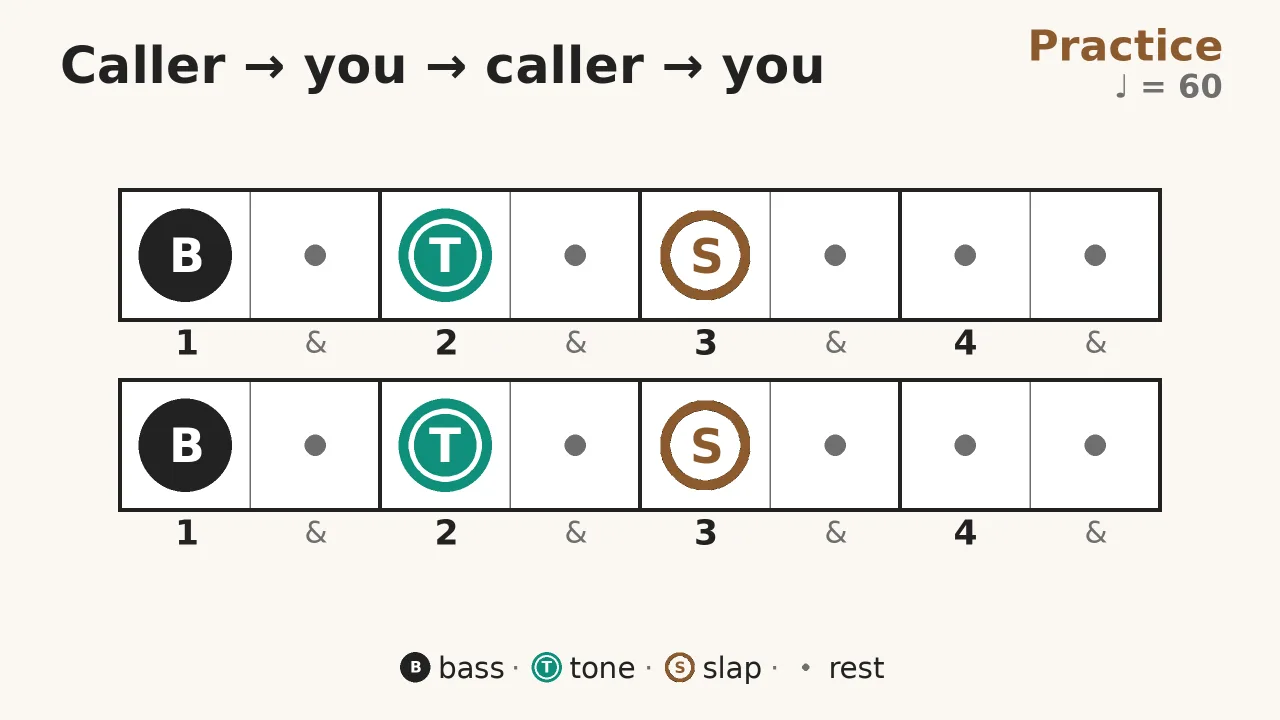
A reply is also a handover. When your four beats are complete, the other drummer needs the next turn—even if you could keep playing. Call and response works when both players leave that room.
Build on Listen and Respond: listen for one four-beat bar, copy it in the next, then listen again without resetting the pulse. These are neutral echo exercises. Unlike the Kuku entrance call, the phrase here is something you repeat.

  1. Bass
  2. Rest
  3. Tone
  4. Rest
  5. Slap
  6. Rest
  7. Rest
  8. Rest
  9. Bass
  10. Rest
  11. Tone
  12. Rest
  13. Slap
  14. Rest
  15. Rest
  16. Rest
A complete example played for you: four beats of call, then four beats of identical response at 60 BPM. The continuing click joins the turns.
Read row 1 as the caller’s turn and row 2 as your answer. Then return to listening on row 1. Both rows keep their silent fourth beat.

Same sounds, different spaces

The next exchange uses two phrases you have met before. A: B–T–S––– puts bass, tone and slap on 1, 2 and 3, with beat 4 silent. B: B––T––S– places the tone on the & after 2 and the slap on 4.
Listen before deciding which to answer. Do not start playing A merely because the previous call was A. Your reply must preserve the particular spacing you just heard.

  1. Bass
  2. Rest
  3. Tone
  4. Rest
  5. Slap
  6. Rest
  7. Rest
  8. Rest
  9. Bass
  10. Rest
  11. Rest
  12. Tone
  13. Rest
  14. Rest
  15. Slap
  16. Rest
Compare A in the first bar with B in the second. Both use bass, tone and slap, but their tone and slap arrive at different times. This clip is a comparison, not your response space.

In the app: a self-check exercise and a practice. Get the app

Quick check

The latest call places its tone on the & after 2 and slap on 4. Which answer matches it?
Show the answer

B--T--S-. Phrase B preserves the offbeat tone and slap on 4.

1 more question in the app Get the app

Practise in the free Djembe app