Harriet Music Get the Djembe app

Lesson 6 of 13 12 minutes

Sinte Djembe Accompaniment: Strokes and Timing

Harriet In this lesson you will play a documented Sinte accompaniment with the correct stroke sequence and timing.

  1. 1. Meet Your Djembe
    1. Lesson 1: Meet the Djembe
    2. Lesson 2: Position Your Djembe
    3. Lesson 3: Find Your Playing Posture
    4. Lesson 4: Play Your First Bass
    5. Lesson 5: Find the Open Tone
    6. Lesson 6: Hear Bass and Tone
    7. Lesson 7: Keep a Steady Pulse
  2. 2. Your First Rhythms
    1. Lesson 1: Alternate Your Hands
    2. Lesson 2: Combine Bass and Tone
    3. Lesson 3: Learn the Slap Stroke
    4. Lesson 4: Recognize the Three Strokes
    5. Lesson 5: Read a Rhythm Grid
    6. Lesson 6: Count Beats and Offbeats
    7. Lesson 7: Play Eighth Note Patterns
    8. Lesson 8: Build Your First Phrase
    9. Lesson 9: Repeat Rhythms by Ear
    10. Lesson 10: Shape Your Accents
  3. 3. Play Your First Kuku
    1. Lesson 1: Discover the Kuku Rhythm
    2. Lesson 2: Learn Kuku Accompaniment One
    3. Lesson 3: Keep Your Kuku Pattern
    4. Lesson 4: Learn Kuku Accompaniment Two
    5. Lesson 5: Switch Between Kuku Parts
    6. Lesson 6: Recognize the Kuku Call
    7. Lesson 7: Play Along With Kuku
  4. 4. Playing Together
    1. Lesson 1: Listen and Respond
    2. Lesson 2: Practice Call and Response
    3. Lesson 3: Follow Another Djembe Part
    4. Lesson 4: Feel the Dunun Pulse
    5. Lesson 5: Play Without the Click
    6. Lesson 6: Keep Your Place
  5. 5. Traditional Rhythms
    1. Lesson 1: Discover the Djolé Rhythm
    2. Lesson 2: Learn Djolé Accompaniment
    3. Lesson 3: Follow the Djolé Call
    4. Lesson 4: Play Djolé With Others
    5. Lesson 5: Discover the Sinte Rhythm
    6. Lesson 6: Learn Sinte Accompaniment
    7. Lesson 7: Follow the Sinte Call
    8. Lesson 8: Play Sinte With Others
    9. Lesson 9: Discover the Fanga Rhythm
    10. Lesson 10: Learn Fanga Accompaniment
    11. Lesson 11: Follow the Fanga Call
    12. Lesson 12: Play Fanga With Others
    13. Lesson 13: Recognize Traditional Rhythms
  6. 6. Discover Twelve Eight Rhythms
    1. Lesson 1: Feel Three Subdivisions
    2. Lesson 2: Count in Twelve Eight
    3. Lesson 3: Play Your First Ternary Patterns
    4. Lesson 4: Discover the Soli Rhythm
    5. Lesson 5: Learn Soli Accompaniment
    6. Lesson 6: Follow the Soli Call
    7. Lesson 7: Play Soli With Others
    8. Lesson 8: Feel the Ternary Groove
  7. 7. Breaks Variations and Performance
    1. Lesson 1: Understand Musical Calls
    2. Lesson 2: Play a Simple Break
    3. Lesson 3: Return After a Break
    4. Lesson 4: Create Small Rhythmic Variations
    5. Lesson 5: Control Your Playing Tempo
    6. Lesson 6: Start and Finish Together
    7. Lesson 7: Plan an Ensemble Arrangement
    8. Lesson 8: Lead a Simple Call
    9. Lesson 9: Improvise a Short Solo
    10. Lesson 10: Perform a Complete Rhythm

Give the spaces their full length

The opening tone pair makes this part easy to recognize. Keeping the spaces after it is what lets the whole phrase settle. Use the bass, tone and slap you already know, with four equal positions in each beat: 1 e & a.
First hear the complete voice at a slow practice tempo. Tap four main beats before adding your hands.

  1. Tone
  2. Tone
  3. Rest
  4. Slap
  5. Bass
  6. Rest
  7. Slap
  8. Rest
  9. Bass
  10. Rest
  11. Rest
  12. Slap
  13. Bass
  14. Rest
  15. Slap
  16. Rest
The complete first voice twice at 50 BPM, after four count-in beats.

Lars Pistorius’s Learn SINTE on Djembe | Voice 1 + Notation accompanies this lesson because it isolates the same voice. Compare its phrasing with the slow reference; pause before any faster playing.

Play the video

The video plays from YouTube and belongs to its author.

Read one cycle

Each numbered beat spans four boxes. T is tone, B bass, S slap; a dash means wait for that position. The first two tones occupy 1 and e. The following slap is on a, leaving the & empty.
The written hands follow Lars’s score: R is right and L is left. Consecutive strokes may use the same hand; let it rebound during the intervening space.
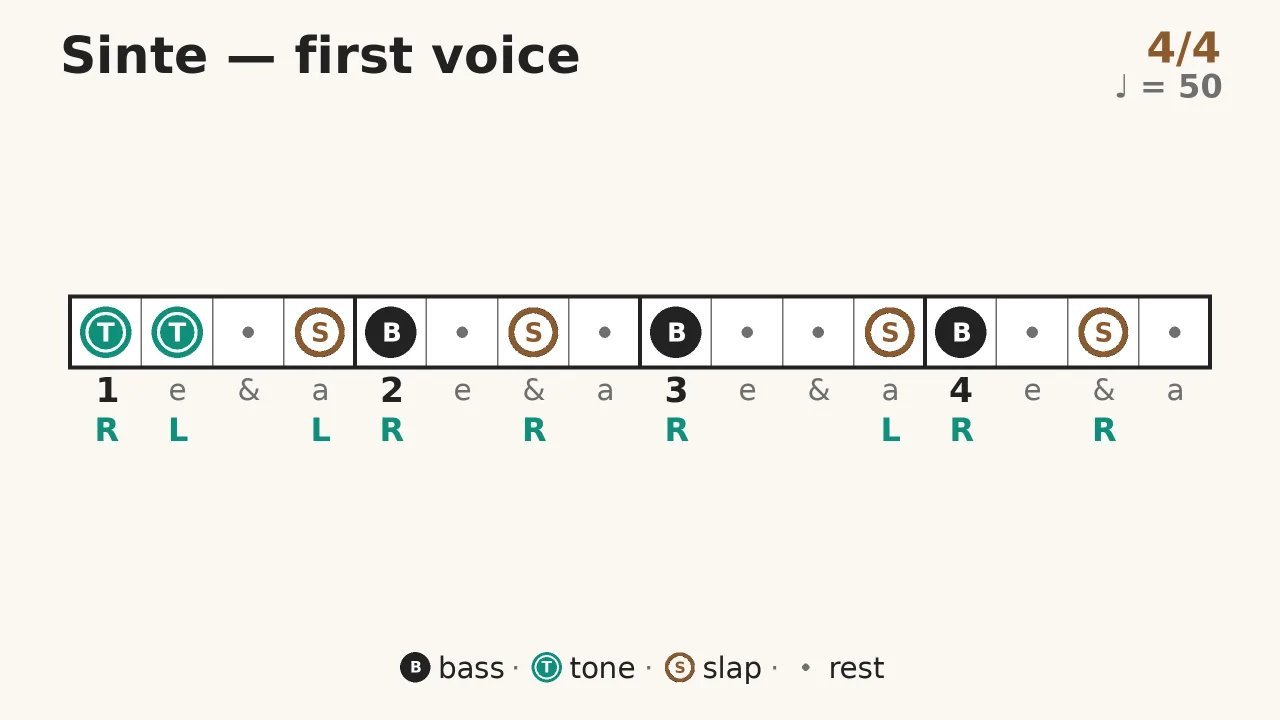
One four-beat cycle. Keep each empty position even, including the final a of 4.

Build beats 1 and 2

Play tone, tone, wait, slap | bass, wait, slap, wait. Use R–L–L–R–R for those five strokes. The slap on the a of 1 leads into the bass on 2; it does not make beat 2 arrive early.
The next clip isolates these two beats and leaves beats 3 and 4 silent. Keep counting through that silence before repeating.

  1. Tone
  2. Tone
  3. Rest
  4. Slap
  5. Bass
  6. Rest
  7. Slap
  8. Rest
  9. Rest
  10. Rest
  11. Rest
  12. Rest
  13. Rest
  14. Rest
  15. Rest
  16. Rest
Opening fragment twice; beats 3 and 4 are deliberately empty.

Connect the ending

Beats 3 and 4 are bass, wait, wait, slap | bass, wait, slap, wait, using R–L–R–R. The slap on the a of 3 leads into the bass on 4. These approaching slaps are clear landmarks, not instructions to hit harder.
After the slap on the & of 4, leave the a empty. Then the right-hand tone starts the next cycle on 1. Do not squeeze that final space.

  1. Rest
  2. Rest
  3. Rest
  4. Rest
  5. Rest
  6. Rest
  7. Rest
  8. Rest
  9. Bass
  10. Rest
  11. Rest
  12. Slap
  13. Bass
  14. Rest
  15. Slap
  16. Rest
Ending fragment twice; count through the silent first two beats.

In the app: a practice. Get the app

  1. Tone
  2. Tone
  3. Rest
  4. Slap
  5. Bass
  6. Rest
  7. Slap
  8. Rest
  9. Bass
  10. Rest
  11. Rest
  12. Slap
  13. Bass
  14. Rest
  15. Slap
  16. Rest
Return to the whole voice and compare stroke choices and spacing.

In the app: a self-check exercise. Get the app

Quick check

After the slap on the & of 4, what connects this cycle to the next?
Show the answer

A rest on a, then the opening tone on 1. The final empty position preserves the space before the new tone pair.

1 more question in the app Get the app

Practise in the free Djembe app