A small phrase with a spacious ending
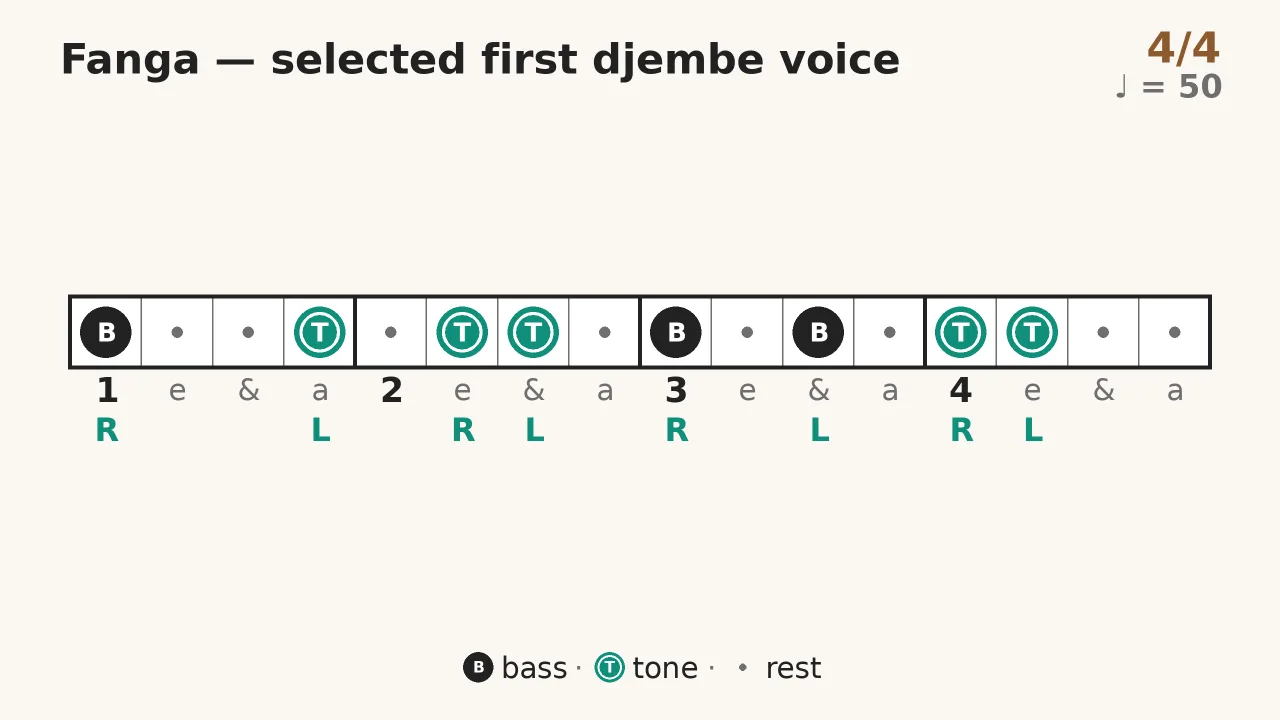
The Fanga teaching part introduced in Discover the Fanga Rhythm combines basses and tones, leaving room before it repeats. We will keep R Clark’s documented version throughout these exercises. It is our study arrangement, rather than a claim to reproduce every stroke of the welcome-song performance.
You already know how to count 1 e & a. First hear the whole part before reading its sequence.
- Bass
- Rest
- Rest
- Tone
- Rest
- Tone
- Tone
- Rest
- Bass
- Rest
- Bass
- Rest
- Tone
- Tone
- Rest
- Rest
Put every stroke in its place
Beat 1 is bass, wait, wait, tone. Beat 2 is wait, tone, tone, wait. Beat 3 is bass, wait, bass, wait. Beat 4 is tone, tone, wait, wait.
This part needs bass and tone only; do not add slaps. Try alternating R–L across the eight played strokes, letting each hand rebound. The letters below are a comfortable practice suggestion, not a rule for every Fanga player.
Start with two beats
The first tone arrives just before 2, but 2 itself is empty. Keep counting through it before the next tones on e and &. This prevents the tone group from sliding onto the main beat.
In the fragment clip, beats 3 and 4 are deliberately silent; continue counting them.
- Bass
- Rest
- Rest
- Tone
- Rest
- Tone
- Tone
- Rest
- Rest
- Rest
- Rest
- Rest
- Rest
- Rest
- Rest
- Rest
Let the ending return
Play the two basses on 3 and &, then the tones on 4 and e. Leave & a empty. The next bass belongs on the next 1; do not add another pause or shorten the written space.
Practice beat 4 into the next beat 1 a few times, then put the whole phrase together.
- Rest
- Rest
- Rest
- Rest
- Rest
- Rest
- Rest
- Rest
- Bass
- Rest
- Bass
- Rest
- Tone
- Tone
- Rest
- Rest
In the app: a practice and a self-check exercise. Get the app
Quick check
1 more question in the app Get the app
