Harriet Music Get the Djembe app

Lesson 3 of 8 11 minutes

First Ternary Djembe Patterns in 12/8

Harriet In this lesson you will play simple ternary patterns with bass, tone, slap and rests without losing the larger beat.

  1. 1. Meet Your Djembe
    1. Lesson 1: Meet the Djembe
    2. Lesson 2: Position Your Djembe
    3. Lesson 3: Find Your Playing Posture
    4. Lesson 4: Play Your First Bass
    5. Lesson 5: Find the Open Tone
    6. Lesson 6: Hear Bass and Tone
    7. Lesson 7: Keep a Steady Pulse
  2. 2. Your First Rhythms
    1. Lesson 1: Alternate Your Hands
    2. Lesson 2: Combine Bass and Tone
    3. Lesson 3: Learn the Slap Stroke
    4. Lesson 4: Recognize the Three Strokes
    5. Lesson 5: Read a Rhythm Grid
    6. Lesson 6: Count Beats and Offbeats
    7. Lesson 7: Play Eighth Note Patterns
    8. Lesson 8: Build Your First Phrase
    9. Lesson 9: Repeat Rhythms by Ear
    10. Lesson 10: Shape Your Accents
  3. 3. Play Your First Kuku
    1. Lesson 1: Discover the Kuku Rhythm
    2. Lesson 2: Learn Kuku Accompaniment One
    3. Lesson 3: Keep Your Kuku Pattern
    4. Lesson 4: Learn Kuku Accompaniment Two
    5. Lesson 5: Switch Between Kuku Parts
    6. Lesson 6: Recognize the Kuku Call
    7. Lesson 7: Play Along With Kuku
  4. 4. Playing Together
    1. Lesson 1: Listen and Respond
    2. Lesson 2: Practice Call and Response
    3. Lesson 3: Follow Another Djembe Part
    4. Lesson 4: Feel the Dunun Pulse
    5. Lesson 5: Play Without the Click
    6. Lesson 6: Keep Your Place
  5. 5. Traditional Rhythms
    1. Lesson 1: Discover the Djolé Rhythm
    2. Lesson 2: Learn Djolé Accompaniment
    3. Lesson 3: Follow the Djolé Call
    4. Lesson 4: Play Djolé With Others
    5. Lesson 5: Discover the Sinte Rhythm
    6. Lesson 6: Learn Sinte Accompaniment
    7. Lesson 7: Follow the Sinte Call
    8. Lesson 8: Play Sinte With Others
    9. Lesson 9: Discover the Fanga Rhythm
    10. Lesson 10: Learn Fanga Accompaniment
    11. Lesson 11: Follow the Fanga Call
    12. Lesson 12: Play Fanga With Others
    13. Lesson 13: Recognize Traditional Rhythms
  6. 6. Discover Twelve Eight Rhythms
    1. Lesson 1: Feel Three Subdivisions
    2. Lesson 2: Count in Twelve Eight
    3. Lesson 3: Play Your First Ternary Patterns
    4. Lesson 4: Discover the Soli Rhythm
    5. Lesson 5: Learn Soli Accompaniment
    6. Lesson 6: Follow the Soli Call
    7. Lesson 7: Play Soli With Others
    8. Lesson 8: Feel the Ternary Groove
  7. 7. Breaks Variations and Performance
    1. Lesson 1: Understand Musical Calls
    2. Lesson 2: Play a Simple Break
    3. Lesson 3: Return After a Break
    4. Lesson 4: Create Small Rhythmic Variations
    5. Lesson 5: Control Your Playing Tempo
    6. Lesson 6: Start and Finish Together
    7. Lesson 7: Plan an Ensemble Arrangement
    8. Lesson 8: Lead a Simple Call
    9. Lesson 9: Improvise a Short Solo
    10. Lesson 10: Perform a Complete Rhythm

Keep counting when your hands are quiet

A rest takes time just as a played stroke does. Keep the count from Count in Twelve Eight going through 1-and-a, 2-and-a, 3-and-a, 4-and-a, even when a hand waits.
These are neutral practice patterns, preparing your coordination for later rhythms. Start with one bass on each numbered beat.
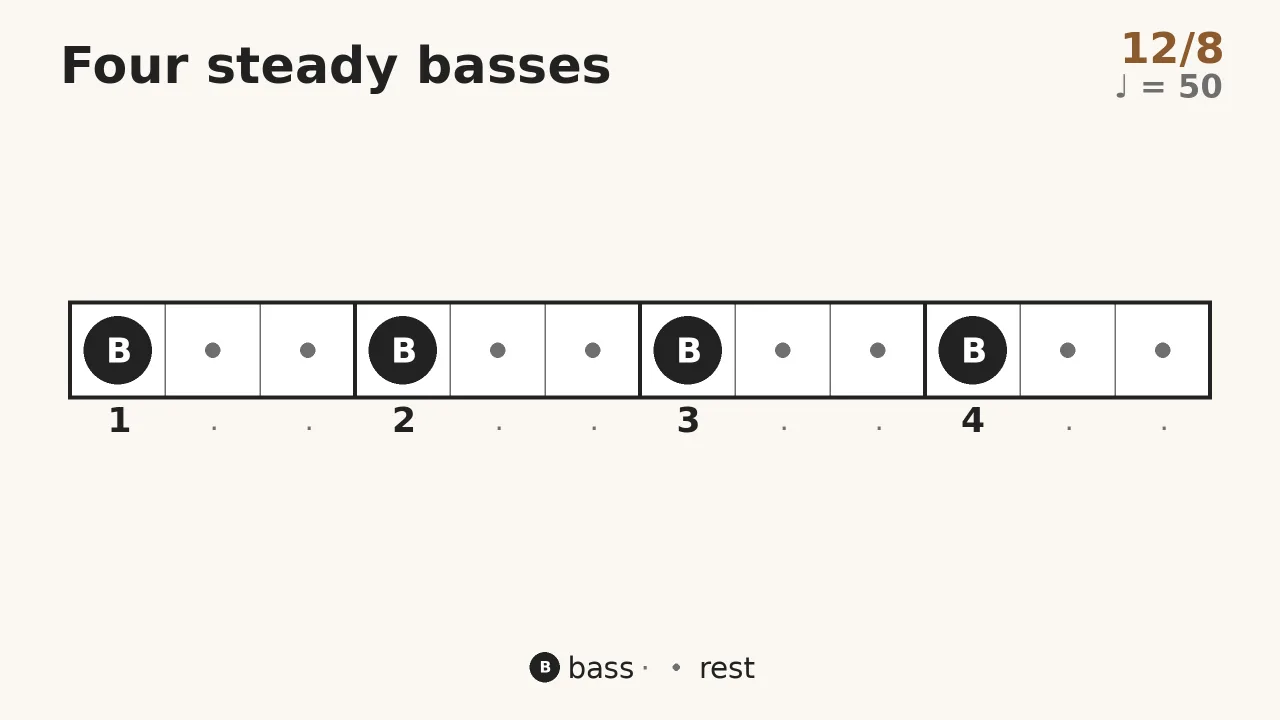
Each bass starts a group of three; the following two positions remain silent.
  1. Bass
  2. Rest
  3. Rest
  4. Bass
  5. Rest
  6. Rest
  7. Bass
  8. Rest
  9. Rest
  10. Bass
  11. Rest
  12. Rest
Four main-beat basses, twice at 50 BPM.

Add the third position

Now play a tone on each a. The group is bass, wait, tone. The empty and still lasts one position: do not bring the tone forward or turn the group into two equally spaced sounds.
Use a comfortable right-hand bass and left-hand tone, or the reverse if that feels more relaxed. Speak all three positions before playing.
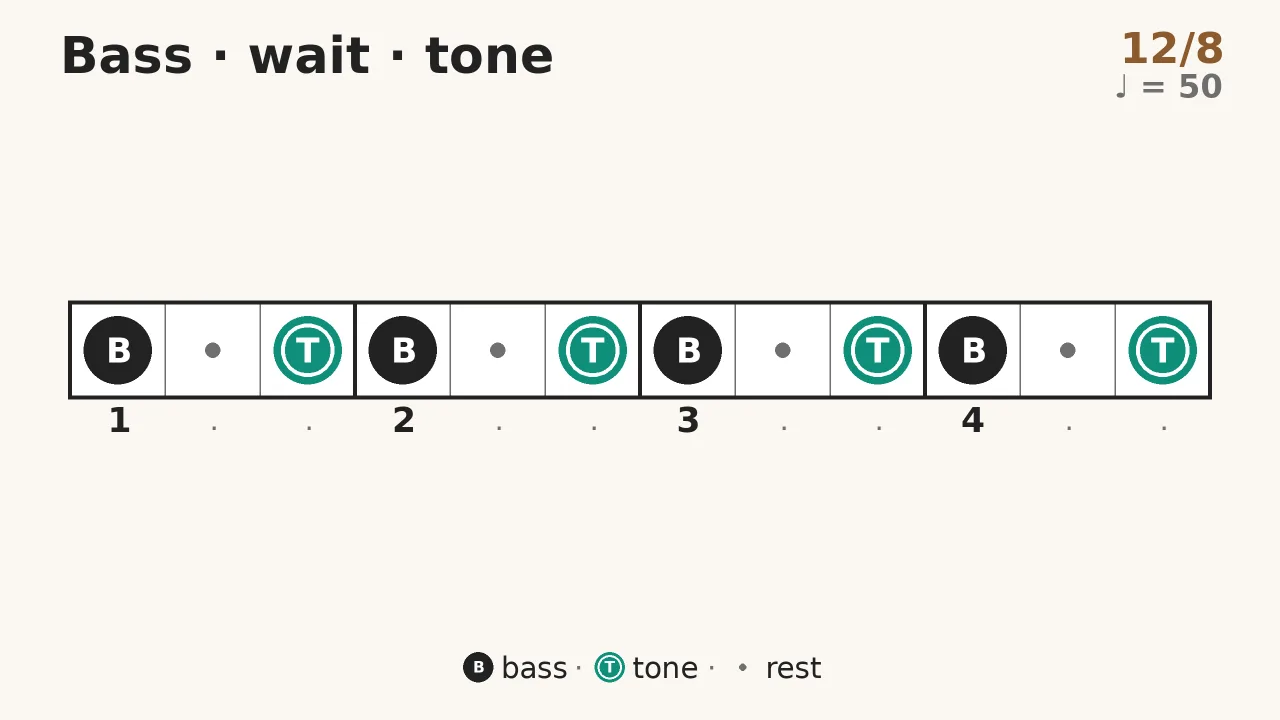
The tone occupies the third position in each beat; the middle position stays empty.
  1. Bass
  2. Rest
  3. Tone
  4. Bass
  5. Rest
  6. Tone
  7. Bass
  8. Rest
  9. Tone
  10. Bass
  11. Rest
  12. Tone
Bass on each number, tone on each a, twice at 50 BPM.

Change the leading sound

Alternate bass, wait, tone with slap, wait, tone. Beats 1 and 3 start with bass; beats 2 and 4 start with slap. The tones stay on every a, and every and stays empty.
Try R–L for each played pair, with the right hand changing its stroke sound between bass and slap. Keep the slap clear and comfortable, without adding force.
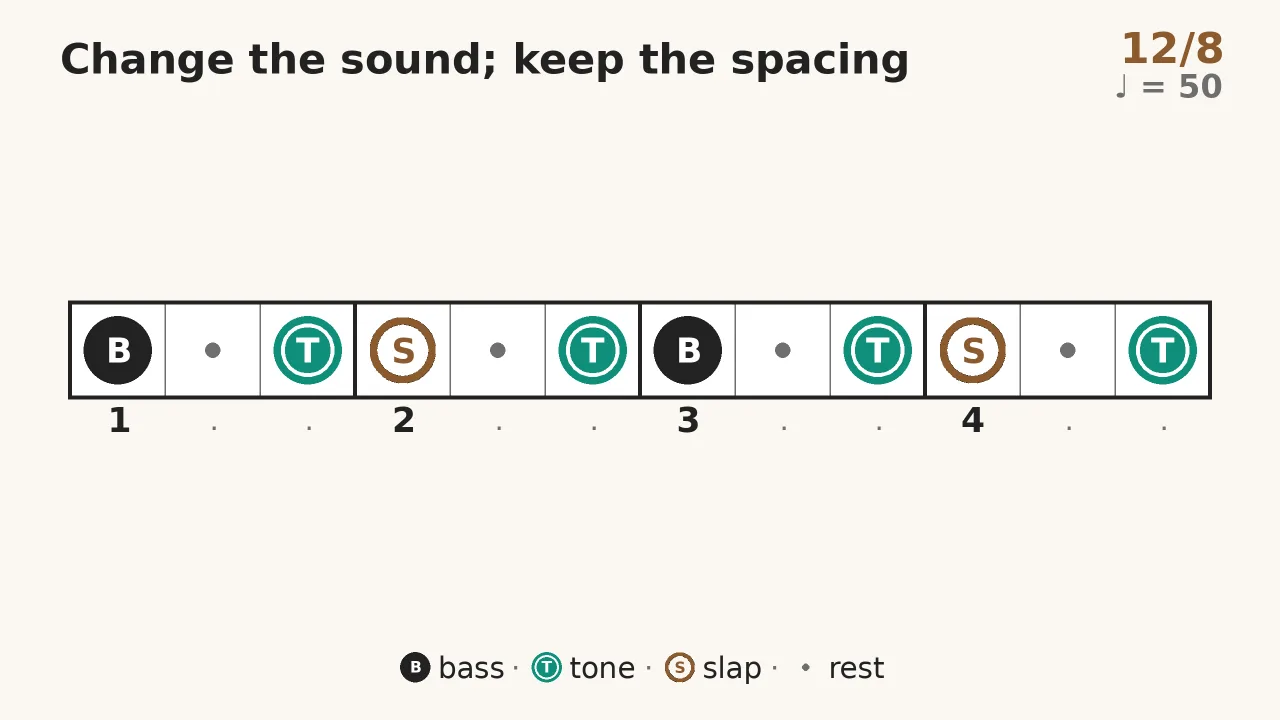
B–wait–T, S–wait–T, B–wait–T, S–wait–T across four beats.
  1. Bass
  2. Rest
  3. Tone
  4. Slap
  5. Rest
  6. Tone
  7. Bass
  8. Rest
  9. Tone
  10. Slap
  11. Rest
  12. Tone
Mixed practice pattern, twice at 50 BPM. The subdivision stays unchanged.

In the app: a practice and 2 self-check exercises. Get the app

Quick check

In bass–wait–tone, which part of the spoken count stays silent?
Show the answer

And. Bass is on the number, tone on a, and the middle and stays empty.

1 more question in the app Get the app

Practise in the free Djembe app