The last sound is not always the entrance
A call can finish sounding while there is still time left before your part begins. Entering as soon as you hear its last stroke can put the whole accompaniment ahead of the group.
Keep the first part from Learn Djolé Accompaniment, at 50 BPM. Your job is to listen through the signal, enter on the agreed beat and keep the part steady afterwards. You do not need to play the call.
One cue, a clearly agreed return
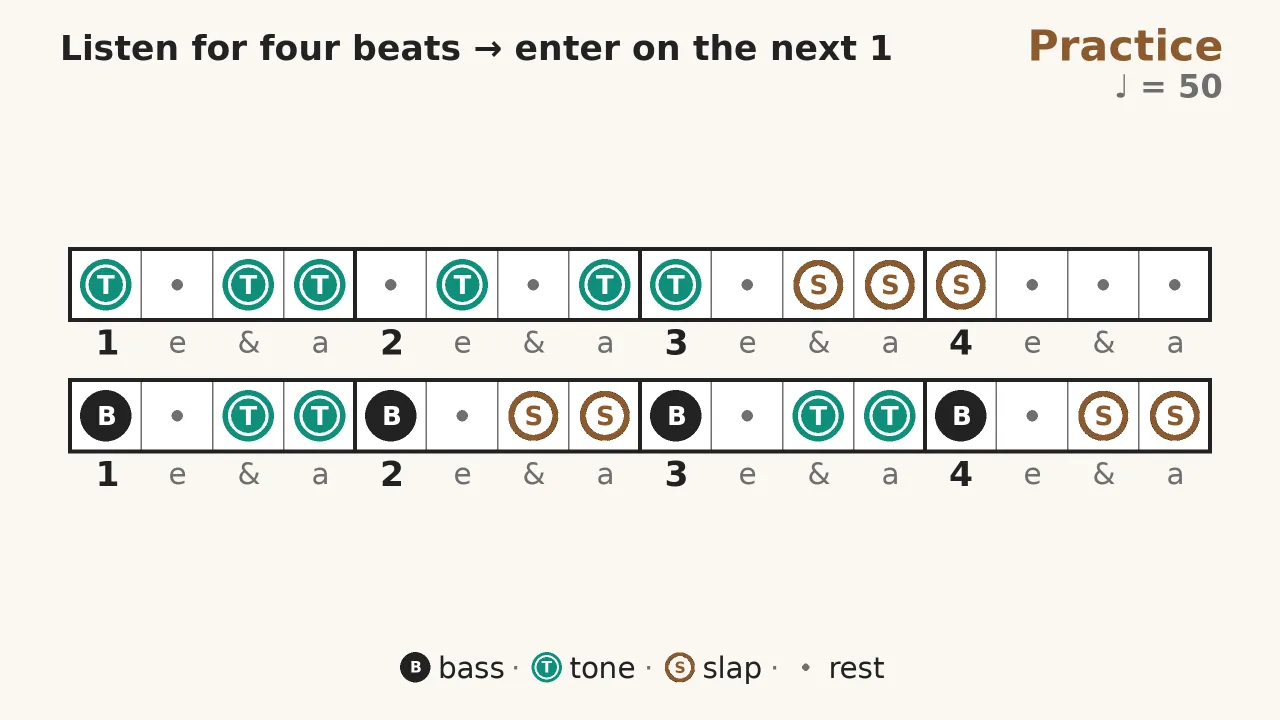
For this exercise we use a call from Leicestershire Music’s Djolé notation, alongside the accompaniment already learned. It is a different teaching source from Lars Pistorius’s videos. Our audio simplifies the source’s opening double tone attack to one tone; the remaining stroke positions and spaces stay intact. Treat it as a timing practice version, not an exact recording of the original call.
Here the cue begins on 1 and occupies four beats. We agree to start the accompaniment on the next 1. Other calls and arrangements may begin elsewhere; listen to the agreed signal rather than assuming every first sound is beat 1.
- Tone
- Rest
- Tone
- Tone
- Rest
- Tone
- Rest
- Tone
- Tone
- Rest
- Slap
- Slap
- Slap
- Rest
- Rest
- Rest
- Bass
- Rest
- Tone
- Tone
- Bass
- Rest
- Slap
- Slap
- Bass
- Rest
- Tone
- Tone
- Bass
- Rest
- Slap
- Slap
Let the final space finish
Near the end, hear three slaps on 3 &, 3 a and 4. The final slap does not release you immediately: keep 4 e & a moving, then place your bass on the next 1. In other words, one complete main-beat interval separates that last slap from your entrance.
Silently rehearse the bass while the call sounds. When you enter, continue the familiar bass–rest–tone–tone and bass–rest–slap–slap units. Do not echo the three slaps or add a fill.
- Rest
- Rest
- Rest
- Rest
- Rest
- Rest
- Rest
- Rest
- Tone
- Rest
- Slap
- Slap
- Slap
- Rest
- Rest
- Rest
- Bass
- Rest
- Tone
- Tone
- Bass
- Rest
- Slap
- Slap
- Bass
- Rest
- Tone
- Tone
- Bass
- Rest
- Slap
- Slap
Hear the signal with less help
The next clip gives four count-in beats, then removes the click. The cue and one cycle of accompaniment still sound at 50 BPM. Keep the same silent count and continue for two more cycles when the reference finishes. Return to the clicked version if you lose the final space.
- Tone
- Rest
- Tone
- Tone
- Rest
- Tone
- Rest
- Tone
- Tone
- Rest
- Slap
- Slap
- Slap
- Rest
- Rest
- Rest
- Bass
- Rest
- Tone
- Tone
- Bass
- Rest
- Slap
- Slap
- Bass
- Rest
- Tone
- Tone
- Bass
- Rest
- Slap
- Slap
Pause by agreement, then resume
Practise a planned stop before trying unpredictable ones. Play two cycles with your own metronome, then stop it. Start the clip below: its first four clicks are your agreed pause, during which you stay silent. The cue follows; resume with the first bass after it and continue for three cycles in total. The clip supplies the first of those cycles.
This is a restart exercise, so starting playback is allowed to reset the preparation. With a partner, make it continuous: agree a one-bar pause while they keep time, then have them give the same practice cue. You return on the following 1.
- Rest
- Rest
- Rest
- Rest
- Rest
- Rest
- Rest
- Rest
- Rest
- Rest
- Rest
- Rest
- Rest
- Rest
- Rest
- Rest
- Tone
- Rest
- Tone
- Tone
- Rest
- Tone
- Rest
- Tone
- Tone
- Rest
- Slap
- Slap
- Slap
- Rest
- Rest
- Rest
- Bass
- Rest
- Tone
- Tone
- Bass
- Rest
- Slap
- Slap
- Bass
- Rest
- Tone
- Tone
- Bass
- Rest
- Slap
- Slap
In the app: a practice. Get the app
Quick check
1 more question in the app Get the app
