Harriet Music Get the Djembe app

Lesson 7 of 8 11 minutes

Play Soli on Djembe With Other Drummers

Harriet In this lesson you will maintain a Soli accompaniment alongside the ensemble while feeling the twelve-subdivision cycle.

  1. 1. Meet Your Djembe
    1. Lesson 1: Meet the Djembe
    2. Lesson 2: Position Your Djembe
    3. Lesson 3: Find Your Playing Posture
    4. Lesson 4: Play Your First Bass
    5. Lesson 5: Find the Open Tone
    6. Lesson 6: Hear Bass and Tone
    7. Lesson 7: Keep a Steady Pulse
  2. 2. Your First Rhythms
    1. Lesson 1: Alternate Your Hands
    2. Lesson 2: Combine Bass and Tone
    3. Lesson 3: Learn the Slap Stroke
    4. Lesson 4: Recognize the Three Strokes
    5. Lesson 5: Read a Rhythm Grid
    6. Lesson 6: Count Beats and Offbeats
    7. Lesson 7: Play Eighth Note Patterns
    8. Lesson 8: Build Your First Phrase
    9. Lesson 9: Repeat Rhythms by Ear
    10. Lesson 10: Shape Your Accents
  3. 3. Play Your First Kuku
    1. Lesson 1: Discover the Kuku Rhythm
    2. Lesson 2: Learn Kuku Accompaniment One
    3. Lesson 3: Keep Your Kuku Pattern
    4. Lesson 4: Learn Kuku Accompaniment Two
    5. Lesson 5: Switch Between Kuku Parts
    6. Lesson 6: Recognize the Kuku Call
    7. Lesson 7: Play Along With Kuku
  4. 4. Playing Together
    1. Lesson 1: Listen and Respond
    2. Lesson 2: Practice Call and Response
    3. Lesson 3: Follow Another Djembe Part
    4. Lesson 4: Feel the Dunun Pulse
    5. Lesson 5: Play Without the Click
    6. Lesson 6: Keep Your Place
  5. 5. Traditional Rhythms
    1. Lesson 1: Discover the Djolé Rhythm
    2. Lesson 2: Learn Djolé Accompaniment
    3. Lesson 3: Follow the Djolé Call
    4. Lesson 4: Play Djolé With Others
    5. Lesson 5: Discover the Sinte Rhythm
    6. Lesson 6: Learn Sinte Accompaniment
    7. Lesson 7: Follow the Sinte Call
    8. Lesson 8: Play Sinte With Others
    9. Lesson 9: Discover the Fanga Rhythm
    10. Lesson 10: Learn Fanga Accompaniment
    11. Lesson 11: Follow the Fanga Call
    12. Lesson 12: Play Fanga With Others
    13. Lesson 13: Recognize Traditional Rhythms
  6. 6. Discover Twelve Eight Rhythms
    1. Lesson 1: Feel Three Subdivisions
    2. Lesson 2: Count in Twelve Eight
    3. Lesson 3: Play Your First Ternary Patterns
    4. Lesson 4: Discover the Soli Rhythm
    5. Lesson 5: Learn Soli Accompaniment
    6. Lesson 6: Follow the Soli Call
    7. Lesson 7: Play Soli With Others
    8. Lesson 8: Feel the Ternary Groove
  7. 7. Breaks Variations and Performance
    1. Lesson 1: Understand Musical Calls
    2. Lesson 2: Play a Simple Break
    3. Lesson 3: Return After a Break
    4. Lesson 4: Create Small Rhythmic Variations
    5. Lesson 5: Control Your Playing Tempo
    6. Lesson 6: Start and Finish Together
    7. Lesson 7: Plan an Ensemble Arrangement
    8. Lesson 8: Lead a Simple Call
    9. Lesson 9: Improvise a Short Solo
    10. Lesson 10: Perform a Complete Rhythm

Keep the spaces while the other drummer moves

A second part can fill places where your hands wait. Your own silence still belongs to the rhythm. Hold the first voice from Learn Soli Accompaniment, keeping three positions in each main beat even when the surrounding sounds change.
First review your part alone. Then hear it against the other djembe voice in the same documented Hallström arrangement.

  1. Slap
  2. Rest
  3. Tone
  4. Slap
  5. Rest
  6. Rest
  7. Slap
  8. Rest
  9. Tone
  10. Slap
  11. Rest
  12. Rest
Your first voice alone at 50 BPM.
Both voices at 50 BPM: yours is clearer in front; the other voice is softer.S - T S - - S - T S - - / B - S - T T S - S B - S
  1. Bass
  2. Rest
  3. Slap
  4. Rest
  5. Tone
  6. Tone
  7. Slap
  8. Rest
  9. Slap
  10. Bass
  11. Rest
  12. Slap
Other voice alone: listen without learning it as a new part.

Use two checkpoints

On each 1, your opening slap meets the other part’s bass. Inside your own part, the tone on a of 1 leads directly into your slap on 2; the same relationship returns on 3 into 4.
Use those checkpoints to hear alignment. When the other voice fills your rests, keep your tone near the following slap instead of moving it halfway between main beats.
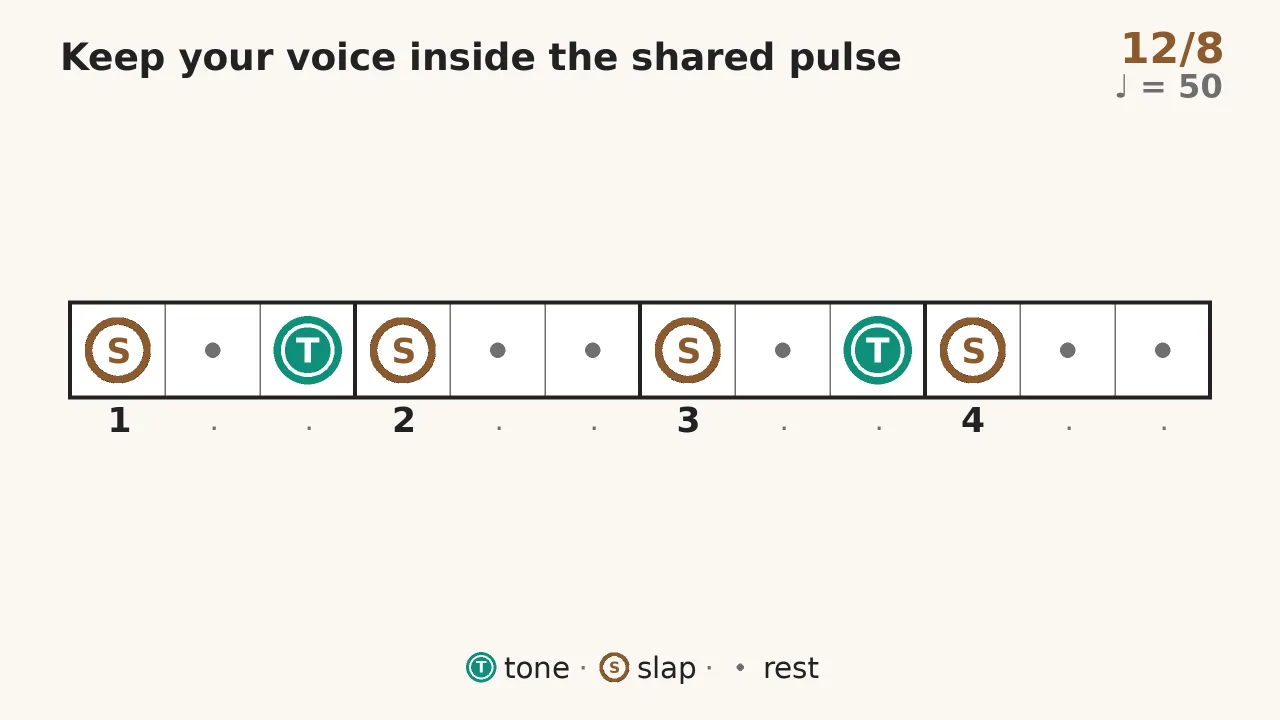
Your first voice keeps its twelve positions. The first slap is the shared cycle beginning; the tones on a lead into the next numbered slaps.

Start together and continue

Return to the single-slap timing adaptation from Follow the Soli Call. Its last tone lands on 4; keep and-a empty, then enter with slap on the next 1.
The next clip supplies the adapted cue and one ensemble cycle. Continue for eight uninterrupted cycles yourself. With a partner, ask them to keep the documented second voice soft enough that you can still hear both parts.

Adapted cue followed by one ensemble cycle, with no count-in.S - T T - T T - T T - - | S - T S - - S - T S - - / - - - - - - - - - - - - | B - S - T T S - S B - S

In the app: a practice. Get the app

Extend only when the spacing holds

The pad score checks timing, while your drum sound needs your own listening. Check that the tones stay on the third subdivision and the spaces after 2 and 4 remain full.
When eight cycles at 50 BPM feel stable, try the optional sixteen-cycle level at 60 BPM with no guide. Keep the same part; this is a continuity task.

In the app: a self-check exercise. Get the app

Quick check

Which shared event helps locate the beginning of our ensemble cycle?
Show the answer

Your opening slap meets the other voice’s bass on 1. The documented first positions give a dependable shared boundary without making the parts identical.

1 more question in the app Get the app

Practise in the free Djembe app