Harriet Music Get the Djembe app

Lesson 4 of 10 9 minutes

How to Create Small Rhythm Variations on the Djembe

Harriet In this lesson you will modify a simple rhythmic phrase while preserving its pulse, length and recognizable structure.

  1. 1. Meet Your Djembe
    1. Lesson 1: Meet the Djembe
    2. Lesson 2: Position Your Djembe
    3. Lesson 3: Find Your Playing Posture
    4. Lesson 4: Play Your First Bass
    5. Lesson 5: Find the Open Tone
    6. Lesson 6: Hear Bass and Tone
    7. Lesson 7: Keep a Steady Pulse
  2. 2. Your First Rhythms
    1. Lesson 1: Alternate Your Hands
    2. Lesson 2: Combine Bass and Tone
    3. Lesson 3: Learn the Slap Stroke
    4. Lesson 4: Recognize the Three Strokes
    5. Lesson 5: Read a Rhythm Grid
    6. Lesson 6: Count Beats and Offbeats
    7. Lesson 7: Play Eighth Note Patterns
    8. Lesson 8: Build Your First Phrase
    9. Lesson 9: Repeat Rhythms by Ear
    10. Lesson 10: Shape Your Accents
  3. 3. Play Your First Kuku
    1. Lesson 1: Discover the Kuku Rhythm
    2. Lesson 2: Learn Kuku Accompaniment One
    3. Lesson 3: Keep Your Kuku Pattern
    4. Lesson 4: Learn Kuku Accompaniment Two
    5. Lesson 5: Switch Between Kuku Parts
    6. Lesson 6: Recognize the Kuku Call
    7. Lesson 7: Play Along With Kuku
  4. 4. Playing Together
    1. Lesson 1: Listen and Respond
    2. Lesson 2: Practice Call and Response
    3. Lesson 3: Follow Another Djembe Part
    4. Lesson 4: Feel the Dunun Pulse
    5. Lesson 5: Play Without the Click
    6. Lesson 6: Keep Your Place
  5. 5. Traditional Rhythms
    1. Lesson 1: Discover the Djolé Rhythm
    2. Lesson 2: Learn Djolé Accompaniment
    3. Lesson 3: Follow the Djolé Call
    4. Lesson 4: Play Djolé With Others
    5. Lesson 5: Discover the Sinte Rhythm
    6. Lesson 6: Learn Sinte Accompaniment
    7. Lesson 7: Follow the Sinte Call
    8. Lesson 8: Play Sinte With Others
    9. Lesson 9: Discover the Fanga Rhythm
    10. Lesson 10: Learn Fanga Accompaniment
    11. Lesson 11: Follow the Fanga Call
    12. Lesson 12: Play Fanga With Others
    13. Lesson 13: Recognize Traditional Rhythms
  6. 6. Discover Twelve Eight Rhythms
    1. Lesson 1: Feel Three Subdivisions
    2. Lesson 2: Count in Twelve Eight
    3. Lesson 3: Play Your First Ternary Patterns
    4. Lesson 4: Discover the Soli Rhythm
    5. Lesson 5: Learn Soli Accompaniment
    6. Lesson 6: Follow the Soli Call
    7. Lesson 7: Play Soli With Others
    8. Lesson 8: Feel the Ternary Groove
  7. 7. Breaks Variations and Performance
    1. Lesson 1: Understand Musical Calls
    2. Lesson 2: Play a Simple Break
    3. Lesson 3: Return After a Break
    4. Lesson 4: Create Small Rhythmic Variations
    5. Lesson 5: Control Your Playing Tempo
    6. Lesson 6: Start and Finish Together
    7. Lesson 7: Plan an Ensemble Arrangement
    8. Lesson 8: Lead a Simple Call
    9. Lesson 9: Improvise a Short Solo
    10. Lesson 10: Perform a Complete Rhythm

One small change can be enough

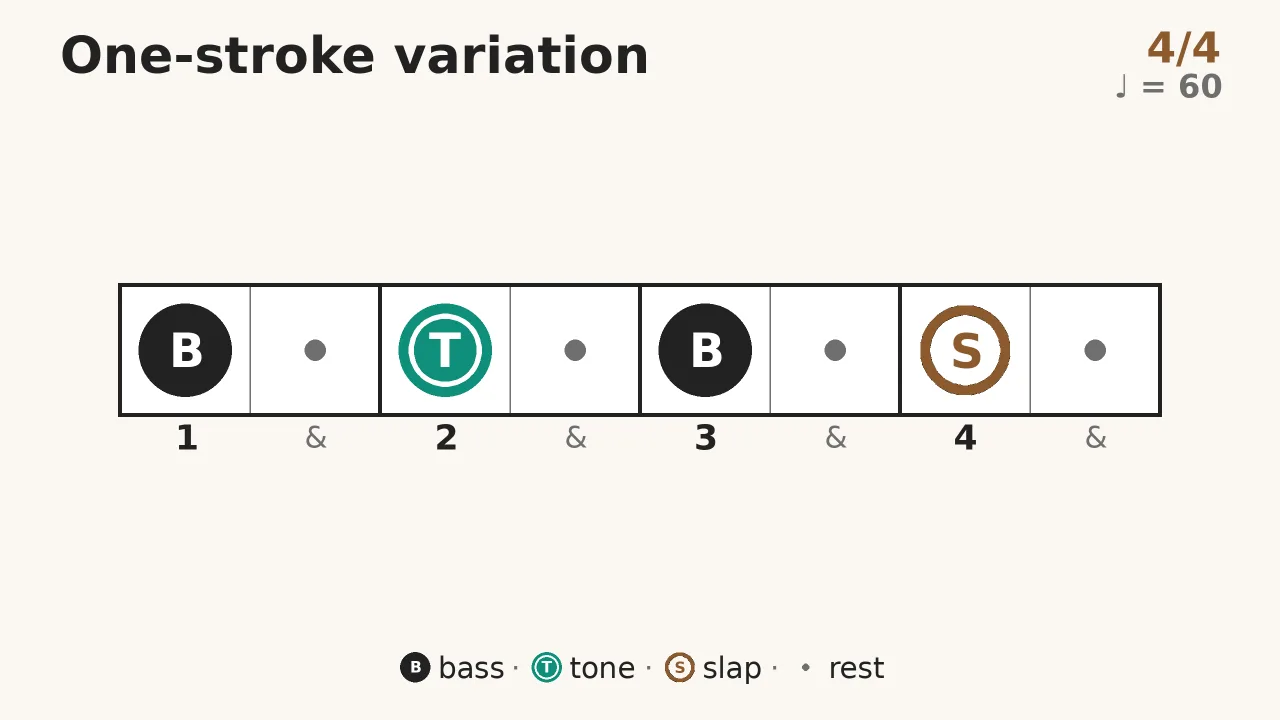
A variation can keep a phrase recognizable while changing its colour. In our neutral practice accompaniment, bass stays on 1 and 3. For one planned cycle, change only the tone on 4 to slap, then return to the original.
This is a practice permission, not an instruction to alter an agreed traditional accompaniment. In a group, make sure the arrangement allows a variation first.

  1. Bass
  2. Rest
  3. Tone
  4. Rest
  5. Bass
  6. Rest
  7. Tone
  8. Rest
Original: bass–tone–bass–tone at 60 BPM.
  1. Bass
  2. Rest
  3. Tone
  4. Rest
  5. Bass
  6. Rest
  7. Slap
  8. Rest
Variation: only beat 4 changes from tone to slap, at the same tempo.

One sound changes; the cycle stays aligned
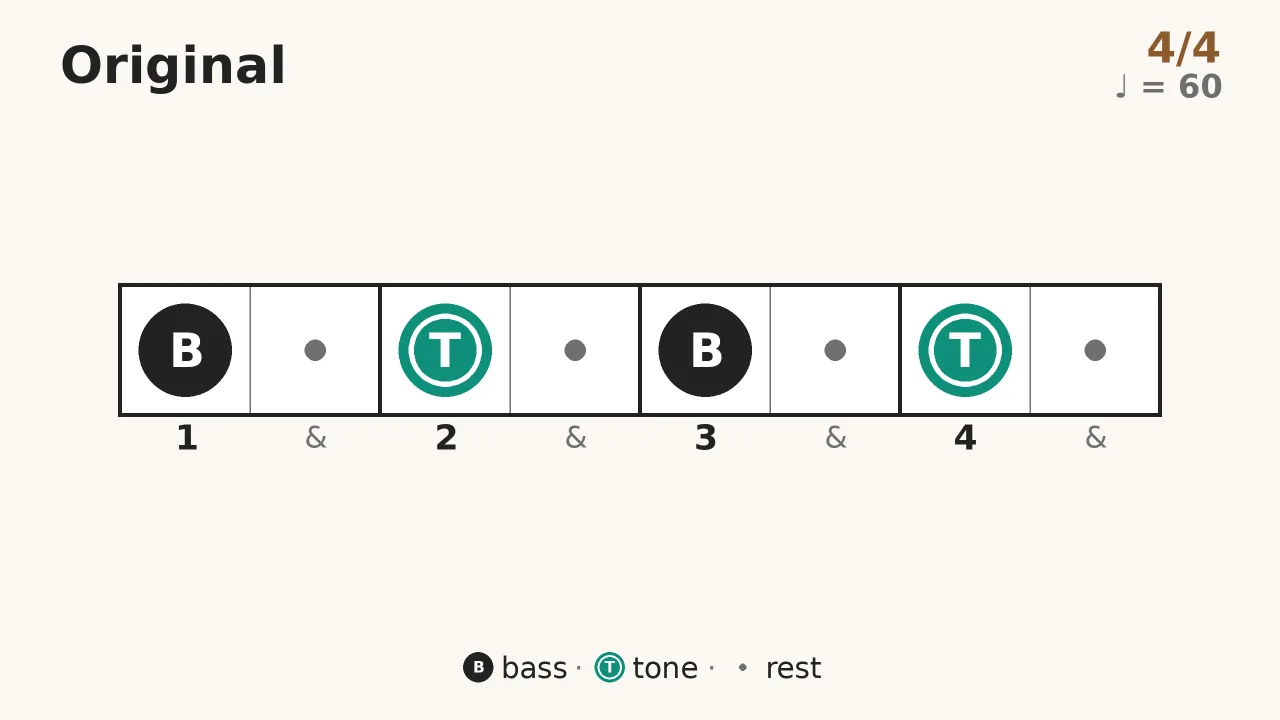
Original: tone on 4.
Before Original: tone on 4.
Variation: slap on 4; every position stays in place.
After Variation: slap on 4; every position stays in place.

Keep the landmarks

The variation has the same four beats and eight positions. Your basses, the tone on 2 and all rests stay unchanged. Use the same hand you would have used on 4, allowing a relaxed change of stroke sound.
Listen for whether the phrase still returns naturally to the opening bass. More force, more notes or a faster final beat are not part of this change.

  1. Bass
  2. Rest
  3. Tone
  4. Rest
  5. Bass
  6. Rest
  7. Tone
  8. Rest
  9. Bass
  10. Rest
  11. Tone
  12. Rest
  13. Bass
  14. Rest
  15. Slap
  16. Rest
  17. Bass
  18. Rest
  19. Tone
  20. Rest
  21. Bass
  22. Rest
  23. Tone
  24. Rest
Original, one variation, then immediate return to original. No count-in.

Quick check

Which result preserves the planned variation?
Show the answer

Change beat 4 to slap while keeping all positions and tempo. Only the selected stroke sound changes; the phrase’s timing and landmarks remain.

1 more question in the app Get the app

Practise in the free Djembe app