Harriet Music Get the Djembe app

Lesson 10 of 10 8 minutes

Djembe Accents: Strong and Soft Strokes in Time

Harriet In this lesson you will play a familiar phrase with contrasting strong and soft strokes without changing tempo.

  1. 1. Meet Your Djembe
    1. Lesson 1: Meet the Djembe
    2. Lesson 2: Position Your Djembe
    3. Lesson 3: Find Your Playing Posture
    4. Lesson 4: Play Your First Bass
    5. Lesson 5: Find the Open Tone
    6. Lesson 6: Hear Bass and Tone
    7. Lesson 7: Keep a Steady Pulse
  2. 2. Your First Rhythms
    1. Lesson 1: Alternate Your Hands
    2. Lesson 2: Combine Bass and Tone
    3. Lesson 3: Learn the Slap Stroke
    4. Lesson 4: Recognize the Three Strokes
    5. Lesson 5: Read a Rhythm Grid
    6. Lesson 6: Count Beats and Offbeats
    7. Lesson 7: Play Eighth Note Patterns
    8. Lesson 8: Build Your First Phrase
    9. Lesson 9: Repeat Rhythms by Ear
    10. Lesson 10: Shape Your Accents
  3. 3. Play Your First Kuku
    1. Lesson 1: Discover the Kuku Rhythm
    2. Lesson 2: Learn Kuku Accompaniment One
    3. Lesson 3: Keep Your Kuku Pattern
    4. Lesson 4: Learn Kuku Accompaniment Two
    5. Lesson 5: Switch Between Kuku Parts
    6. Lesson 6: Recognize the Kuku Call
    7. Lesson 7: Play Along With Kuku
  4. 4. Playing Together
    1. Lesson 1: Listen and Respond
    2. Lesson 2: Practice Call and Response
    3. Lesson 3: Follow Another Djembe Part
    4. Lesson 4: Feel the Dunun Pulse
    5. Lesson 5: Play Without the Click
    6. Lesson 6: Keep Your Place
  5. 5. Traditional Rhythms
    1. Lesson 1: Discover the Djolé Rhythm
    2. Lesson 2: Learn Djolé Accompaniment
    3. Lesson 3: Follow the Djolé Call
    4. Lesson 4: Play Djolé With Others
    5. Lesson 5: Discover the Sinte Rhythm
    6. Lesson 6: Learn Sinte Accompaniment
    7. Lesson 7: Follow the Sinte Call
    8. Lesson 8: Play Sinte With Others
    9. Lesson 9: Discover the Fanga Rhythm
    10. Lesson 10: Learn Fanga Accompaniment
    11. Lesson 11: Follow the Fanga Call
    12. Lesson 12: Play Fanga With Others
    13. Lesson 13: Recognize Traditional Rhythms
  6. 6. Discover Twelve Eight Rhythms
    1. Lesson 1: Feel Three Subdivisions
    2. Lesson 2: Count in Twelve Eight
    3. Lesson 3: Play Your First Ternary Patterns
    4. Lesson 4: Discover the Soli Rhythm
    5. Lesson 5: Learn Soli Accompaniment
    6. Lesson 6: Follow the Soli Call
    7. Lesson 7: Play Soli With Others
    8. Lesson 8: Feel the Ternary Groove
  7. 7. Breaks Variations and Performance
    1. Lesson 1: Understand Musical Calls
    2. Lesson 2: Play a Simple Break
    3. Lesson 3: Return After a Break
    4. Lesson 4: Create Small Rhythmic Variations
    5. Lesson 5: Control Your Playing Tempo
    6. Lesson 6: Start and Finish Together
    7. Lesson 7: Plan an Ensemble Arrangement
    8. Lesson 8: Lead a Simple Call
    9. Lesson 9: Improvise a Short Solo
    10. Lesson 10: Perform a Complete Rhythm

The same notes can speak differently

A phrase can sound different even when every stroke lands in exactly the same place. Bringing one stroke forward and letting the others sit more quietly gives the rhythm a new shape. This change in relative loudness is part of dynamics; the emphasized stroke is an accent.
Use the bass–tone–slap–tone phrase from Build Your First Phrase. An accent is a controlled contrast, not a demand for maximum force. Often you can make one stroke stand out by softening the others.

  1. Bass
  2. Rest
  3. Tone
  4. Rest
  5. Slap
  6. Rest
  7. Tone
  8. Rest
First, the familiar phrase played softly without an added accent. Notice its spacing.
  1. Bass
  2. Rest
  3. Tone
  4. Rest
  5. Slap
  6. Rest
  7. Tone
  8. Rest
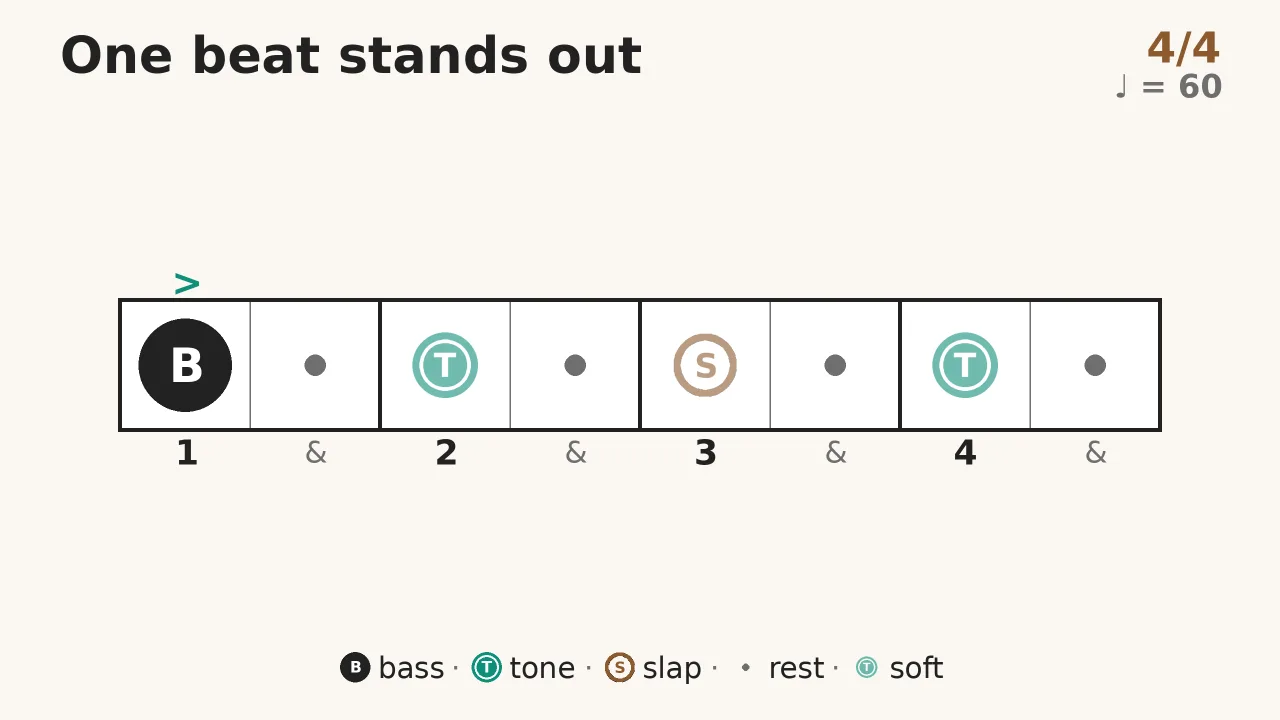
Now the bass on beat 1 stands out. The stroke order, rests and 60 BPM tempo have not changed.
The > mark shows emphasis on beat 1. Lowercase letters mark softer strokes; the & positions remain silent.

Move the emphasis, not the stroke

Play the bass on 1 at a comfortable normal volume and the other three strokes more softly. Keep their contact areas and sound identities: a soft slap is still a slap. The smaller strokes should not become early or disappear.
Next, let the tone on beat 2 stand out and soften the bass, slap and final tone. Nothing moves to another position in time. If louder playing makes you rush, reduce the volume difference and listen to the click again.

  1. Bass
  2. Rest
  3. Tone
  4. Rest
  5. Slap
  6. Rest
  7. Tone
  8. Rest
Emphasis moves to the tone on beat 2. Compare the feel with the beat-1 version while keeping the same count.

Find the emphasis by ear

The next two clips keep the same bass–tone–slap–tone phrase and 60 BPM tempo. Only the emphasis changes.

After four count-in clicks, count 1, 2, 3, 4 from the first bass. Listen before reading the notation and choose which beat stands out.

  1. Bass
  2. Rest
  3. Tone
  4. Rest
  5. Slap
  6. Rest
  7. Tone
  8. Rest
Listening check A: count the four beats and listen for the emphasis.

Quick check

In listening check A, which beat is emphasized?
Show the answer

Beat 3. The slap on beat 3 stands out while the other strokes are softer. The stroke order, spacing and tempo stay the same.

  1. Bass
  2. Rest
  3. Tone
  4. Rest
  5. Slap
  6. Rest
  7. Tone
  8. Rest
Listening check B: count the four beats and listen for the emphasis.

Quick check

In listening check B, which beat is emphasized?
Show the answer

Beat 4. The final tone, on beat 4, stands out while the other strokes are softer. The stroke order, spacing and tempo stay the same.

Quick check

You move the accent from beat 1 to beat 2. What changes in this exercise?
Show the answer

Which stroke stands out in volume. Only the relative emphasis changes; all stroke positions and rests remain the same.

1 more question in the app Get the app

Practise in the free Djembe app