Give the group a clear next step
A useful call makes the destination predictable. You will lead the K phrase already selected in Plan an Ensemble Arrangement, rather than adding another traditional signal. Its clarity comes from placement and complete timing, not extra force.
Agree on the response before playing. For the entrance exercise: after four count-in beats, you play K alone for one cycle; the group starts A on the next 1 and you join them.
- Bass
- Rest
- Tone
- Tone
- Rest
- Slap
- Rest
- Rest
- Bass
- Rest
- Tone
- Rest
- Bass
- Rest
- Tone
- Rest
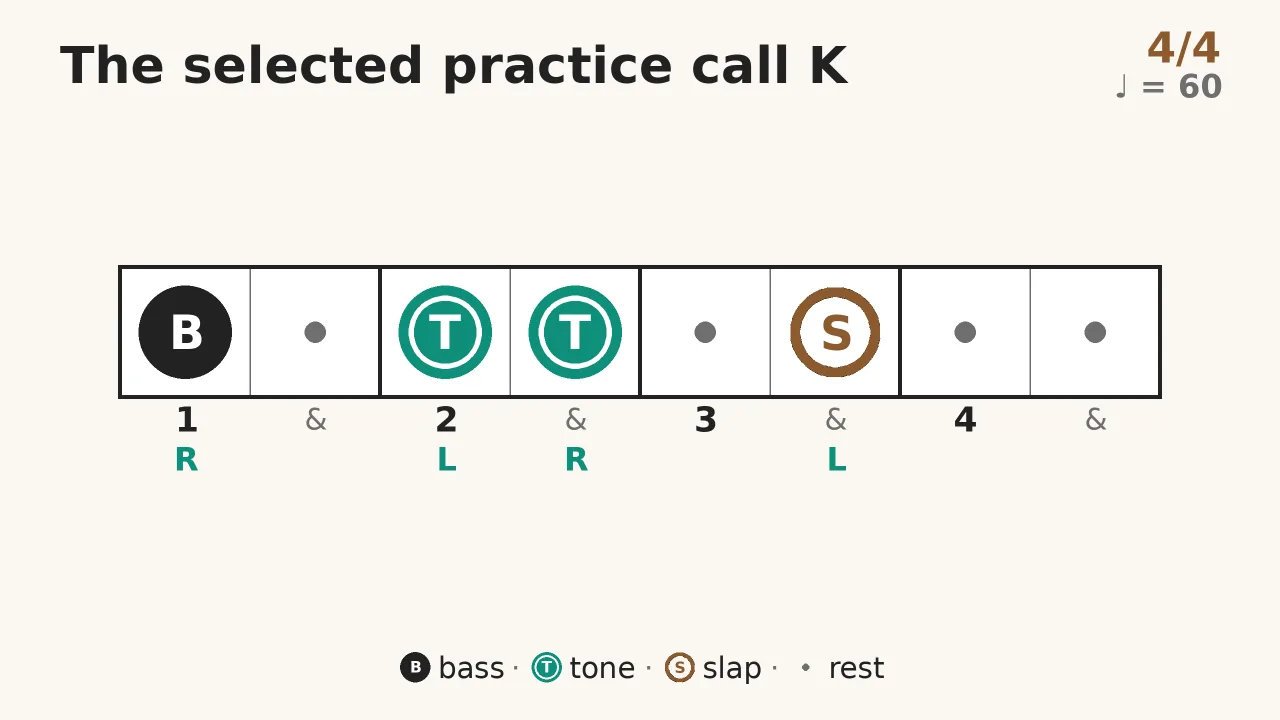
Count through your last silence
Use the same R–L–R–L suggestion as Play a Simple Break. Count 1-and, 2-and, 3-and, 4-and throughout. After your last slap, keep counting 4-and and be ready to play the opening bass with the group.
Make sure your partner is ready and can see you before the count. Settle the pulse first, then give the whole phrase. A clear relaxed stroke is easier to repeat than a forced loud one.
- Rest
- Rest
- Rest
- Rest
- Rest
- Rest
- Rest
- Rest
- Bass
- Rest
- Tone
- Rest
- Bass
- Rest
- Tone
- Rest
Use the planned transition
In the eight-cycle map, give K instead of A in cycle 2. Your partner keeps A during your call. Both play K in cycle 3, then return to A in 4. Your call changes the next cycle, not the one already under way.
Later, K in cycle 6 announces shared K in 7 and the final bass in 8. Confirm that destination beforehand. The same notes can serve different jobs because the arrangement specifies the response.
In the app: a self-check exercise. Get the app
Quick check
1 more question in the app Get the app
