Harriet Music Get the Djembe app

Lesson 1 of 13 8 minutes

Djolé Rhythm on Djembe: Hear the Groove

Harriet In this lesson you will recognize Djolé by ear and identify its repeating pulse and main rhythmic accents.

  1. 1. Meet Your Djembe
    1. Lesson 1: Meet the Djembe
    2. Lesson 2: Position Your Djembe
    3. Lesson 3: Find Your Playing Posture
    4. Lesson 4: Play Your First Bass
    5. Lesson 5: Find the Open Tone
    6. Lesson 6: Hear Bass and Tone
    7. Lesson 7: Keep a Steady Pulse
  2. 2. Your First Rhythms
    1. Lesson 1: Alternate Your Hands
    2. Lesson 2: Combine Bass and Tone
    3. Lesson 3: Learn the Slap Stroke
    4. Lesson 4: Recognize the Three Strokes
    5. Lesson 5: Read a Rhythm Grid
    6. Lesson 6: Count Beats and Offbeats
    7. Lesson 7: Play Eighth Note Patterns
    8. Lesson 8: Build Your First Phrase
    9. Lesson 9: Repeat Rhythms by Ear
    10. Lesson 10: Shape Your Accents
  3. 3. Play Your First Kuku
    1. Lesson 1: Discover the Kuku Rhythm
    2. Lesson 2: Learn Kuku Accompaniment One
    3. Lesson 3: Keep Your Kuku Pattern
    4. Lesson 4: Learn Kuku Accompaniment Two
    5. Lesson 5: Switch Between Kuku Parts
    6. Lesson 6: Recognize the Kuku Call
    7. Lesson 7: Play Along With Kuku
  4. 4. Playing Together
    1. Lesson 1: Listen and Respond
    2. Lesson 2: Practice Call and Response
    3. Lesson 3: Follow Another Djembe Part
    4. Lesson 4: Feel the Dunun Pulse
    5. Lesson 5: Play Without the Click
    6. Lesson 6: Keep Your Place
  5. 5. Traditional Rhythms
    1. Lesson 1: Discover the Djolé Rhythm
    2. Lesson 2: Learn Djolé Accompaniment
    3. Lesson 3: Follow the Djolé Call
    4. Lesson 4: Play Djolé With Others
    5. Lesson 5: Discover the Sinte Rhythm
    6. Lesson 6: Learn Sinte Accompaniment
    7. Lesson 7: Follow the Sinte Call
    8. Lesson 8: Play Sinte With Others
    9. Lesson 9: Discover the Fanga Rhythm
    10. Lesson 10: Learn Fanga Accompaniment
    11. Lesson 11: Follow the Fanga Call
    12. Lesson 12: Play Fanga With Others
    13. Lesson 13: Recognize Traditional Rhythms
  6. 6. Discover Twelve Eight Rhythms
    1. Lesson 1: Feel Three Subdivisions
    2. Lesson 2: Count in Twelve Eight
    3. Lesson 3: Play Your First Ternary Patterns
    4. Lesson 4: Discover the Soli Rhythm
    5. Lesson 5: Learn Soli Accompaniment
    6. Lesson 6: Follow the Soli Call
    7. Lesson 7: Play Soli With Others
    8. Lesson 8: Feel the Ternary Groove
  7. 7. Breaks Variations and Performance
    1. Lesson 1: Understand Musical Calls
    2. Lesson 2: Play a Simple Break
    3. Lesson 3: Return After a Break
    4. Lesson 4: Create Small Rhythmic Variations
    5. Lesson 5: Control Your Playing Tempo
    6. Lesson 6: Start and Finish Together
    7. Lesson 7: Plan an Ensemble Arrangement
    8. Lesson 8: Lead a Simple Call
    9. Lesson 9: Improvise a Short Solo
    10. Lesson 10: Perform a Complete Rhythm

A familiar pulse, a different conversation

A new rhythm can feel unfamiliar even when its underlying pulse is steady. The change comes from the sounds placed around that pulse: low anchors, bright replies and spaces that return in a recognizable order.
Djolé is associated with the Guinea–Sierra Leone border region and a masked-dance tradition originally accompanied by square siko drums. The djembe arrangements heard today reflect a later setting for that music. Here we will follow one contemporary teaching arrangement by Lars and Joshua Pistorius, keeping the same version for the next four lessons.

Start with the beat you already know

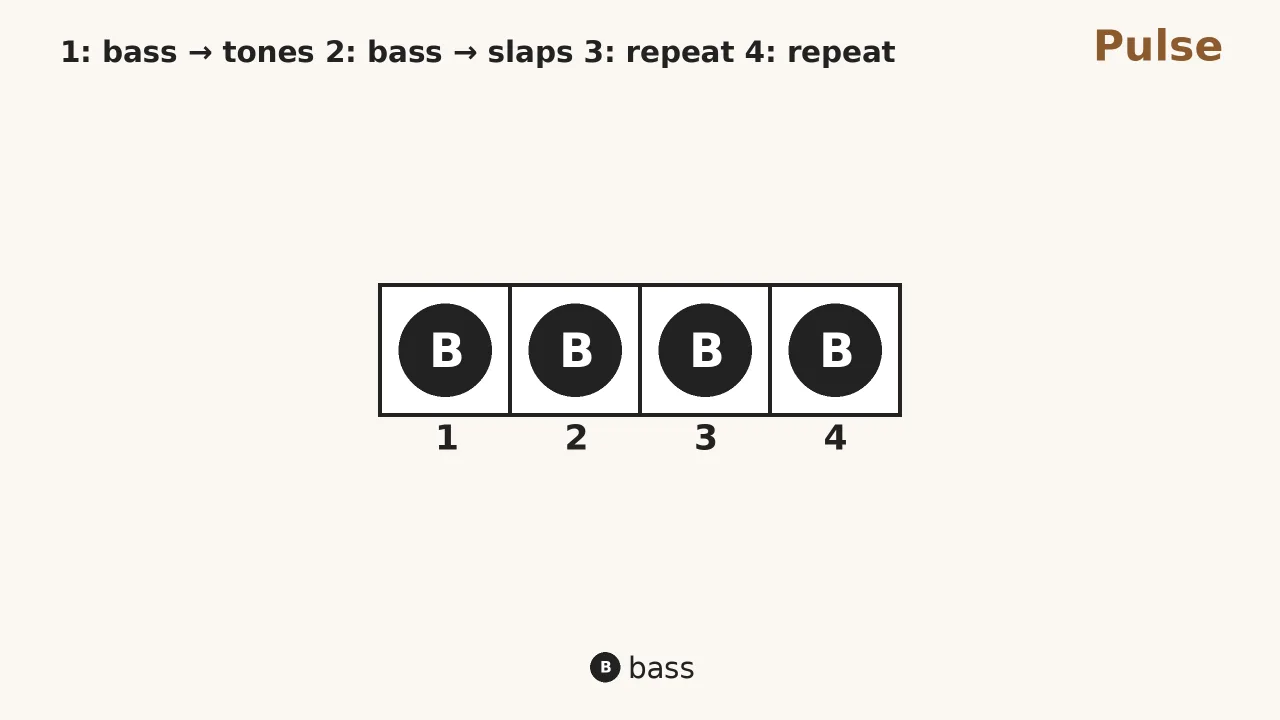
Tap four evenly spaced beats without trying to copy every drum sound. The short reference below establishes that steady motion. It is a pulse aid, not the Djolé accompaniment.
In the recording, let your tapping follow the performers rather than leaving a separate metronome running. For now, the quicker notes are sounds to recognize; the next lesson takes the accompaniment apart.

  1. Bass
  2. Bass
  3. Bass
  4. Bass
Four bass beats at 60 BPM: a pulse reference only. Tap once with each sound.

For our first listen, Lars and Joshua Pistorius’s seaside performance places two djembe parts together. Notice how a recurring low sound supports brighter groups above it. Around 1:10, the displayed first-part notation gives a useful listening landmark: paired tones alternate with paired slaps.

Play the video

The video plays from YouTube and belongs to its author.

Hear what returns

Focus on that first part rather than the busier second voice. Its basses provide regular anchors. After one bass comes a pair of tones; after the next comes a pair of slaps. The same contrast returns. Hear the sharper slap pair as a recognizable feature, not as an instruction to hit harder.
This differs from our first Kuku unit, which had a tone pair followed later by one slap. These are clues to the two examples we are studying, not a rule that every performance of either rhythm must use those exact notes.
A listening map of the first Djolé voice: bass on each numbered beat. After beats 1 and 3, hear the tone pair; after beats 2 and 4, hear the slap pair. The diagram shows the main-beat anchors only, not all the notes.
  1. Bass
  2. Rest
  3. Tone
  4. Tone
  5. Bass
  6. Rest
  7. Slap
  8. Slap
  9. Bass
  10. Rest
  11. Tone
  12. Tone
  13. Bass
  14. Rest
  15. Slap
  16. Slap
Isolated Djolé listening reference at 60 BPM, repeated twice. Keep four main beats; let the quicker tone and slap pairs pass between them.

Recognize the example without its name

Listen to A and B below before answering the first question. One is the familiar Kuku unit; the other is the Djolé voice just introduced. Identify the repeating sound shape rather than the speed or recording quality.

  1. Bass
  2. Rest
  3. Tone
  4. Tone
  5. Rest
  6. Rest
  7. Slap
  8. Rest
Example A: listen for the space and the single slap.
  1. Bass
  2. Rest
  3. Tone
  4. Tone
  5. Bass
  6. Rest
  7. Slap
  8. Slap
  9. Bass
  10. Rest
  11. Tone
  12. Tone
  13. Bass
  14. Rest
  15. Slap
  16. Slap
Example B: listen for the alternating pairs.

Quick check

Which example matches the Djolé accompaniment introduced here, and why?
Show the answer

B, because recurring basses lead to alternating pairs of tones and slaps.. B repeats the documented Djolé first voice. A is the opening Kuku unit already learned. Speed alone does not identify a rhythm.

1 more question in the app Get the app

Practise in the free Djembe app