Keep three spaces inside the signal
A busy call can make the larger beat feel less obvious. Keep your 1-and-a grouping underneath it so that your entrance arrives calmly. Your response is the first voice from Learn Soli Accompaniment, beginning with slap.
For this rehearsal, listen through one complete four-beat signal and start on the next 1. First hear the cue followed by both documented djembe parts.
The source and the final space
This is the signal listed with Lennart Hallström’s Soli arrangement. Its written opening uses a slap flam. Our practice audio replaces that opening with one slap, keeping all remaining note positions unchanged. It is a timing adaptation; you do not need to play the call or learn a flam here.
The call’s last tone is on 4. Keep and-a silent after it, then enter with your slap on the next 1. Do not mistake the last call tone for your first accompaniment stroke.
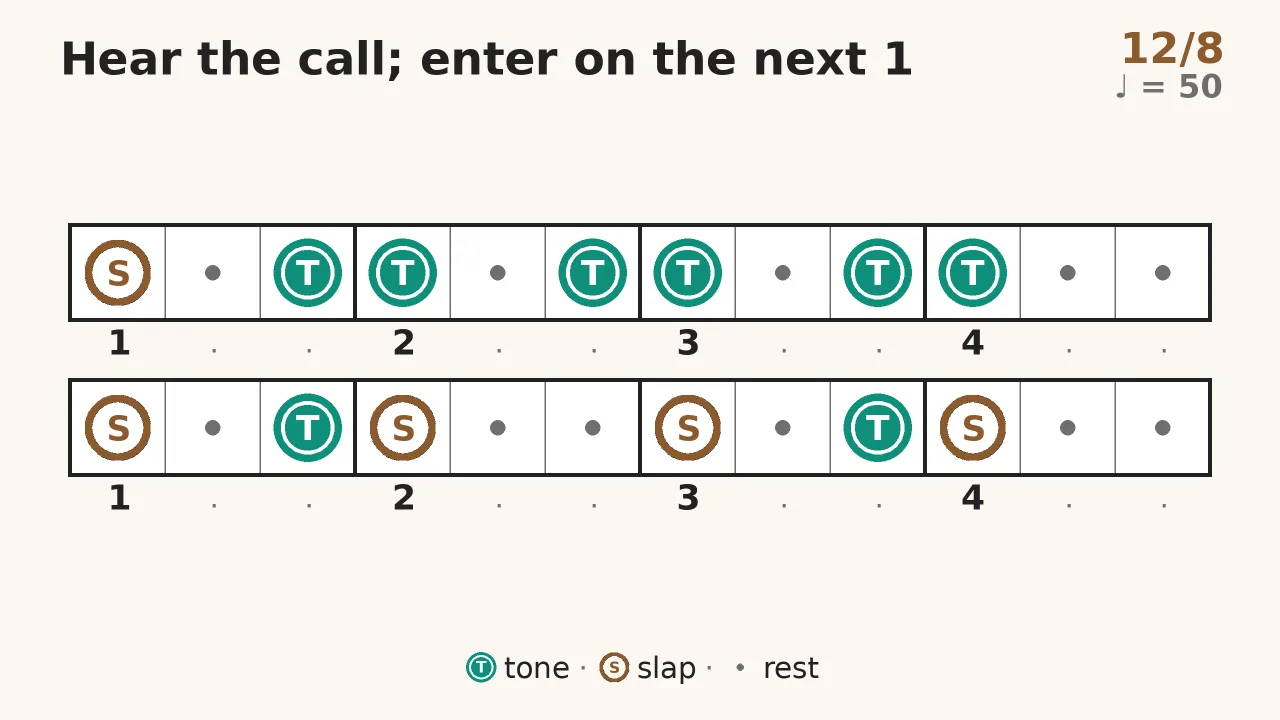
- Slap
- Rest
- Tone
- Tone
- Rest
- Tone
- Tone
- Rest
- Tone
- Tone
- Rest
- Rest
- Rest
- Rest
- Rest
- Rest
- Rest
- Rest
- Tone
- Rest
- Tone
- Tone
- Rest
- Rest
- Slap
- Rest
- Tone
- Slap
- Rest
- Rest
- Slap
- Rest
- Tone
- Slap
- Rest
- Rest
Enter with the known part
Replay the full context clip and join on the accompaniment’s first slap. Continue for four complete cycles yourself; the clip provides only the first one. Keep the tone on a of 1 and 3 and the spaces after 2 and 4.
When the entry works with the click, try the unchanged cue below without it. Hear the phrase itself rather than estimating how long a recording has been running.
- Slap
- Rest
- Tone
- Tone
- Rest
- Tone
- Tone
- Rest
- Tone
- Tone
- Rest
- Rest
- Slap
- Rest
- Tone
- Slap
- Rest
- Rest
- Slap
- Rest
- Tone
- Slap
- Rest
- Rest
In the app: a practice. Get the app
Quick check
1 more question in the app Get the app