Harriet Music Get the Djembe app

Lesson 4 of 8 8 minutes

Soli Rhythm on Djembe: A 12/8 Groove

Harriet In this lesson you will recognize a ternary Soli arrangement and identify its repeating cycle and main accents.

  1. 1. Meet Your Djembe
    1. Lesson 1: Meet the Djembe
    2. Lesson 2: Position Your Djembe
    3. Lesson 3: Find Your Playing Posture
    4. Lesson 4: Play Your First Bass
    5. Lesson 5: Find the Open Tone
    6. Lesson 6: Hear Bass and Tone
    7. Lesson 7: Keep a Steady Pulse
  2. 2. Your First Rhythms
    1. Lesson 1: Alternate Your Hands
    2. Lesson 2: Combine Bass and Tone
    3. Lesson 3: Learn the Slap Stroke
    4. Lesson 4: Recognize the Three Strokes
    5. Lesson 5: Read a Rhythm Grid
    6. Lesson 6: Count Beats and Offbeats
    7. Lesson 7: Play Eighth Note Patterns
    8. Lesson 8: Build Your First Phrase
    9. Lesson 9: Repeat Rhythms by Ear
    10. Lesson 10: Shape Your Accents
  3. 3. Play Your First Kuku
    1. Lesson 1: Discover the Kuku Rhythm
    2. Lesson 2: Learn Kuku Accompaniment One
    3. Lesson 3: Keep Your Kuku Pattern
    4. Lesson 4: Learn Kuku Accompaniment Two
    5. Lesson 5: Switch Between Kuku Parts
    6. Lesson 6: Recognize the Kuku Call
    7. Lesson 7: Play Along With Kuku
  4. 4. Playing Together
    1. Lesson 1: Listen and Respond
    2. Lesson 2: Practice Call and Response
    3. Lesson 3: Follow Another Djembe Part
    4. Lesson 4: Feel the Dunun Pulse
    5. Lesson 5: Play Without the Click
    6. Lesson 6: Keep Your Place
  5. 5. Traditional Rhythms
    1. Lesson 1: Discover the Djolé Rhythm
    2. Lesson 2: Learn Djolé Accompaniment
    3. Lesson 3: Follow the Djolé Call
    4. Lesson 4: Play Djolé With Others
    5. Lesson 5: Discover the Sinte Rhythm
    6. Lesson 6: Learn Sinte Accompaniment
    7. Lesson 7: Follow the Sinte Call
    8. Lesson 8: Play Sinte With Others
    9. Lesson 9: Discover the Fanga Rhythm
    10. Lesson 10: Learn Fanga Accompaniment
    11. Lesson 11: Follow the Fanga Call
    12. Lesson 12: Play Fanga With Others
    13. Lesson 13: Recognize Traditional Rhythms
  6. 6. Discover Twelve Eight Rhythms
    1. Lesson 1: Feel Three Subdivisions
    2. Lesson 2: Count in Twelve Eight
    3. Lesson 3: Play Your First Ternary Patterns
    4. Lesson 4: Discover the Soli Rhythm
    5. Lesson 5: Learn Soli Accompaniment
    6. Lesson 6: Follow the Soli Call
    7. Lesson 7: Play Soli With Others
    8. Lesson 8: Feel the Ternary Groove
  7. 7. Breaks Variations and Performance
    1. Lesson 1: Understand Musical Calls
    2. Lesson 2: Play a Simple Break
    3. Lesson 3: Return After a Break
    4. Lesson 4: Create Small Rhythmic Variations
    5. Lesson 5: Control Your Playing Tempo
    6. Lesson 6: Start and Finish Together
    7. Lesson 7: Plan an Ensemble Arrangement
    8. Lesson 8: Lead a Simple Call
    9. Lesson 9: Improvise a Short Solo
    10. Lesson 10: Perform a Complete Rhythm

A rhythm with a particular setting

Soli belongs to Malinké musical traditions in Guinea and is associated with initiation ceremonies. Tam Tam Mandingue Djembe Academy describes Soli Rapide in that setting; Leicestershire Music’s teaching notes also connect Soli with the passage into adulthood. Its context deserves more care than treating it as a generic party beat.
You have already practiced four main beats containing three positions each. Now listen for that larger pulse within a named rhythm.

Tam Tam Mandingue Djembe Academy’s short Djembe Soli Rapide performance introduces the sound. Listen once as a whole, then replay while looking for a comfortable larger beat rather than tapping every quick stroke. Our slow written study version follows below.

Play the video

The video plays from YouTube and belongs to its author.

One documented version to follow

Our practical reference is Lennart Hallström’s Soli notation on Djembe.net, linked there to an African Drum Rhythms practice recording. We will keep its first djembe voice for the next lessons. It is a specific study arrangement; the academy performance is broader listening context, not a claim that every part matches note for note.
First hear two documented djembe parts together at a slow practice tempo. Let the repeating shape settle before following individual strokes.

The documented study arrangement: first djembe louder, another listed djembe voice softer, one cycle at 60 BPM.S - T S - - S - T S - - / B - S - T T S - S B - S

Follow the larger circle

Count 1-and-a through 4-and-a. The first voice has a repeating two-beat shape, heard twice across our four-beat cycle. Its bright slap landmarks fall on 1 and 2, then 3 and 4; those on 2 and 4 are followed by two silent positions.
The pulse map below marks only the four main beats. It is not the complete accompaniment. Detailed strokes come in Learn Soli Accompaniment.
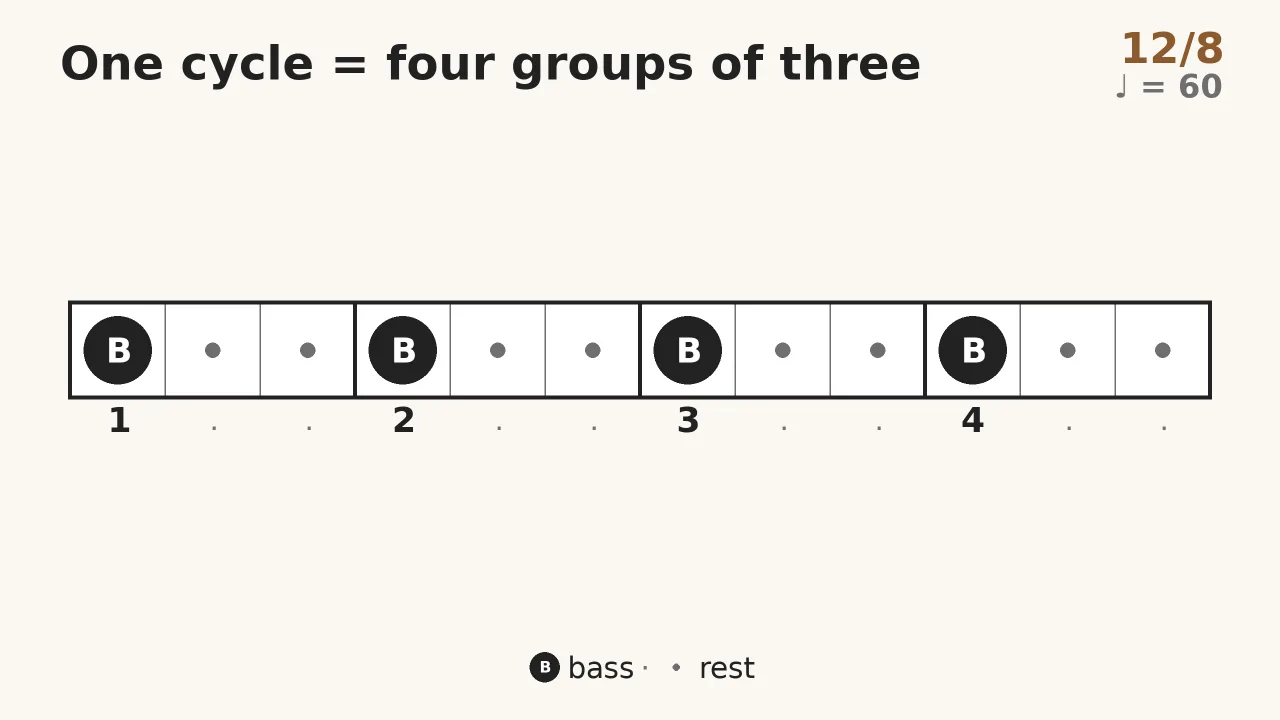
Pulse guide only: four main beats, each followed by two subdivision positions. Return from 4-and-a directly to 1.
  1. Slap
  2. Rest
  3. Tone
  4. Slap
  5. Rest
  6. Rest
  7. Slap
  8. Rest
  9. Tone
  10. Slap
  11. Rest
  12. Rest
The selected first voice alone, once at 60 BPM. Hear the two-beat shape repeat.

Quick check

In the selected study voice, how does the short shape relate to our four-beat cycle?
Show the answer

A two-beat shape repeats twice. The first voice repeats its two-beat shape across beats 1–2 and 3–4.

1 more question in the app Get the app

Practise in the free Djembe app