Keep the part that supports the music
A welcome song can change its phrases while a drum part continues underneath. The same listening skill applies when another drum has a busier or more regular pattern: hear it while keeping your own spaces.
Bring the part from Learn Fanga Accompaniment and the two-cycle cue from Follow the Fanga Call. Our practice uses the same R Clark arrangement throughout.
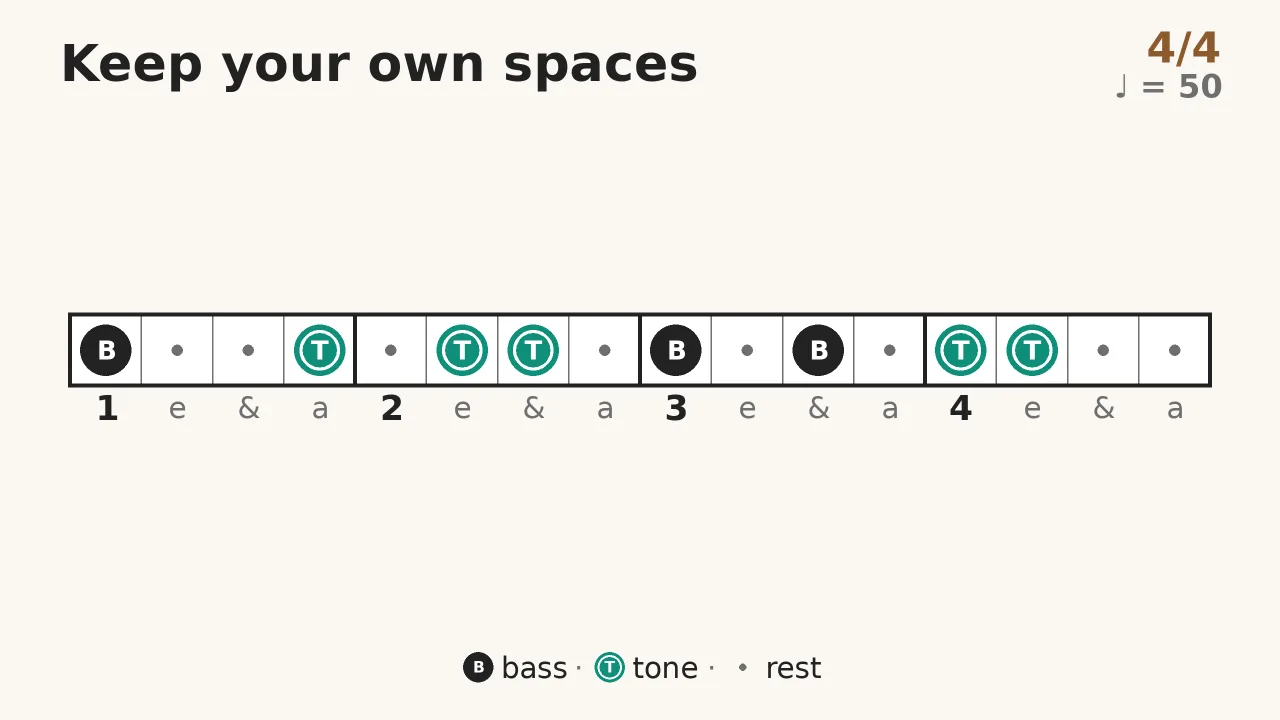
- Bass
- Rest
- Rest
- Tone
- Rest
- Tone
- Tone
- Rest
- Bass
- Rest
- Bass
- Rest
- Tone
- Tone
- Rest
- Rest
- Tone
- Tone
- Rest
- Rest
- Tone
- Tone
- Rest
- Rest
- Tone
- Tone
- Rest
- Rest
- Tone
- Tone
- Rest
- Rest
Meet at the cycle boundary
Your bass on 1 lines up with the first tone of the other voice. Later, you leave 2 empty while that voice plays a tone there. Keep your own tones on e and & of 2; do not slide them onto its beat.
The shared beginning is a useful checkpoint. You can hear a stroke in another part without treating it as one you must play.
Start from the agreed signal
The complete two-row cue ends with tones on 4 and e. Keep & a empty, then begin your bass on the next 1. The clip supplies one ensemble cycle after the cue; continue for eight cycles yourself.
If you miss the entrance, leave your hands quiet, keep counting and locate the next clear cycle beginning. Rejoin with the opening bass; do not squeeze in the notes you missed.
In the app: a practice. Get the app
Judge the drum sound too
The pad exercise scores timing; it does not hear bass or tone quality on your instrument. Check that both sounds remain distinct, the hands feel relaxed, and your rests keep their length. Record a short take or ask a partner to listen.
When eight cycles at 50 BPM are comfortable, the optional final level extends to sixteen cycles at 60 BPM, without a guide.
In the app: a self-check exercise. Get the app
Quick check
1 more question in the app Get the app