Harriet Music Get the Djembe app

Lesson 1 of 10 8 minutes

Djembe Calls Explained: Signals in Group Drumming

Harriet In this lesson you will recognize how calls signal entrances, transitions and changes during group drumming.

  1. 1. Meet Your Djembe
    1. Lesson 1: Meet the Djembe
    2. Lesson 2: Position Your Djembe
    3. Lesson 3: Find Your Playing Posture
    4. Lesson 4: Play Your First Bass
    5. Lesson 5: Find the Open Tone
    6. Lesson 6: Hear Bass and Tone
    7. Lesson 7: Keep a Steady Pulse
  2. 2. Your First Rhythms
    1. Lesson 1: Alternate Your Hands
    2. Lesson 2: Combine Bass and Tone
    3. Lesson 3: Learn the Slap Stroke
    4. Lesson 4: Recognize the Three Strokes
    5. Lesson 5: Read a Rhythm Grid
    6. Lesson 6: Count Beats and Offbeats
    7. Lesson 7: Play Eighth Note Patterns
    8. Lesson 8: Build Your First Phrase
    9. Lesson 9: Repeat Rhythms by Ear
    10. Lesson 10: Shape Your Accents
  3. 3. Play Your First Kuku
    1. Lesson 1: Discover the Kuku Rhythm
    2. Lesson 2: Learn Kuku Accompaniment One
    3. Lesson 3: Keep Your Kuku Pattern
    4. Lesson 4: Learn Kuku Accompaniment Two
    5. Lesson 5: Switch Between Kuku Parts
    6. Lesson 6: Recognize the Kuku Call
    7. Lesson 7: Play Along With Kuku
  4. 4. Playing Together
    1. Lesson 1: Listen and Respond
    2. Lesson 2: Practice Call and Response
    3. Lesson 3: Follow Another Djembe Part
    4. Lesson 4: Feel the Dunun Pulse
    5. Lesson 5: Play Without the Click
    6. Lesson 6: Keep Your Place
  5. 5. Traditional Rhythms
    1. Lesson 1: Discover the Djolé Rhythm
    2. Lesson 2: Learn Djolé Accompaniment
    3. Lesson 3: Follow the Djolé Call
    4. Lesson 4: Play Djolé With Others
    5. Lesson 5: Discover the Sinte Rhythm
    6. Lesson 6: Learn Sinte Accompaniment
    7. Lesson 7: Follow the Sinte Call
    8. Lesson 8: Play Sinte With Others
    9. Lesson 9: Discover the Fanga Rhythm
    10. Lesson 10: Learn Fanga Accompaniment
    11. Lesson 11: Follow the Fanga Call
    12. Lesson 12: Play Fanga With Others
    13. Lesson 13: Recognize Traditional Rhythms
  6. 6. Discover Twelve Eight Rhythms
    1. Lesson 1: Feel Three Subdivisions
    2. Lesson 2: Count in Twelve Eight
    3. Lesson 3: Play Your First Ternary Patterns
    4. Lesson 4: Discover the Soli Rhythm
    5. Lesson 5: Learn Soli Accompaniment
    6. Lesson 6: Follow the Soli Call
    7. Lesson 7: Play Soli With Others
    8. Lesson 8: Feel the Ternary Groove
  7. 7. Breaks Variations and Performance
    1. Lesson 1: Understand Musical Calls
    2. Lesson 2: Play a Simple Break
    3. Lesson 3: Return After a Break
    4. Lesson 4: Create Small Rhythmic Variations
    5. Lesson 5: Control Your Playing Tempo
    6. Lesson 6: Start and Finish Together
    7. Lesson 7: Plan an Ensemble Arrangement
    8. Lesson 8: Lead a Simple Call
    9. Lesson 9: Improvise a Short Solo
    10. Lesson 10: Perform a Complete Rhythm

A signal has a job

You have already followed entrance cues in Kuku, Djolé, Sinte and Soli. A group can also agree on signals for a transition or an ending. Hearing the notes is only half the task: you need to know what response the arrangement expects, and when.
Keep the familiar Djolé first part ready for the examples below. The cue is the single-tone timing adaptation from Follow the Djolé Call.

  1. Tone
  2. Rest
  3. Tone
  4. Tone
  5. Rest
  6. Tone
  7. Rest
  8. Tone
  9. Tone
  10. Rest
  11. Slap
  12. Slap
  13. Slap
  14. Rest
  15. Rest
  16. Rest
  17. Bass
  18. Rest
  19. Tone
  20. Tone
  21. Bass
  22. Rest
  23. Slap
  24. Slap
  25. Bass
  26. Rest
  27. Tone
  28. Tone
  29. Bass
  30. Rest
  31. Slap
  32. Slap
Entrance example: the known adapted Djolé cue, then the familiar first part. No count-in.

Agree before playing

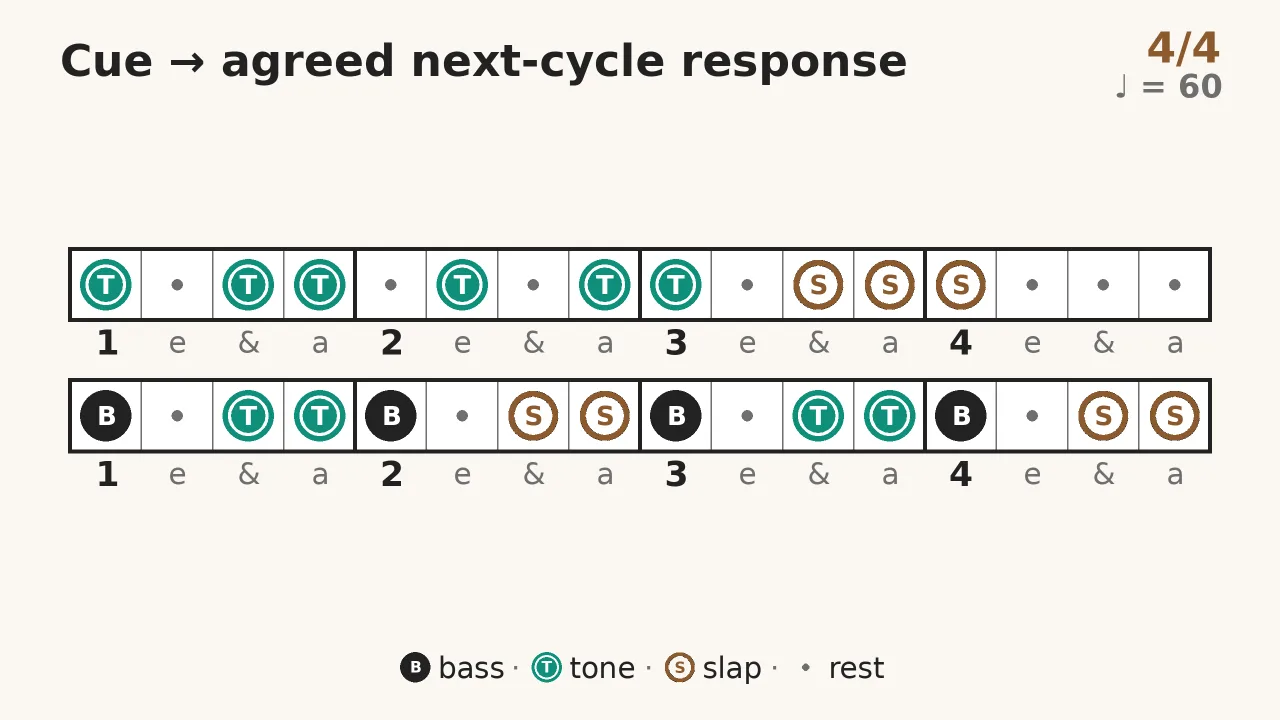
In that example, the agreement is listen through the cue, then enter on the next 1. Its final slaps occupy & of 3, a of 3 and 4. The empty e & a finish beat 4 before your opening bass.
For the next example only, agree that the same cue means finish this cue cycle, then stop. This illustrates how an ending can be organized in rehearsal; it is not a claim that this is the traditional Djolé ending.

  1. Bass
  2. Rest
  3. Tone
  4. Tone
  5. Bass
  6. Rest
  7. Slap
  8. Slap
  9. Bass
  10. Rest
  11. Tone
  12. Tone
  13. Bass
  14. Rest
  15. Slap
  16. Slap
  17. Tone
  18. Rest
  19. Tone
  20. Tone
  21. Rest
  22. Tone
  23. Rest
  24. Tone
  25. Tone
  26. Rest
  27. Slap
  28. Slap
  29. Slap
  30. Rest
  31. Rest
  32. Rest
  33. Rest
  34. Rest
  35. Rest
  36. Rest
  37. Rest
  38. Rest
  39. Rest
  40. Rest
  41. Rest
  42. Rest
  43. Rest
  44. Rest
  45. Rest
  46. Rest
  47. Rest
  48. Rest
Ending agreement: one accompaniment cycle, the known adapted cue, then one complete silent cycle. No count-in.
Entrance agreement: cue above, accompaniment below. The final three empty positions of the cue remain part of beat 4.

A transition also needs a destination

Before playing a break, agree which part changes, whether everyone joins, and which cycle starts it. “Change something when you hear a call” is too vague. Play a Simple Break and Return After a Break will give us one fixed practice transition.
Following a call means taking the agreed action; it does not mean echoing its notes. Leading a call comes later in Lead a Simple Call.

Quick check

Under the entrance agreement, when does your Djolé part begin?
Show the answer

On the next 1 after the whole call and its final space. The agreed next 1 follows the complete four-beat cue, including the empty e & a after 4.

1 more question in the app Get the app

Practise in the free Djembe app