Harriet Music Get the Djembe app

Lesson 5 of 6 8 minutes

Djembe Timing: Keep Time Without the Metronome

Harriet In this lesson you will continue a steady pattern when the metronome disappears and return in time when it resumes.

  1. 1. Meet Your Djembe
    1. Lesson 1: Meet the Djembe
    2. Lesson 2: Position Your Djembe
    3. Lesson 3: Find Your Playing Posture
    4. Lesson 4: Play Your First Bass
    5. Lesson 5: Find the Open Tone
    6. Lesson 6: Hear Bass and Tone
    7. Lesson 7: Keep a Steady Pulse
  2. 2. Your First Rhythms
    1. Lesson 1: Alternate Your Hands
    2. Lesson 2: Combine Bass and Tone
    3. Lesson 3: Learn the Slap Stroke
    4. Lesson 4: Recognize the Three Strokes
    5. Lesson 5: Read a Rhythm Grid
    6. Lesson 6: Count Beats and Offbeats
    7. Lesson 7: Play Eighth Note Patterns
    8. Lesson 8: Build Your First Phrase
    9. Lesson 9: Repeat Rhythms by Ear
    10. Lesson 10: Shape Your Accents
  3. 3. Play Your First Kuku
    1. Lesson 1: Discover the Kuku Rhythm
    2. Lesson 2: Learn Kuku Accompaniment One
    3. Lesson 3: Keep Your Kuku Pattern
    4. Lesson 4: Learn Kuku Accompaniment Two
    5. Lesson 5: Switch Between Kuku Parts
    6. Lesson 6: Recognize the Kuku Call
    7. Lesson 7: Play Along With Kuku
  4. 4. Playing Together
    1. Lesson 1: Listen and Respond
    2. Lesson 2: Practice Call and Response
    3. Lesson 3: Follow Another Djembe Part
    4. Lesson 4: Feel the Dunun Pulse
    5. Lesson 5: Play Without the Click
    6. Lesson 6: Keep Your Place
  5. 5. Traditional Rhythms
    1. Lesson 1: Discover the Djolé Rhythm
    2. Lesson 2: Learn Djolé Accompaniment
    3. Lesson 3: Follow the Djolé Call
    4. Lesson 4: Play Djolé With Others
    5. Lesson 5: Discover the Sinte Rhythm
    6. Lesson 6: Learn Sinte Accompaniment
    7. Lesson 7: Follow the Sinte Call
    8. Lesson 8: Play Sinte With Others
    9. Lesson 9: Discover the Fanga Rhythm
    10. Lesson 10: Learn Fanga Accompaniment
    11. Lesson 11: Follow the Fanga Call
    12. Lesson 12: Play Fanga With Others
    13. Lesson 13: Recognize Traditional Rhythms
  6. 6. Discover Twelve Eight Rhythms
    1. Lesson 1: Feel Three Subdivisions
    2. Lesson 2: Count in Twelve Eight
    3. Lesson 3: Play Your First Ternary Patterns
    4. Lesson 4: Discover the Soli Rhythm
    5. Lesson 5: Learn Soli Accompaniment
    6. Lesson 6: Follow the Soli Call
    7. Lesson 7: Play Soli With Others
    8. Lesson 8: Feel the Ternary Groove
  7. 7. Breaks Variations and Performance
    1. Lesson 1: Understand Musical Calls
    2. Lesson 2: Play a Simple Break
    3. Lesson 3: Return After a Break
    4. Lesson 4: Create Small Rhythmic Variations
    5. Lesson 5: Control Your Playing Tempo
    6. Lesson 6: Start and Finish Together
    7. Lesson 7: Plan an Ensemble Arrangement
    8. Lesson 8: Lead a Simple Call
    9. Lesson 9: Improvise a Short Solo
    10. Lesson 10: Perform a Complete Rhythm

Silence reveals the pulse you carry

A metronome can keep reminding you where the beat is. When that reminder disappears, your own sense of time has to continue. The useful check comes when the reference returns: does it meet the beat you were already playing?
Use the familiar B–T–B–T– pattern: bass on 1 and 3, tone on 2 and 4. Keep the movements small and the four beats even. There is no speed increase in this lesson.

Sound, silence, return

In the next clip, four bass sounds act as the beat reference instead of electronic clicks. They mark one bar at 60 BPM, disappear for one complete bar and return for one bar at the unchanged tempo.
Keep your own pattern going throughout. Continue counting during the silent bar; do not treat the absence of sound as a pause in time. Your bass on the next 1 should meet the first returning reference sound.
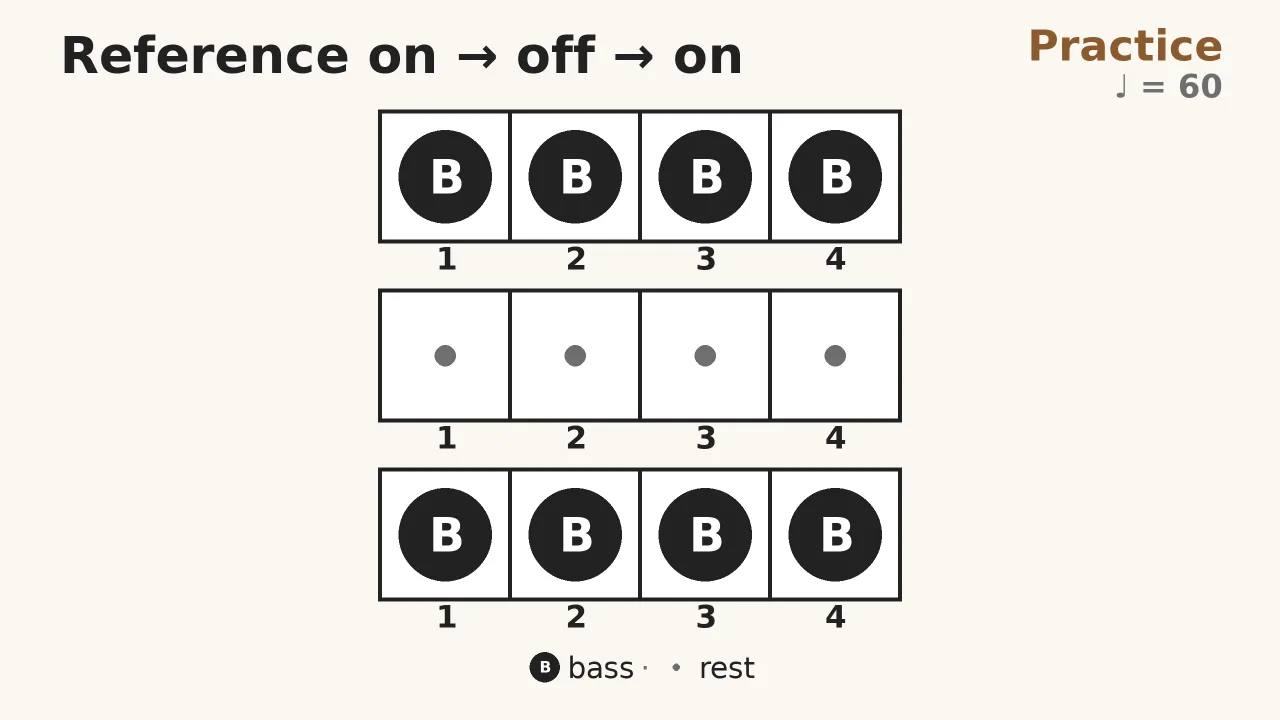
Reference timeline: row 1 sounds on all four beats; row 2 is silent; row 3 sounds again. These boxes describe the reference only. You continue your own B-T-B-T- through every row.
  1. Bass
  2. Bass
  3. Bass
  4. Bass
  5. Rest
  6. Rest
  7. Rest
  8. Rest
  9. Bass
  10. Bass
  11. Bass
  12. Bass
60 BPM throughout. Four audible bass beats, four silent beats, four returning beats. Listen once to learn the sequence, then replay and keep your own pattern going.

Let the return tell you what happened

If your expected 1 lands before the returning sound, you may have rushed or miscounted the gap. If it lands after, you may have slowed down or added time. Check the count before diagnosing speed.
Do not squeeze in extra notes or stretch the final space to hide a mismatch. Finish the attempt, then restart with smaller movements and an even count. If needed, play just bass on each main beat for the next attempt. A partner can make the silent gap shorter while you build confidence.

In the app: a practice. Get the app

Once one silent bar is reliable, a partner can keep a steady 60 BPM count silently while sounding two supported bars, leaving two bars quiet, then returning on 1. Your playing continues throughout. Extend the gap, not the tempo. Without a partner, repeat the supplied one-bar-gap exercise rather than guessing when a longer reference should return.

Quick check

What is the best check of the silent-bar attempt?
Show the answer

Your next 1 aligned with the returning reference without a correction.. Alignment with the unchanged returning beat tests whether the pulse continued accurately.

1 more question in the app Get the app

Practise in the free Djembe app