Harriet Music Get the Djembe app

Lesson 5 of 7 10 minutes

Djembe Open Tone: How to Get a Clear, Ringing Sound

Harriet In this lesson you will produce a clear, ringing tone near the edge of the drumhead using relaxed fingers.

  1. 1. Meet Your Djembe
    1. Lesson 1: Meet the Djembe
    2. Lesson 2: Position Your Djembe
    3. Lesson 3: Find Your Playing Posture
    4. Lesson 4: Play Your First Bass
    5. Lesson 5: Find the Open Tone
    6. Lesson 6: Hear Bass and Tone
    7. Lesson 7: Keep a Steady Pulse
  2. 2. Your First Rhythms
    1. Lesson 1: Alternate Your Hands
    2. Lesson 2: Combine Bass and Tone
    3. Lesson 3: Learn the Slap Stroke
    4. Lesson 4: Recognize the Three Strokes
    5. Lesson 5: Read a Rhythm Grid
    6. Lesson 6: Count Beats and Offbeats
    7. Lesson 7: Play Eighth Note Patterns
    8. Lesson 8: Build Your First Phrase
    9. Lesson 9: Repeat Rhythms by Ear
    10. Lesson 10: Shape Your Accents
  3. 3. Play Your First Kuku
    1. Lesson 1: Discover the Kuku Rhythm
    2. Lesson 2: Learn Kuku Accompaniment One
    3. Lesson 3: Keep Your Kuku Pattern
    4. Lesson 4: Learn Kuku Accompaniment Two
    5. Lesson 5: Switch Between Kuku Parts
    6. Lesson 6: Recognize the Kuku Call
    7. Lesson 7: Play Along With Kuku
  4. 4. Playing Together
    1. Lesson 1: Listen and Respond
    2. Lesson 2: Practice Call and Response
    3. Lesson 3: Follow Another Djembe Part
    4. Lesson 4: Feel the Dunun Pulse
    5. Lesson 5: Play Without the Click
    6. Lesson 6: Keep Your Place
  5. 5. Traditional Rhythms
    1. Lesson 1: Discover the Djolé Rhythm
    2. Lesson 2: Learn Djolé Accompaniment
    3. Lesson 3: Follow the Djolé Call
    4. Lesson 4: Play Djolé With Others
    5. Lesson 5: Discover the Sinte Rhythm
    6. Lesson 6: Learn Sinte Accompaniment
    7. Lesson 7: Follow the Sinte Call
    8. Lesson 8: Play Sinte With Others
    9. Lesson 9: Discover the Fanga Rhythm
    10. Lesson 10: Learn Fanga Accompaniment
    11. Lesson 11: Follow the Fanga Call
    12. Lesson 12: Play Fanga With Others
    13. Lesson 13: Recognize Traditional Rhythms
  6. 6. Discover Twelve Eight Rhythms
    1. Lesson 1: Feel Three Subdivisions
    2. Lesson 2: Count in Twelve Eight
    3. Lesson 3: Play Your First Ternary Patterns
    4. Lesson 4: Discover the Soli Rhythm
    5. Lesson 5: Learn Soli Accompaniment
    6. Lesson 6: Follow the Soli Call
    7. Lesson 7: Play Soli With Others
    8. Lesson 8: Feel the Ternary Groove
  7. 7. Breaks Variations and Performance
    1. Lesson 1: Understand Musical Calls
    2. Lesson 2: Play a Simple Break
    3. Lesson 3: Return After a Break
    4. Lesson 4: Create Small Rhythmic Variations
    5. Lesson 5: Control Your Playing Tempo
    6. Lesson 6: Start and Finish Together
    7. Lesson 7: Plan an Ensemble Arrangement
    8. Lesson 8: Lead a Simple Call
    9. Lesson 9: Improvise a Short Solo
    10. Lesson 10: Perform a Complete Rhythm

A brighter voice near the edge

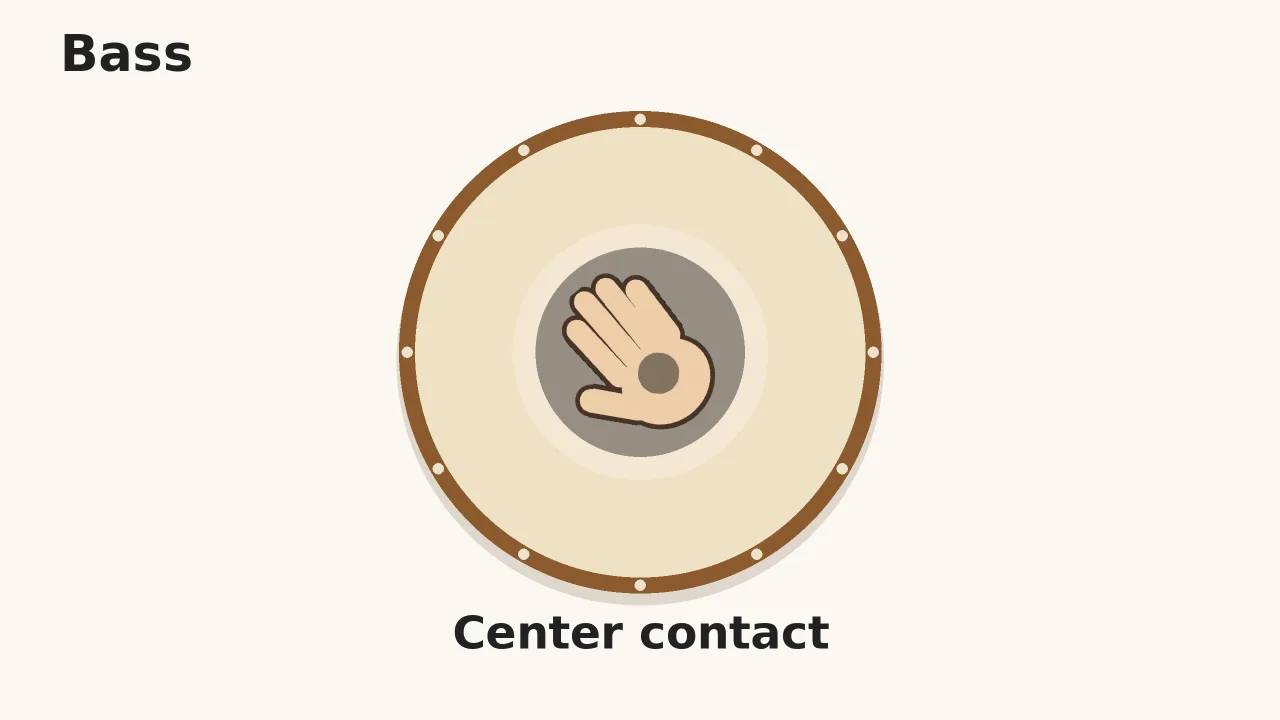
The same drum that produces a deep bass can also give a clear, ringing sound. Moving the contact from the palm near the center to the fingers near the edge changes the character of the note. This is the open tone: a contrast in sound, not simply an increase in volume.

The recording below lets you hear that contrast before exploring the hand position.

  1. Bass
  2. Rest
  3. Tone
  4. Rest
Bass, then open tone, repeated once. Listen for the deeper bass and the brighter ring of the tone. These are recorded reference strokes.

Two contact areas

Bass: palm near the center, giving a deep, full sound.
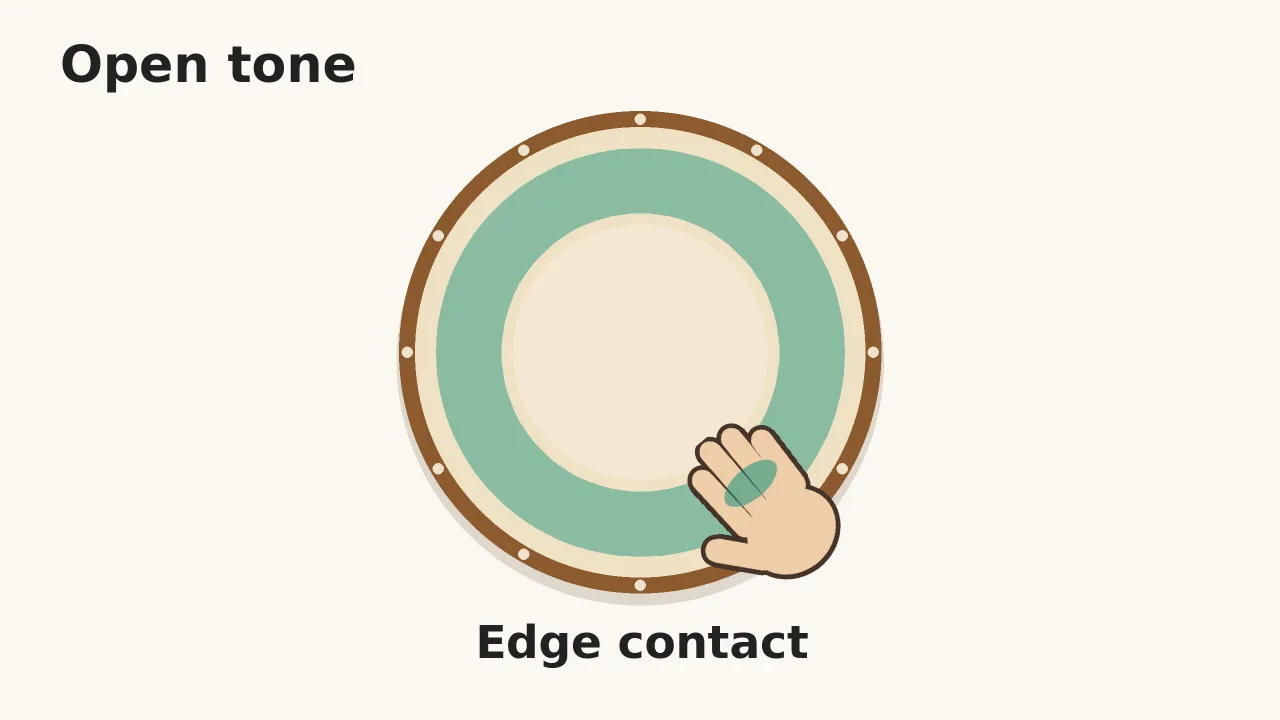
Tone: relaxed fingers on the skin near the edge, giving a ringing sound.

Fingers near the edge

Begin with the relaxed setup and easy release from Play Your First Bass. The open tone is a clear, ringing sound made with the fingers on the skin near the edge, rather than the palm near the center. Keep the fingers together without squeezing them rigidly.
Place the fingers over the skin with your knuckles just outside the circle. Keep your hands above the surface rather than dropping your wrists below it. Use a small, relaxed movement and let the fingers come away after contact. You are striking the skin, not the wooden rim.

Steve Rivers of Unbeatable Energy breaks down this contact position in the following demonstration, including how to keep the knuckles clear of the hard rim. His brief mention of slap is a preview; the focus here is the open tone.

Play the video

The video plays from YouTube and belongs to its author.

Quick check

Your tone is dull and your fingers stay against the skin. What is the best first adjustment?
Show the answer

Keep the fingers near the edge but let them release after contact.. Releasing the fingers allows the open tone to ring; extra force or rim contact is not the solution.

Practise in the free Djembe app