Harriet Music Get the Djembe app

Lesson 1 of 7 5 minutes

Parts of a Djembe: Head, Rim, Bowl and Base Explained

Harriet In this lesson you will identify the main parts of the djembe and understand how the instrument produces sound.

  1. 1. Meet Your Djembe
    1. Lesson 1: Meet the Djembe
    2. Lesson 2: Position Your Djembe
    3. Lesson 3: Find Your Playing Posture
    4. Lesson 4: Play Your First Bass
    5. Lesson 5: Find the Open Tone
    6. Lesson 6: Hear Bass and Tone
    7. Lesson 7: Keep a Steady Pulse
  2. 2. Your First Rhythms
    1. Lesson 1: Alternate Your Hands
    2. Lesson 2: Combine Bass and Tone
    3. Lesson 3: Learn the Slap Stroke
    4. Lesson 4: Recognize the Three Strokes
    5. Lesson 5: Read a Rhythm Grid
    6. Lesson 6: Count Beats and Offbeats
    7. Lesson 7: Play Eighth Note Patterns
    8. Lesson 8: Build Your First Phrase
    9. Lesson 9: Repeat Rhythms by Ear
    10. Lesson 10: Shape Your Accents
  3. 3. Play Your First Kuku
    1. Lesson 1: Discover the Kuku Rhythm
    2. Lesson 2: Learn Kuku Accompaniment One
    3. Lesson 3: Keep Your Kuku Pattern
    4. Lesson 4: Learn Kuku Accompaniment Two
    5. Lesson 5: Switch Between Kuku Parts
    6. Lesson 6: Recognize the Kuku Call
    7. Lesson 7: Play Along With Kuku
  4. 4. Playing Together
    1. Lesson 1: Listen and Respond
    2. Lesson 2: Practice Call and Response
    3. Lesson 3: Follow Another Djembe Part
    4. Lesson 4: Feel the Dunun Pulse
    5. Lesson 5: Play Without the Click
    6. Lesson 6: Keep Your Place
  5. 5. Traditional Rhythms
    1. Lesson 1: Discover the Djolé Rhythm
    2. Lesson 2: Learn Djolé Accompaniment
    3. Lesson 3: Follow the Djolé Call
    4. Lesson 4: Play Djolé With Others
    5. Lesson 5: Discover the Sinte Rhythm
    6. Lesson 6: Learn Sinte Accompaniment
    7. Lesson 7: Follow the Sinte Call
    8. Lesson 8: Play Sinte With Others
    9. Lesson 9: Discover the Fanga Rhythm
    10. Lesson 10: Learn Fanga Accompaniment
    11. Lesson 11: Follow the Fanga Call
    12. Lesson 12: Play Fanga With Others
    13. Lesson 13: Recognize Traditional Rhythms
  6. 6. Discover Twelve Eight Rhythms
    1. Lesson 1: Feel Three Subdivisions
    2. Lesson 2: Count in Twelve Eight
    3. Lesson 3: Play Your First Ternary Patterns
    4. Lesson 4: Discover the Soli Rhythm
    5. Lesson 5: Learn Soli Accompaniment
    6. Lesson 6: Follow the Soli Call
    7. Lesson 7: Play Soli With Others
    8. Lesson 8: Feel the Ternary Groove
  7. 7. Breaks Variations and Performance
    1. Lesson 1: Understand Musical Calls
    2. Lesson 2: Play a Simple Break
    3. Lesson 3: Return After a Break
    4. Lesson 4: Create Small Rhythmic Variations
    5. Lesson 5: Control Your Playing Tempo
    6. Lesson 6: Start and Finish Together
    7. Lesson 7: Plan an Ensemble Arrangement
    8. Lesson 8: Lead a Simple Call
    9. Lesson 9: Improvise a Short Solo
    10. Lesson 10: Perform a Complete Rhythm

A drum with several voices

The djembe is a hand-played drum from West Africa, particularly associated with Mandé musical traditions. It often plays alongside other djembes and dunun drums in an ensemble: a group of musicians playing together.

You need no playing experience for this lesson. Look at your own drum if you have one, or use the illustration below. For now, explore its parts and listen; you will learn how to make the sounds later.
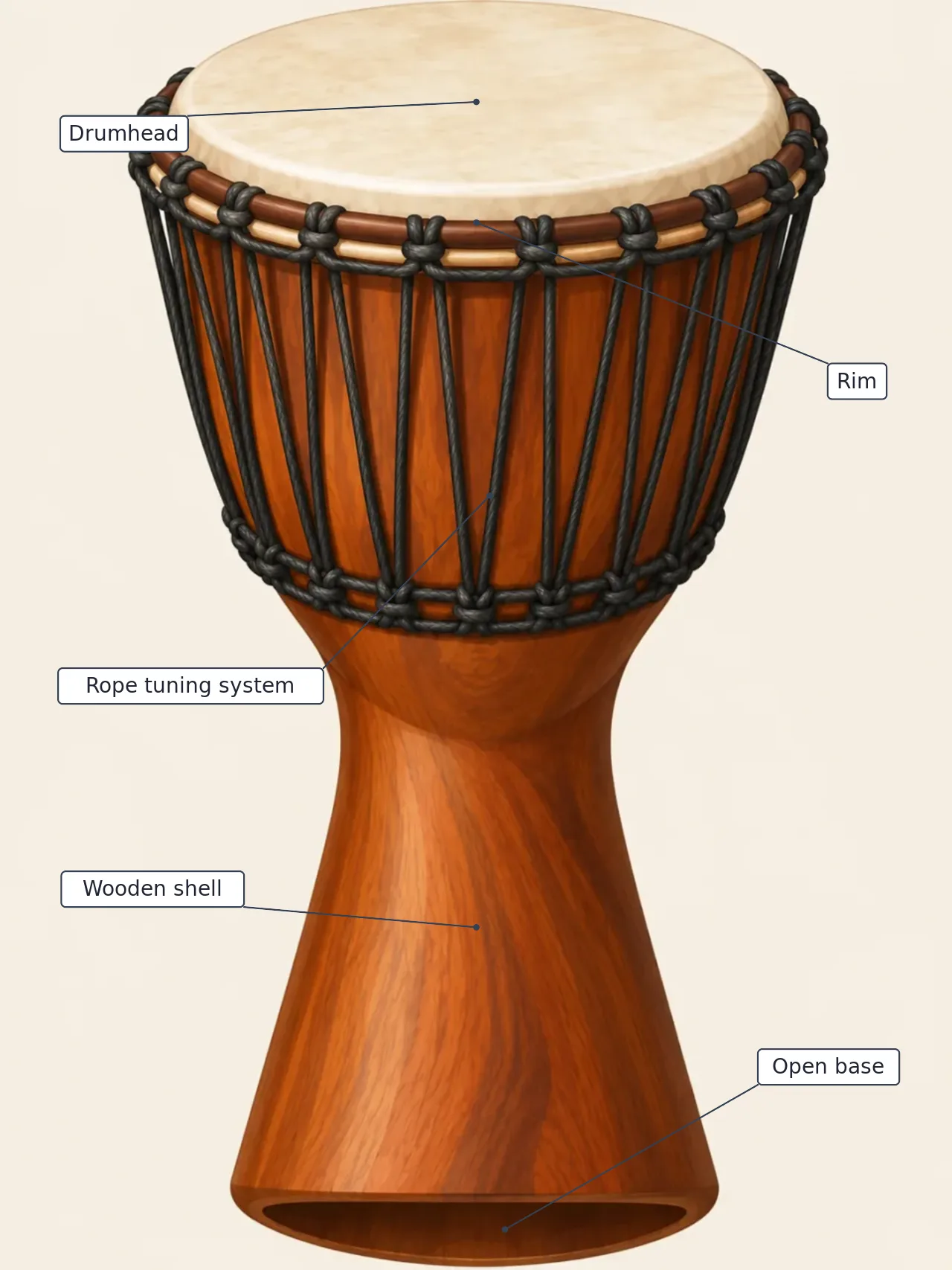
Follow the drum from its stretched head to its open base.
Drumhead
The stretched skin vibrates when struck.
Rim
The edge around the playing surface.
Rope tuning system
The rope network holds the drumhead under tension.
Wooden shell
The hollow wooden body reinforces the sound.
Open base
The open bottom lets air move out of the shell.

Find the five parts

  • Drumhead: the stretched skin across the top—the surface you play.
  • Rim: the edge around the drumhead.
  • Rope tuning system: the network of ropes that helps hold the head under tension.
  • Wooden shell: the hollow, goblet-shaped body beneath the head.
  • Open base: the opening at the bottom of the shell.

When a hand strikes the head, the skin vibrates: it moves rapidly back and forth. The hollow body and the air inside help reinforce that vibration into the drum’s resonant sound. The bottom is open rather than sealed.

Your djembe may differ in size or material, or use metal tuning hardware instead of ropes. Those differences change its appearance and sound, but the basic playing techniques remain similar.

Listen to three sounds

A djembe can produce a deep bass, a clear, ringing tone, and a sharper slap. Listen to them in that order below, then replay the clip and notice how their sound changes.

This is a first introduction to their voices, not a pattern to copy. You do not need to read the letters under the player or try the strokes yet.

  1. Bass
  2. Rest
  3. Rest
  4. Rest
  5. Tone
  6. Rest
  7. Rest
  8. Rest
  9. Slap
  10. Rest
  11. Rest
  12. Rest
Bass first, then tone, then slap. Listen for deep resonance, ringing tone and a sharper attack.

Quick check

After a hand strikes the drumhead, how does the djembe produce its resonant sound?
Show the answer

The skin vibrates and the hollow body helps reinforce the sound.. The struck skin vibrates, and the hollow body and air inside reinforce the sound; the bottom is open.

Next, Position Your Djembe will help you set the drum securely so its open base can do its job.

Practise in the free Djembe app