Harriet Music Get the Djembe app

Lesson 8 of 10 9 minutes

Your First Djembe Phrase: Bass, Tone and Slap

Harriet In this lesson you will perform and repeat a short rhythmic phrase combining bass, tone, slap and rests.

  1. 1. Meet Your Djembe
    1. Lesson 1: Meet the Djembe
    2. Lesson 2: Position Your Djembe
    3. Lesson 3: Find Your Playing Posture
    4. Lesson 4: Play Your First Bass
    5. Lesson 5: Find the Open Tone
    6. Lesson 6: Hear Bass and Tone
    7. Lesson 7: Keep a Steady Pulse
  2. 2. Your First Rhythms
    1. Lesson 1: Alternate Your Hands
    2. Lesson 2: Combine Bass and Tone
    3. Lesson 3: Learn the Slap Stroke
    4. Lesson 4: Recognize the Three Strokes
    5. Lesson 5: Read a Rhythm Grid
    6. Lesson 6: Count Beats and Offbeats
    7. Lesson 7: Play Eighth Note Patterns
    8. Lesson 8: Build Your First Phrase
    9. Lesson 9: Repeat Rhythms by Ear
    10. Lesson 10: Shape Your Accents
  3. 3. Play Your First Kuku
    1. Lesson 1: Discover the Kuku Rhythm
    2. Lesson 2: Learn Kuku Accompaniment One
    3. Lesson 3: Keep Your Kuku Pattern
    4. Lesson 4: Learn Kuku Accompaniment Two
    5. Lesson 5: Switch Between Kuku Parts
    6. Lesson 6: Recognize the Kuku Call
    7. Lesson 7: Play Along With Kuku
  4. 4. Playing Together
    1. Lesson 1: Listen and Respond
    2. Lesson 2: Practice Call and Response
    3. Lesson 3: Follow Another Djembe Part
    4. Lesson 4: Feel the Dunun Pulse
    5. Lesson 5: Play Without the Click
    6. Lesson 6: Keep Your Place
  5. 5. Traditional Rhythms
    1. Lesson 1: Discover the Djolé Rhythm
    2. Lesson 2: Learn Djolé Accompaniment
    3. Lesson 3: Follow the Djolé Call
    4. Lesson 4: Play Djolé With Others
    5. Lesson 5: Discover the Sinte Rhythm
    6. Lesson 6: Learn Sinte Accompaniment
    7. Lesson 7: Follow the Sinte Call
    8. Lesson 8: Play Sinte With Others
    9. Lesson 9: Discover the Fanga Rhythm
    10. Lesson 10: Learn Fanga Accompaniment
    11. Lesson 11: Follow the Fanga Call
    12. Lesson 12: Play Fanga With Others
    13. Lesson 13: Recognize Traditional Rhythms
  6. 6. Discover Twelve Eight Rhythms
    1. Lesson 1: Feel Three Subdivisions
    2. Lesson 2: Count in Twelve Eight
    3. Lesson 3: Play Your First Ternary Patterns
    4. Lesson 4: Discover the Soli Rhythm
    5. Lesson 5: Learn Soli Accompaniment
    6. Lesson 6: Follow the Soli Call
    7. Lesson 7: Play Soli With Others
    8. Lesson 8: Feel the Ternary Groove
  7. 7. Breaks Variations and Performance
    1. Lesson 1: Understand Musical Calls
    2. Lesson 2: Play a Simple Break
    3. Lesson 3: Return After a Break
    4. Lesson 4: Create Small Rhythmic Variations
    5. Lesson 5: Control Your Playing Tempo
    6. Lesson 6: Start and Finish Together
    7. Lesson 7: Plan an Ensemble Arrangement
    8. Lesson 8: Lead a Simple Call
    9. Lesson 9: Improvise a Short Solo
    10. Lesson 10: Perform a Complete Rhythm

Make the end lead back to the beginning

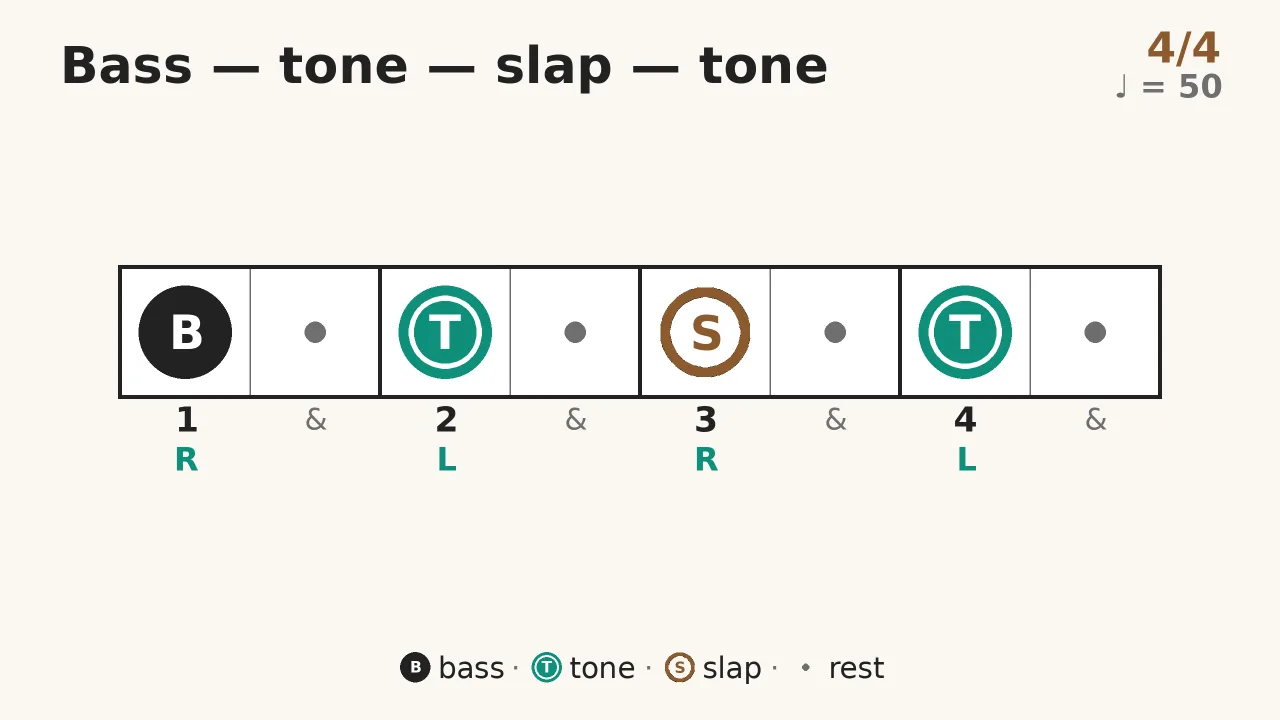
A phrase starts to feel continuous when its last sound leaves room for the next beginning. That is the challenge here: combine bass, tone and slap, keep the spaces, and arrive back on beat 1 without a hesitation.
This is a short practice phrase, not a named traditional rhythm. It builds on Play Eighth Note Patterns and uses just one slap per bar, with room to release the hand. Listen to the whole phrase first; there is no need to copy it immediately.

  1. Bass
  2. Rest
  3. Tone
  4. Rest
  5. Slap
  6. Rest
  7. Tone
  8. Rest
The complete phrase at 60 BPM: bass, tone, slap, tone, with a silent & after every stroke. Four clicks lead into two repeats.
The sounds fall on 1, 2, 3 and 4. Each & is a rest; R and L suggest alternating hands.

Give each half time

At 50 BPM, count 1 & 2 &: play bass on 1 and tone on 2, leaving both & positions silent. Try that half three times. Then count 3 & 4 &: play slap on 3 and tone on 4, again keeping the & positions silent. Try it three times with a rest between attempts.
Connect the halves while continuing the count. The suggested hands are right–left–right–left, so the right hand changes from bass to slap. Keep the contact small and comfortable; if the slap becomes tense, return to an isolated gentle attempt before reconnecting.
When the phrase feels stable, count internally. Let the final & pass, then return to bass on the next 1. Consistent spacing and distinct sounds matter more than speed.

Quick check

After the tone on beat 4 in B – T – S – T –, what comes next?
Show the answer

A rest on the &, then bass on the next 1. The final eighth-note rest has its full time before the next bar begins.

1 more question in the app Get the app

Practise in the free Djembe app