Harriet Music Get the Djembe app

Lesson 7 of 10 9 minutes

Djembe Eighth Note Patterns: Beats, Offbeats, Rests

Harriet In this lesson you will play combinations of beats, offbeats and rests while keeping a steady tempo.

  1. 1. Meet Your Djembe
    1. Lesson 1: Meet the Djembe
    2. Lesson 2: Position Your Djembe
    3. Lesson 3: Find Your Playing Posture
    4. Lesson 4: Play Your First Bass
    5. Lesson 5: Find the Open Tone
    6. Lesson 6: Hear Bass and Tone
    7. Lesson 7: Keep a Steady Pulse
  2. 2. Your First Rhythms
    1. Lesson 1: Alternate Your Hands
    2. Lesson 2: Combine Bass and Tone
    3. Lesson 3: Learn the Slap Stroke
    4. Lesson 4: Recognize the Three Strokes
    5. Lesson 5: Read a Rhythm Grid
    6. Lesson 6: Count Beats and Offbeats
    7. Lesson 7: Play Eighth Note Patterns
    8. Lesson 8: Build Your First Phrase
    9. Lesson 9: Repeat Rhythms by Ear
    10. Lesson 10: Shape Your Accents
  3. 3. Play Your First Kuku
    1. Lesson 1: Discover the Kuku Rhythm
    2. Lesson 2: Learn Kuku Accompaniment One
    3. Lesson 3: Keep Your Kuku Pattern
    4. Lesson 4: Learn Kuku Accompaniment Two
    5. Lesson 5: Switch Between Kuku Parts
    6. Lesson 6: Recognize the Kuku Call
    7. Lesson 7: Play Along With Kuku
  4. 4. Playing Together
    1. Lesson 1: Listen and Respond
    2. Lesson 2: Practice Call and Response
    3. Lesson 3: Follow Another Djembe Part
    4. Lesson 4: Feel the Dunun Pulse
    5. Lesson 5: Play Without the Click
    6. Lesson 6: Keep Your Place
  5. 5. Traditional Rhythms
    1. Lesson 1: Discover the Djolé Rhythm
    2. Lesson 2: Learn Djolé Accompaniment
    3. Lesson 3: Follow the Djolé Call
    4. Lesson 4: Play Djolé With Others
    5. Lesson 5: Discover the Sinte Rhythm
    6. Lesson 6: Learn Sinte Accompaniment
    7. Lesson 7: Follow the Sinte Call
    8. Lesson 8: Play Sinte With Others
    9. Lesson 9: Discover the Fanga Rhythm
    10. Lesson 10: Learn Fanga Accompaniment
    11. Lesson 11: Follow the Fanga Call
    12. Lesson 12: Play Fanga With Others
    13. Lesson 13: Recognize Traditional Rhythms
  6. 6. Discover Twelve Eight Rhythms
    1. Lesson 1: Feel Three Subdivisions
    2. Lesson 2: Count in Twelve Eight
    3. Lesson 3: Play Your First Ternary Patterns
    4. Lesson 4: Discover the Soli Rhythm
    5. Lesson 5: Learn Soli Accompaniment
    6. Lesson 6: Follow the Soli Call
    7. Lesson 7: Play Soli With Others
    8. Lesson 8: Feel the Ternary Groove
  7. 7. Breaks Variations and Performance
    1. Lesson 1: Understand Musical Calls
    2. Lesson 2: Play a Simple Break
    3. Lesson 3: Return After a Break
    4. Lesson 4: Create Small Rhythmic Variations
    5. Lesson 5: Control Your Playing Tempo
    6. Lesson 6: Start and Finish Together
    7. Lesson 7: Plan an Ensemble Arrangement
    8. Lesson 8: Lead a Simple Call
    9. Lesson 9: Improvise a Short Solo
    10. Lesson 10: Perform a Complete Rhythm

Let the spaces shape the phrase

A rhythm does not need a stroke in every available position. Leaving a space can make the next sound feel quite different—provided that space lasts its full time. The even 1 & 2 & 3 & 4 & count from Count Beats and Offbeats will hold these spaces for you.
Each of the eight boxes below is an eighth-note position: half a beat in this four-beat bar. B is bass, T is tone and a dash means no stroke. The numbers remain the main beats; each & stays halfway between them.
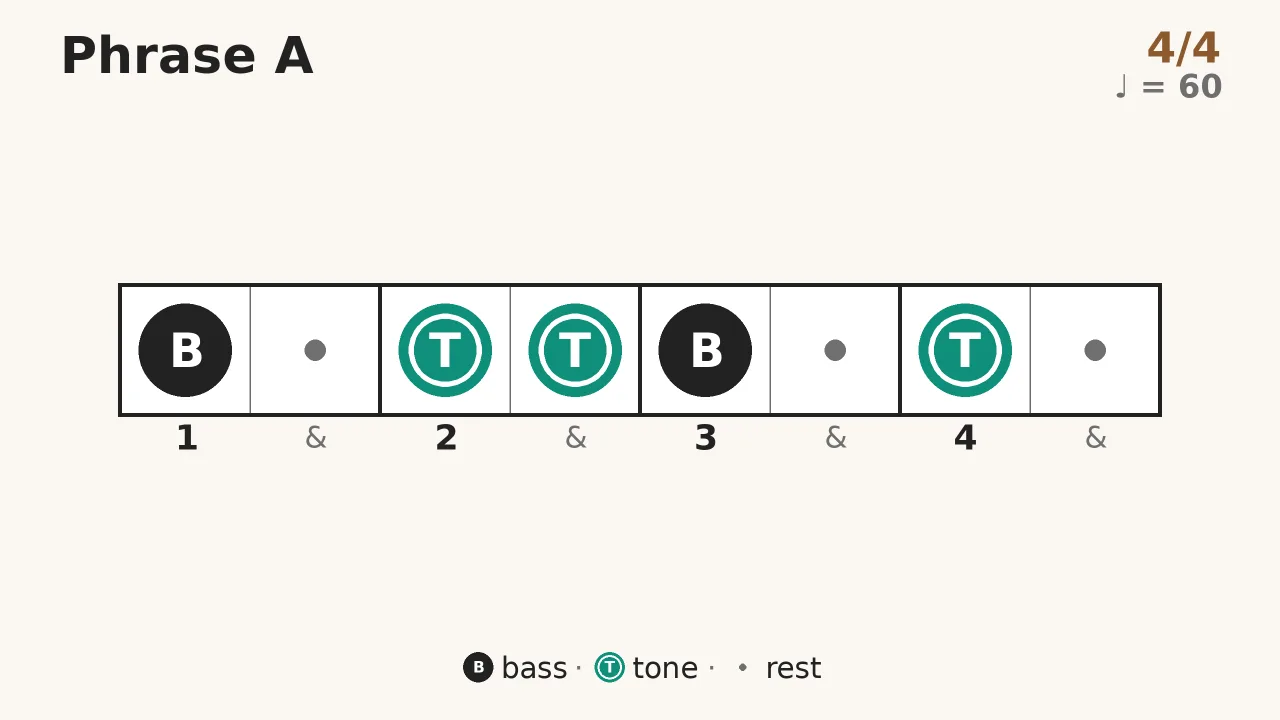
Phrase A: bass on 1, tones on 2 and its &, bass on 3, tone on 4.
  1. Bass
  2. Rest
  3. Tone
  4. Tone
  5. Bass
  6. Rest
  7. Tone
  8. Rest
Hear Phrase A twice after four count-in clicks before trying it.

Build two halves, then join

First count 1 & 2 & and play bass, rest, tone, tone. Repeat that half slowly three times, leaving the second position silent. Then count 3 & 4 & and play bass, rest, tone, rest three times.
Now speak the full eight-position count and connect the halves without an extra pause. The two tones around beat 2 occupy two equal half-beats; do not turn them into a rushed pair. When you loop the bar, the final rest must pass before the next bass on 1.
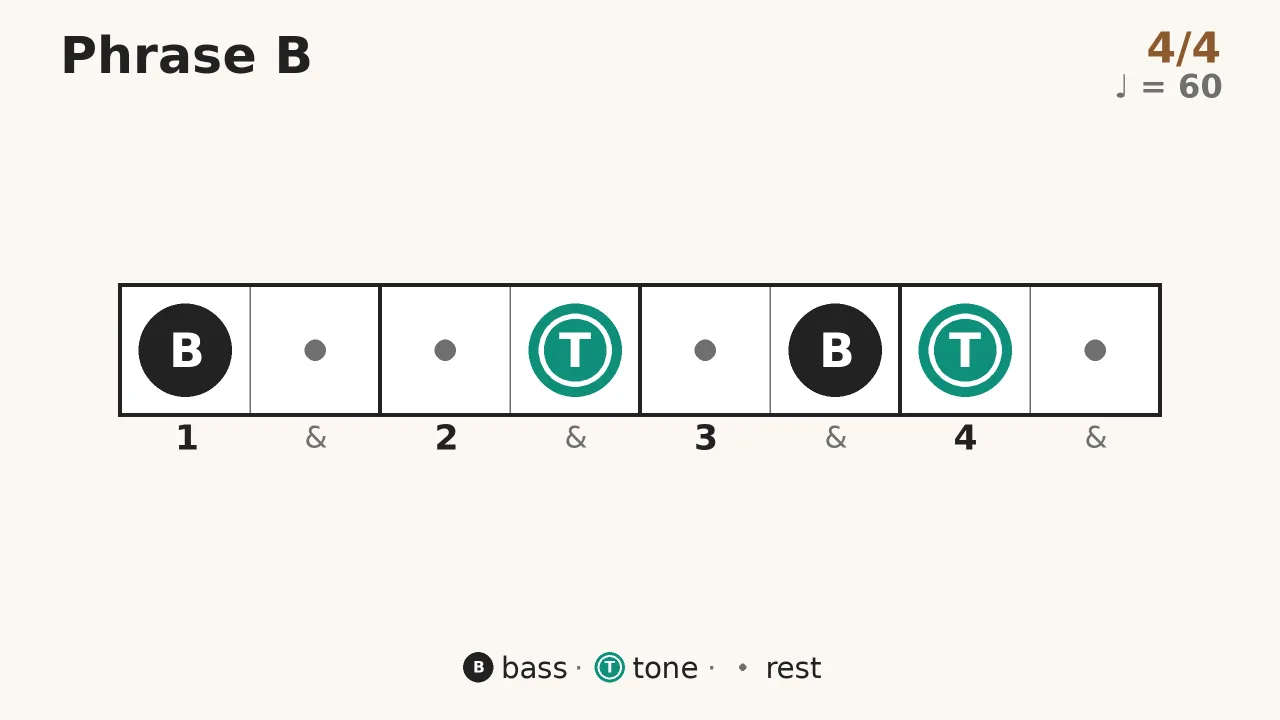
Phrase B leaves beats 2 and 3 silent; strokes fall on their following & positions.
  1. Bass
  2. Rest
  3. Rest
  4. Tone
  5. Rest
  6. Bass
  7. Tone
  8. Rest
Phrase B at the same tempo. Keep hearing the clicks on 2 and 3 even though the drum part is silent there.

In the app: a practice. Get the app

Quick check

Phrase B has no drum stroke on beat 3. What should happen to your count?
Show the answer

Keep beat 3 on its click, then play the bass on its &.. The silent beat still occupies time; the following bass remains on the offbeat.

Practise in the free Djembe app
