Play the route from beginning to end
The final task is to keep a whole arrangement moving: a clear entrance, a steady part, a break, a return and one coordinated ending. Use the eight-cycle neutral classroom arrangement from Plan an Ensemble Arrangement. All of its notes and signals are already familiar.
Choose a leader and an accompanying player. For your first take, keep the standard map without a solo. A solo belongs only in a separately agreed map with its length and return written down; it is optional, not a condition for completing this performance.
Confirm the map and roles
Set 60 BPM, or agree on the slower comfortable tempo established in Control Your Playing Tempo. Count four beats, then the leader gives K alone before cycle 1.
| Cycles | Accompanying player | Leader |
|---|---|---|
| 1–2 | A twice | A in 1, cue K in 2 |
| 3 | Shared K | Shared K |
| 4–6 | A three times | A in 4–5, cue K in 6 |
| 7 | Shared K | Shared K |
| 8 | Final bass on 1, then silence | Same final bass |
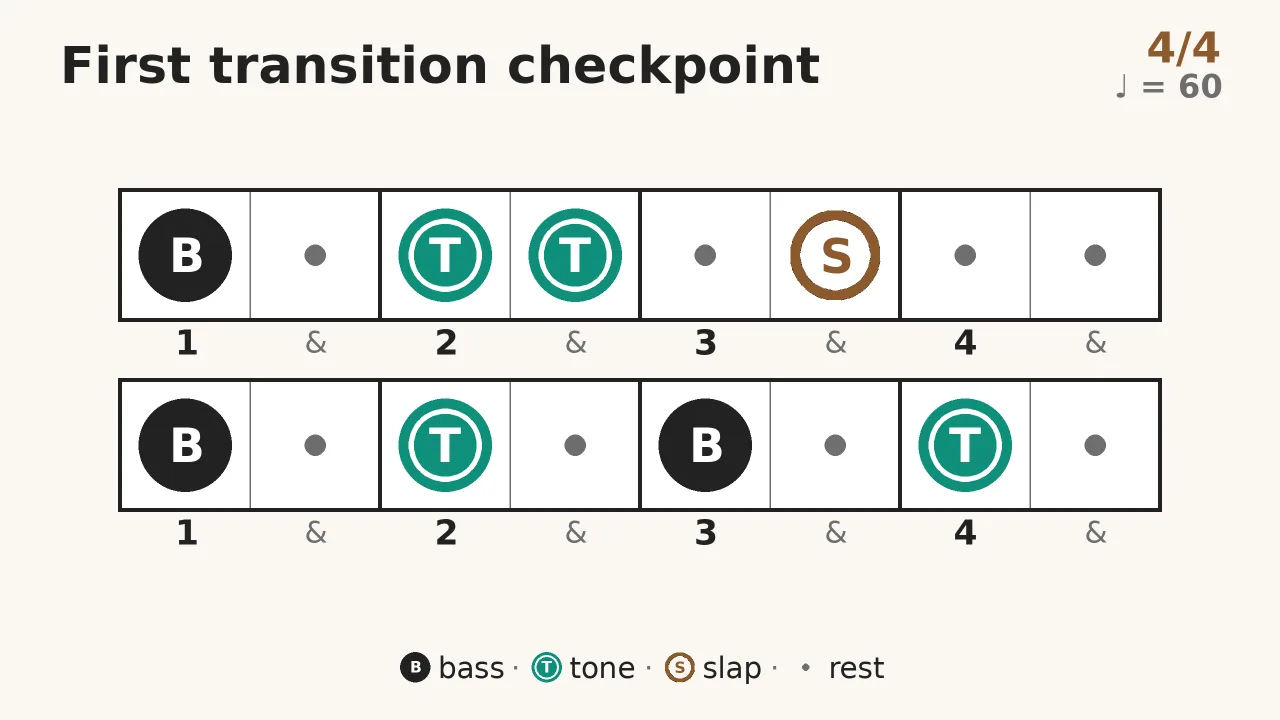
A = B-T-B-T-; K = B-TT-S--. The first shared break returns to A in 4. The later one leads to the final bass in 8. Stay quiet afterwards and let the sound decay.
Hear the complete route in three parts
The short players below cover the whole route in order. Part 1 includes the opening leader cue and cycles 1–2; part 2 covers 3–5; part 3 covers 6–8. Each starts directly at 60 BPM, without a count-in.
Listen to the parts before performing. Their separation is for studying the model; your own take continues across those boundaries without stopping. The accompanying player’s part is clearer and the leader’s cues are softer underneath.
- Bass
- Rest
- Tone
- Tone
- Rest
- Slap
- Rest
- Rest
- Bass
- Rest
- Tone
- Rest
- Bass
- Rest
- Tone
- Rest
- Bass
- Rest
- Tone
- Rest
- Bass
- Rest
- Tone
- Rest
Prepare one uncertain boundary
Before the take, choose whichever boundary feels least secure: opening cue into 1, break 3 into return 4, or break 7 into final bass 8. Rehearse that one transition slowly once or twice, then settle the agreed tempo.
With a partner, keep the leader’s calls audible without forcing volume. Alone, use the model players to rehearse the responses, then perform the whole leader role with the metronome and map. The metronome supplies pulse, not a responsive ensemble.
Choose one improvement for the next take
Name one specific change from your recording: for example, “count the quiet 4-and before returning” or “keep the last accompaniment cycle at the opening tempo.” Rehearse only that boundary, then make a second complete attempt.
Compare whether that one point improved while the rest stayed continuous. If the eight-cycle route is still uncertain, return to Start and Finish Together; if stroke clarity is the issue, revisit the relevant stroke lesson before increasing speed.