Harriet Music Get the Djembe app

Lesson 3 of 6 10 minutes

Keep Your Part While Another Djembe Plays

Harriet In this lesson you will maintain your accompaniment while a contrasting djembe pattern plays alongside it.

  1. 1. Meet Your Djembe
    1. Lesson 1: Meet the Djembe
    2. Lesson 2: Position Your Djembe
    3. Lesson 3: Find Your Playing Posture
    4. Lesson 4: Play Your First Bass
    5. Lesson 5: Find the Open Tone
    6. Lesson 6: Hear Bass and Tone
    7. Lesson 7: Keep a Steady Pulse
  2. 2. Your First Rhythms
    1. Lesson 1: Alternate Your Hands
    2. Lesson 2: Combine Bass and Tone
    3. Lesson 3: Learn the Slap Stroke
    4. Lesson 4: Recognize the Three Strokes
    5. Lesson 5: Read a Rhythm Grid
    6. Lesson 6: Count Beats and Offbeats
    7. Lesson 7: Play Eighth Note Patterns
    8. Lesson 8: Build Your First Phrase
    9. Lesson 9: Repeat Rhythms by Ear
    10. Lesson 10: Shape Your Accents
  3. 3. Play Your First Kuku
    1. Lesson 1: Discover the Kuku Rhythm
    2. Lesson 2: Learn Kuku Accompaniment One
    3. Lesson 3: Keep Your Kuku Pattern
    4. Lesson 4: Learn Kuku Accompaniment Two
    5. Lesson 5: Switch Between Kuku Parts
    6. Lesson 6: Recognize the Kuku Call
    7. Lesson 7: Play Along With Kuku
  4. 4. Playing Together
    1. Lesson 1: Listen and Respond
    2. Lesson 2: Practice Call and Response
    3. Lesson 3: Follow Another Djembe Part
    4. Lesson 4: Feel the Dunun Pulse
    5. Lesson 5: Play Without the Click
    6. Lesson 6: Keep Your Place
  5. 5. Traditional Rhythms
    1. Lesson 1: Discover the Djolé Rhythm
    2. Lesson 2: Learn Djolé Accompaniment
    3. Lesson 3: Follow the Djolé Call
    4. Lesson 4: Play Djolé With Others
    5. Lesson 5: Discover the Sinte Rhythm
    6. Lesson 6: Learn Sinte Accompaniment
    7. Lesson 7: Follow the Sinte Call
    8. Lesson 8: Play Sinte With Others
    9. Lesson 9: Discover the Fanga Rhythm
    10. Lesson 10: Learn Fanga Accompaniment
    11. Lesson 11: Follow the Fanga Call
    12. Lesson 12: Play Fanga With Others
    13. Lesson 13: Recognize Traditional Rhythms
  6. 6. Discover Twelve Eight Rhythms
    1. Lesson 1: Feel Three Subdivisions
    2. Lesson 2: Count in Twelve Eight
    3. Lesson 3: Play Your First Ternary Patterns
    4. Lesson 4: Discover the Soli Rhythm
    5. Lesson 5: Learn Soli Accompaniment
    6. Lesson 6: Follow the Soli Call
    7. Lesson 7: Play Soli With Others
    8. Lesson 8: Feel the Ternary Groove
  7. 7. Breaks Variations and Performance
    1. Lesson 1: Understand Musical Calls
    2. Lesson 2: Play a Simple Break
    3. Lesson 3: Return After a Break
    4. Lesson 4: Create Small Rhythmic Variations
    5. Lesson 5: Control Your Playing Tempo
    6. Lesson 6: Start and Finish Together
    7. Lesson 7: Plan an Ensemble Arrangement
    8. Lesson 8: Lead a Simple Call
    9. Lesson 9: Improvise a Short Solo
    10. Lesson 10: Perform a Complete Rhythm

Listening does not always mean copying

In call and response, you echoed the other drummer. In an ensemble, you often do the opposite: hear their part clearly while keeping your own. A tempting extra tone can pull your hands away from the pattern you meant to play.
Return to the two written parts from Play Along With Kuku. Today keep part one, the bass–tone–tone–slap unit. We use the same course adaptation of Chinta’s arrangement throughout.

  1. Bass
  2. Rest
  3. Tone
  4. Tone
  5. Rest
  6. Rest
  7. Slap
  8. Rest
  9. Bass
  10. Rest
  11. Tone
  12. Tone
  13. Rest
  14. Rest
  15. Slap
  16. Rest
Your part alone at 50 BPM: the first unit repeats twice. Play with it before adding the other drummer.
  1. Bass
  2. Rest
  3. Rest
  4. Rest
  5. Bass
  6. Rest
  7. Rest
  8. Rest
  9. Tone
  10. Rest
  11. Tone
  12. Rest
  13. Tone
  14. Tone
  15. Rest
  16. Rest
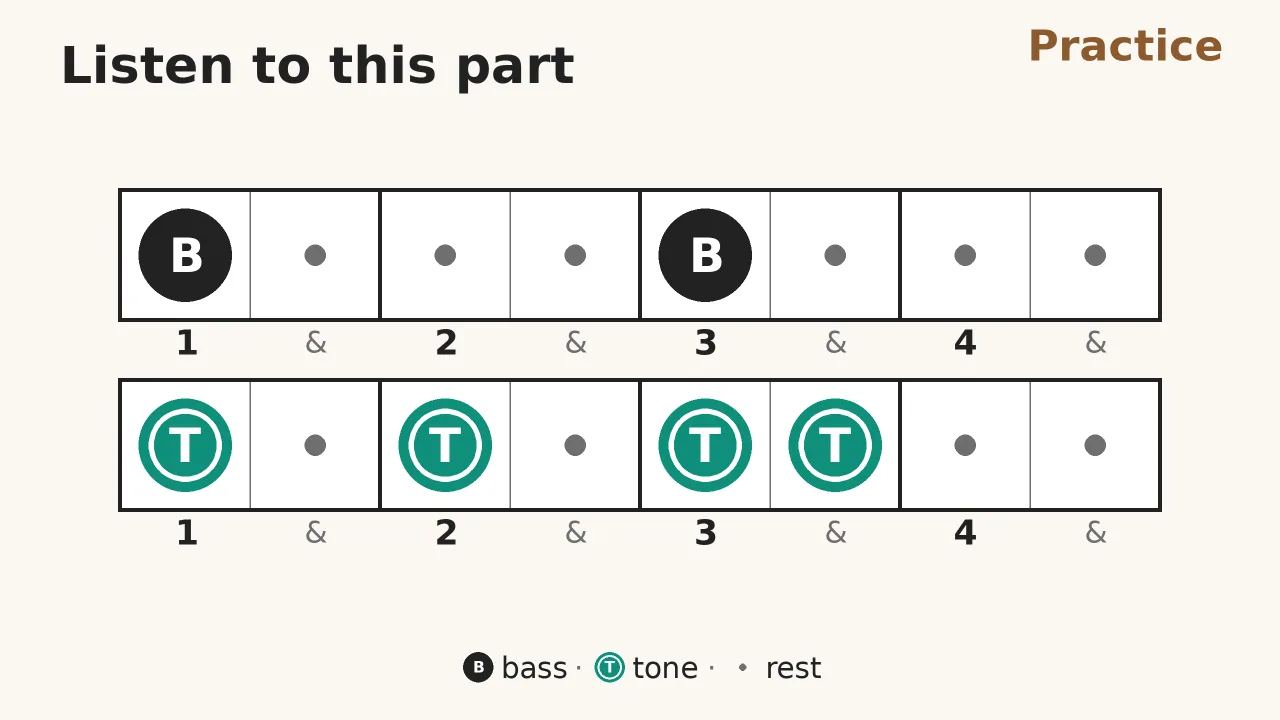
The other part alone: a bass row, then a tone row. Listen once without copying it onto your drum.

Different notes, the same two-bar space
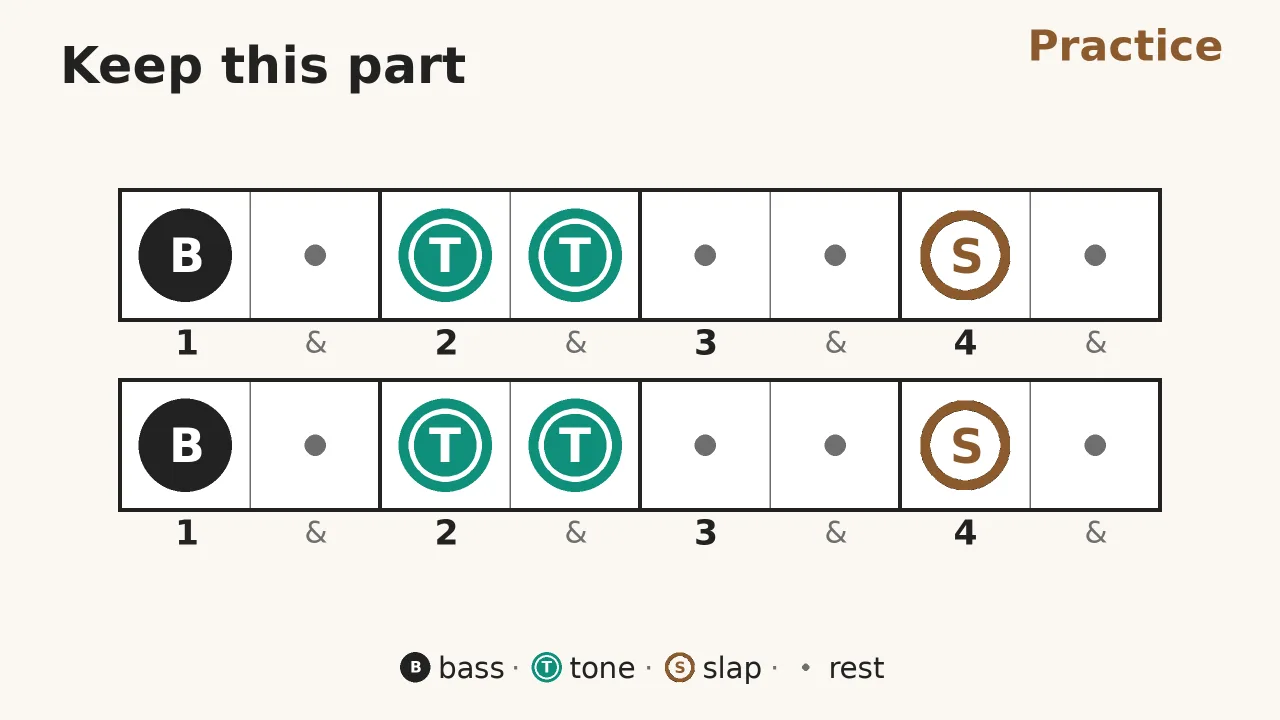
Your first part: two repeats. Each row lasts four practice beats.
The other part: bass row, then tone row. Both row starts align with yours.

Keep two reference points

In the first row, both parts begin with bass. In the second row, your bass meets the other drummer’s tone. Those two different meetings help you recognize where you are in the shared cycle.
Keep your silent beat 3 and the space after your slap. The other part may sound inside those spaces; that does not give you an extra note to play. Start by following the quieter voice with your ear while your hands continue the first part.

First blend: your part is in front, with the other part softer underneath. Keep your own rests.B - T T - - S - | B - T T - - S - / B - - - B - - - | T - T - T T - -
Listening challenge: the other part is now in front and your reference part is softer. Continue playing part one; the foreground change is not a cue to switch.B - - - B - - - | T - T - T T - - / B - T T - - S - | B - T T - - S -

With a partner, begin with their second part quiet. After four steady cycles, ask them to use a comfortable normal volume while you continue. You should still hear both parts; playing louder to drown out the other drummer defeats the listening task.
Judge your physical playing separately from the game result: the pattern stays recognizable, the hands remain comfortable, and you can still notice the other part.

Quick check

Which two observations show that you are following another part without copying it? Select both.
Show the answer

Your own strokes and rests remain unchanged. · You notice when the other part changes from basses to tones.. Independence combines a stable part with active listening.

1 more question in the app Get the app

Practise in the free Djembe app