A missed beat does not have to become a lost minute
Trying to repair a slip with extra strokes often makes the next entrance harder. A short, deliberate silence gives your ears room to find the group again. The other players keep moving through the cycle while you listen.
Use the familiar first Kuku part, B–TT––S–, against the same two-bar second part from the previous ensemble lessons. We are recovering our place in that arrangement, not learning another pattern.
Hear the boundary before you enter
The second part alternates a bass row with a tone row. In our slow practice count, each row lasts four beats. Its tone row plays on 1, 2, 3 and the & after 3, then leaves beat 4 clear. The next bass begins a new two-bar cycle.
That tone ending, space, then bass is the landmark. Do not enter just because you hear any bass: the bass row also has a bass on beat 3. Hear enough of the phrase to distinguish its beginning.
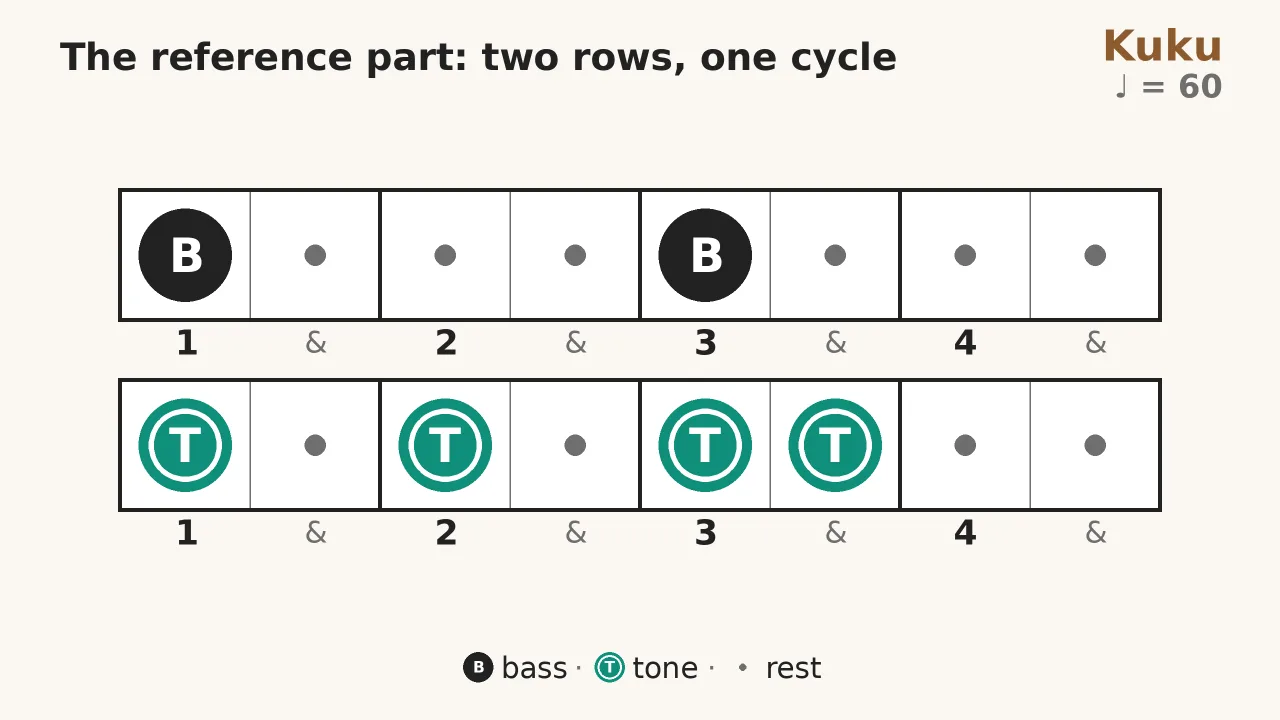
- Bass
- Rest
- Rest
- Rest
- Bass
- Rest
- Rest
- Rest
- Tone
- Rest
- Tone
- Rest
- Tone
- Tone
- Rest
- Rest
Stop, listen, locate, return
Stop uncertain strokes. Keep a small, relaxed pulse in your body instead of filling the silence. Listen for the reference part and its even beat. Locate the tone row and imagine the bass that begins the following row. Silently rehearse your own bass on that next 1. Then return with B–TT––S– and leave its rests intact.
If you are still unsure, let another whole cycle pass. There is no musical debt to repay: do not add notes or speed up to account for what you missed.
Leave a space while the backing continues
In the following sixteen-bar level, part two keeps sounding while you play part one. First play two bars, stay silent for the next two bars—one full cycle—then return on the next bass-row beginning. Keep your part steady for at least three more cycles.
The deliberate silence will count as missed game inputs. The important check here is your placed return and the steady cycles after it, rather than a perfect score. On a later attempt, choose a different moment to stop and wait until you can hear the landmark again. Leave enough of the run to play three full cycles after returning.
In the app: a self-check exercise. Get the app
Bring the routine to your drum
With a partner holding part two at 60 BPM, play two cycles, drop out for one and return. Next, let your partner choose when to signal a dropout; resume only after you recognize the cycle and silently rehearse the entrance. Your partner keeps the pattern unchanged throughout.
If the cycle becomes unclear, stop your part and hear the reference alone. Count its two rows, return quietly, then restore your normal comfortable volume. A successful return stays in place for three complete cycles, without an extra stroke or a burst of speed.
Quick check
1 more question in the app Get the app
