Harriet Music Get the Djembe app

Lesson 3 of 10 12 minutes

How to Play a Djembe Slap (Without Hurting Your Hands)

Harriet In this lesson you will produce a sharp slap using relaxed technique without striking the drum excessively hard.

  1. 1. Meet Your Djembe
    1. Lesson 1: Meet the Djembe
    2. Lesson 2: Position Your Djembe
    3. Lesson 3: Find Your Playing Posture
    4. Lesson 4: Play Your First Bass
    5. Lesson 5: Find the Open Tone
    6. Lesson 6: Hear Bass and Tone
    7. Lesson 7: Keep a Steady Pulse
  2. 2. Your First Rhythms
    1. Lesson 1: Alternate Your Hands
    2. Lesson 2: Combine Bass and Tone
    3. Lesson 3: Learn the Slap Stroke
    4. Lesson 4: Recognize the Three Strokes
    5. Lesson 5: Read a Rhythm Grid
    6. Lesson 6: Count Beats and Offbeats
    7. Lesson 7: Play Eighth Note Patterns
    8. Lesson 8: Build Your First Phrase
    9. Lesson 9: Repeat Rhythms by Ear
    10. Lesson 10: Shape Your Accents
  3. 3. Play Your First Kuku
    1. Lesson 1: Discover the Kuku Rhythm
    2. Lesson 2: Learn Kuku Accompaniment One
    3. Lesson 3: Keep Your Kuku Pattern
    4. Lesson 4: Learn Kuku Accompaniment Two
    5. Lesson 5: Switch Between Kuku Parts
    6. Lesson 6: Recognize the Kuku Call
    7. Lesson 7: Play Along With Kuku
  4. 4. Playing Together
    1. Lesson 1: Listen and Respond
    2. Lesson 2: Practice Call and Response
    3. Lesson 3: Follow Another Djembe Part
    4. Lesson 4: Feel the Dunun Pulse
    5. Lesson 5: Play Without the Click
    6. Lesson 6: Keep Your Place
  5. 5. Traditional Rhythms
    1. Lesson 1: Discover the Djolé Rhythm
    2. Lesson 2: Learn Djolé Accompaniment
    3. Lesson 3: Follow the Djolé Call
    4. Lesson 4: Play Djolé With Others
    5. Lesson 5: Discover the Sinte Rhythm
    6. Lesson 6: Learn Sinte Accompaniment
    7. Lesson 7: Follow the Sinte Call
    8. Lesson 8: Play Sinte With Others
    9. Lesson 9: Discover the Fanga Rhythm
    10. Lesson 10: Learn Fanga Accompaniment
    11. Lesson 11: Follow the Fanga Call
    12. Lesson 12: Play Fanga With Others
    13. Lesson 13: Recognize Traditional Rhythms
  6. 6. Discover Twelve Eight Rhythms
    1. Lesson 1: Feel Three Subdivisions
    2. Lesson 2: Count in Twelve Eight
    3. Lesson 3: Play Your First Ternary Patterns
    4. Lesson 4: Discover the Soli Rhythm
    5. Lesson 5: Learn Soli Accompaniment
    6. Lesson 6: Follow the Soli Call
    7. Lesson 7: Play Soli With Others
    8. Lesson 8: Feel the Ternary Groove
  7. 7. Breaks Variations and Performance
    1. Lesson 1: Understand Musical Calls
    2. Lesson 2: Play a Simple Break
    3. Lesson 3: Return After a Break
    4. Lesson 4: Create Small Rhythmic Variations
    5. Lesson 5: Control Your Playing Tempo
    6. Lesson 6: Start and Finish Together
    7. Lesson 7: Plan an Ensemble Arrangement
    8. Lesson 8: Lead a Simple Call
    9. Lesson 9: Improvise a Short Solo
    10. Lesson 10: Perform a Complete Rhythm

A sharper sound, not a harder hit

When a slap does not sound sharp yet, hitting harder can seem like the obvious solution. But its cutting attack comes from relaxed contact and free-moving fingers, not brute force. Finding that difference takes patient exploration, and it is normal for the sound to be inconsistent at first.

Steve Rivers’s demonstration for Unbeatable Energy is helpful here because it breaks the action into small movements. His approach gives you a way to explore the contact without chasing the sound through force; the practice afterwards leaves plenty of time between attempts.

Play the video

The video plays from YouTube and belongs to its author.

Sharp does not mean hard

Begin with the comfortable setup and open tone from Find the Open Tone. The slap is the third basic sound: sharp and high, with a more cutting attack than the ringing open tone. In later guides, S means slap.
In the approach shown here, Steve uses a subtle skimming contact near the edge, allowing relaxed fingers to move onto the skin. He does not hammer the hard rim. Keep your hand close to the drum and use a small arm movement, with fingers free rather than stiff. Let the hand rebound; do not leave the palm pressed against the head.
There are different ways to produce a slap. Use this demonstration as one approach and compare the sound with a comfortable tone. A louder tone is not automatically a slap.
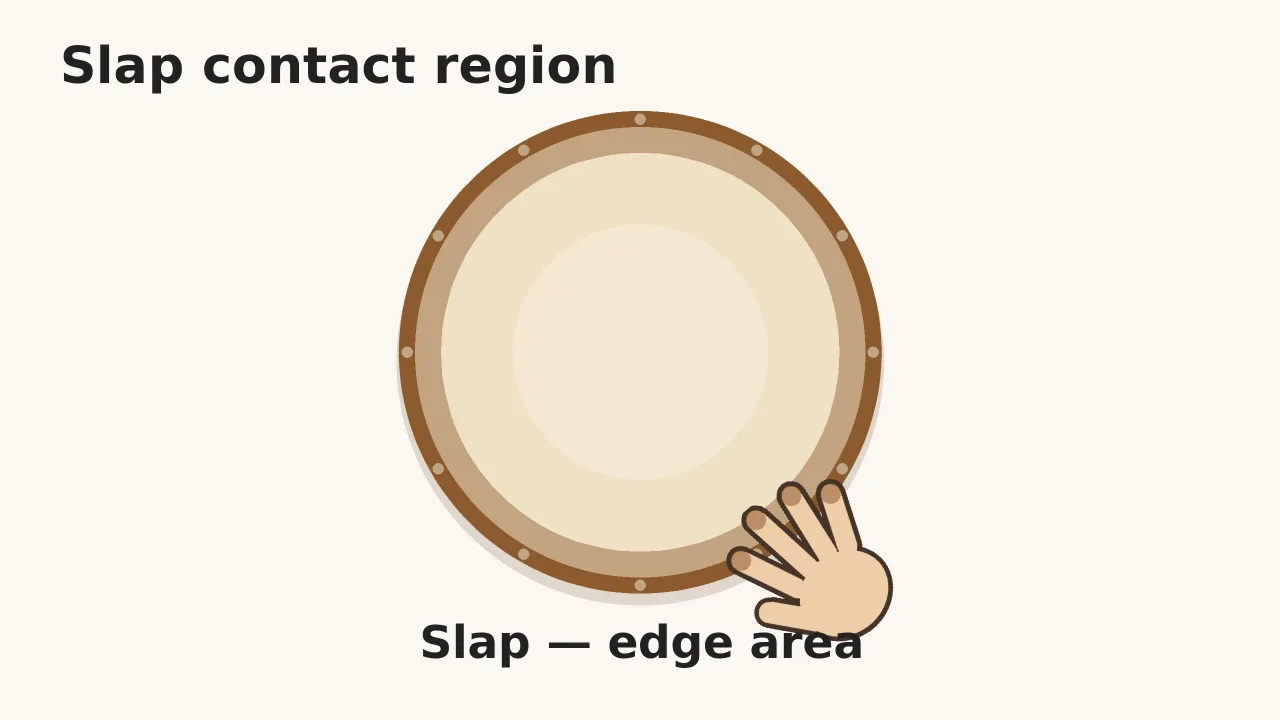
The slap works around the edge area. This schematic locates the region; use the video for the subtle contact and release.
  1. Tone
  2. Rest
  3. Slap
  4. Rest
Open tone, then slap, repeated once. Listen for the ringing tone and the sharper slap attack in these recorded samples.

Quick check

Your slap attempts still sound like tones. What is the best next step?
Show the answer

Revisit contact and finger relaxation using a smaller movement.. Slap depends on contact and relaxed movement; louder or harder is not the same as a sharper attack.

1 more question in the app Get the app

Practise in the free Djembe app