Harriet Music Get the Djembe app

Lesson 1 of 6 7 minutes

Djembe Listening Exercise: Hear a Phrase, Play It Back

Harriet In this lesson you will listen to a short rhythmic phrase and reproduce it accurately after it finishes.

  1. 1. Meet Your Djembe
    1. Lesson 1: Meet the Djembe
    2. Lesson 2: Position Your Djembe
    3. Lesson 3: Find Your Playing Posture
    4. Lesson 4: Play Your First Bass
    5. Lesson 5: Find the Open Tone
    6. Lesson 6: Hear Bass and Tone
    7. Lesson 7: Keep a Steady Pulse
  2. 2. Your First Rhythms
    1. Lesson 1: Alternate Your Hands
    2. Lesson 2: Combine Bass and Tone
    3. Lesson 3: Learn the Slap Stroke
    4. Lesson 4: Recognize the Three Strokes
    5. Lesson 5: Read a Rhythm Grid
    6. Lesson 6: Count Beats and Offbeats
    7. Lesson 7: Play Eighth Note Patterns
    8. Lesson 8: Build Your First Phrase
    9. Lesson 9: Repeat Rhythms by Ear
    10. Lesson 10: Shape Your Accents
  3. 3. Play Your First Kuku
    1. Lesson 1: Discover the Kuku Rhythm
    2. Lesson 2: Learn Kuku Accompaniment One
    3. Lesson 3: Keep Your Kuku Pattern
    4. Lesson 4: Learn Kuku Accompaniment Two
    5. Lesson 5: Switch Between Kuku Parts
    6. Lesson 6: Recognize the Kuku Call
    7. Lesson 7: Play Along With Kuku
  4. 4. Playing Together
    1. Lesson 1: Listen and Respond
    2. Lesson 2: Practice Call and Response
    3. Lesson 3: Follow Another Djembe Part
    4. Lesson 4: Feel the Dunun Pulse
    5. Lesson 5: Play Without the Click
    6. Lesson 6: Keep Your Place
  5. 5. Traditional Rhythms
    1. Lesson 1: Discover the Djolé Rhythm
    2. Lesson 2: Learn Djolé Accompaniment
    3. Lesson 3: Follow the Djolé Call
    4. Lesson 4: Play Djolé With Others
    5. Lesson 5: Discover the Sinte Rhythm
    6. Lesson 6: Learn Sinte Accompaniment
    7. Lesson 7: Follow the Sinte Call
    8. Lesson 8: Play Sinte With Others
    9. Lesson 9: Discover the Fanga Rhythm
    10. Lesson 10: Learn Fanga Accompaniment
    11. Lesson 11: Follow the Fanga Call
    12. Lesson 12: Play Fanga With Others
    13. Lesson 13: Recognize Traditional Rhythms
  6. 6. Discover Twelve Eight Rhythms
    1. Lesson 1: Feel Three Subdivisions
    2. Lesson 2: Count in Twelve Eight
    3. Lesson 3: Play Your First Ternary Patterns
    4. Lesson 4: Discover the Soli Rhythm
    5. Lesson 5: Learn Soli Accompaniment
    6. Lesson 6: Follow the Soli Call
    7. Lesson 7: Play Soli With Others
    8. Lesson 8: Feel the Ternary Groove
  7. 7. Breaks Variations and Performance
    1. Lesson 1: Understand Musical Calls
    2. Lesson 2: Play a Simple Break
    3. Lesson 3: Return After a Break
    4. Lesson 4: Create Small Rhythmic Variations
    5. Lesson 5: Control Your Playing Tempo
    6. Lesson 6: Start and Finish Together
    7. Lesson 7: Plan an Ensemble Arrangement
    8. Lesson 8: Lead a Simple Call
    9. Lesson 9: Improvise a Short Solo
    10. Lesson 10: Perform a Complete Rhythm

Hearing the ending is part of listening

It is tempting to answer as soon as you recognize a phrase. In a rhythmic exchange, that can put your first note inside someone else’s turn. Listen to the sounds and the space after them.
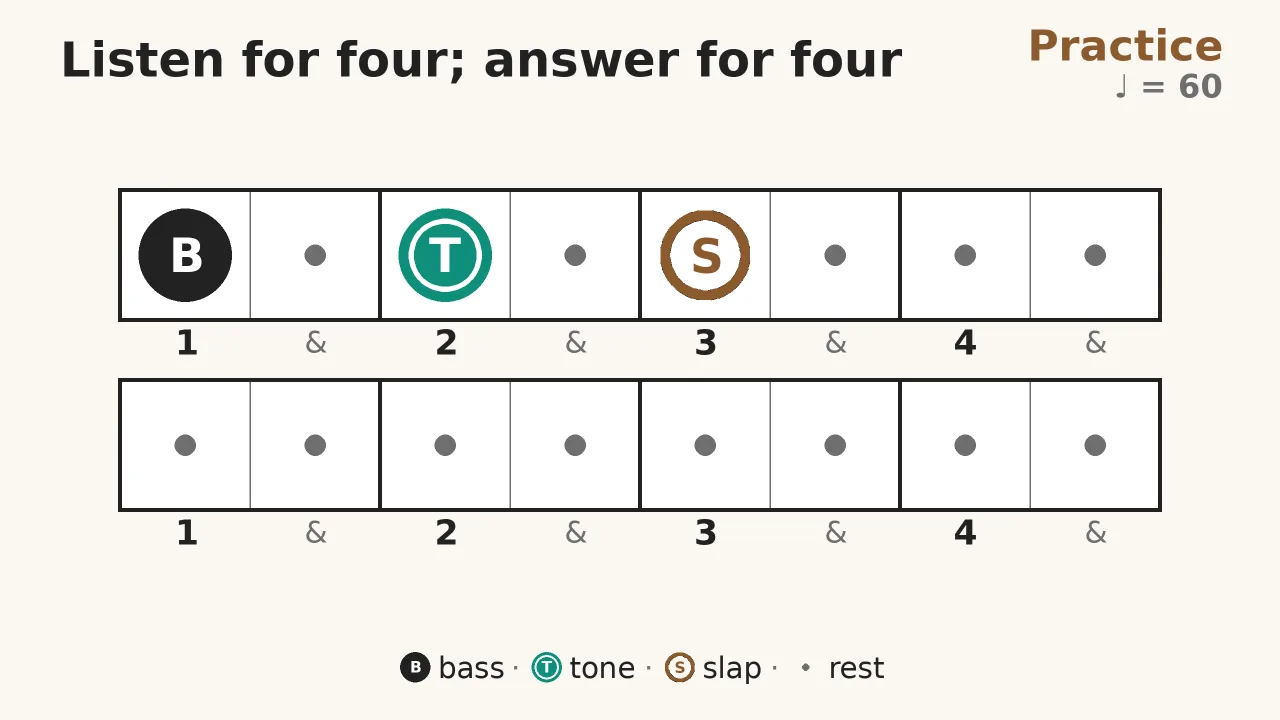
You already copied phrases in Repeat Rhythms by Ear. Now give the model four beats, then use the next four beats for an exact reply. Keep the pulse moving through both turns.

  1. Bass
  2. Rest
  3. Tone
  4. Rest
  5. Slap
  6. Rest
  7. Rest
  8. Rest
  9. Rest
  10. Rest
  11. Rest
  12. Rest
  13. Rest
  14. Rest
  15. Rest
  16. Rest
One bar of count-in, then a four-beat model and four beats of click for your reply. Listen once without playing; replay once more before answering.
Top row: listen to bass on 1, tone on 2, slap on 3, then the silent beat 4. Bottom row: your four-beat turn. Its empty boxes are time for your reply, not instructions to remain silent.

Copy the spaces too

Say “bass, tone, slap, rest” with the four main beats. Start your answer on the next 1, and keep the final beat empty in your reply as well. Each pair of boxes is one beat.
If remembering three sounds makes the entrance hard, first practise B–––T–––: bass on 1, tone on 3. Give the model a full four beats even though its last sound arrives on 3. A partner can play that simpler model, or you can say it before your next-bar reply.

  1. Bass
  2. Rest
  3. Tone
  4. Rest
  5. Slap
  6. Rest
  7. Rest
  8. Rest
  9. Bass
  10. Rest
  11. Tone
  12. Rest
  13. Slap
  14. Rest
  15. Rest
  16. Rest
Check your memory: model, then the identical answer, both played for you. Compare this with what you played; it is no longer an empty reply bar.

Name the error before repeating

A wrong stroke means you used a different sound, such as a tone where the model had a slap. An early entrance means the sounds may be correct, but your reply began before the next bar. Fix the sound by listening again; fix the entrance by keeping the complete count.
For now, finish one listen-and-reply attempt before starting another. A continuous conversation comes next in Practice Call and Response.

Quick check

The model ends with a slap on 3 and silence on 4. When does your bass reply begin?
Show the answer

On the next 1, after the full fourth beat.. The response begins after the complete four-beat model, including its final rest.

1 more question in the app Get the app

Practise in the free Djembe app