Harriet Music Get the Djembe app

Lesson 8 of 13 12 minutes

Play Sinte on Djembe With Other Drummers

Harriet In this lesson you will maintain the Sinte accompaniment while listening to contrasting ensemble parts.

  1. 1. Meet Your Djembe
    1. Lesson 1: Meet the Djembe
    2. Lesson 2: Position Your Djembe
    3. Lesson 3: Find Your Playing Posture
    4. Lesson 4: Play Your First Bass
    5. Lesson 5: Find the Open Tone
    6. Lesson 6: Hear Bass and Tone
    7. Lesson 7: Keep a Steady Pulse
  2. 2. Your First Rhythms
    1. Lesson 1: Alternate Your Hands
    2. Lesson 2: Combine Bass and Tone
    3. Lesson 3: Learn the Slap Stroke
    4. Lesson 4: Recognize the Three Strokes
    5. Lesson 5: Read a Rhythm Grid
    6. Lesson 6: Count Beats and Offbeats
    7. Lesson 7: Play Eighth Note Patterns
    8. Lesson 8: Build Your First Phrase
    9. Lesson 9: Repeat Rhythms by Ear
    10. Lesson 10: Shape Your Accents
  3. 3. Play Your First Kuku
    1. Lesson 1: Discover the Kuku Rhythm
    2. Lesson 2: Learn Kuku Accompaniment One
    3. Lesson 3: Keep Your Kuku Pattern
    4. Lesson 4: Learn Kuku Accompaniment Two
    5. Lesson 5: Switch Between Kuku Parts
    6. Lesson 6: Recognize the Kuku Call
    7. Lesson 7: Play Along With Kuku
  4. 4. Playing Together
    1. Lesson 1: Listen and Respond
    2. Lesson 2: Practice Call and Response
    3. Lesson 3: Follow Another Djembe Part
    4. Lesson 4: Feel the Dunun Pulse
    5. Lesson 5: Play Without the Click
    6. Lesson 6: Keep Your Place
  5. 5. Traditional Rhythms
    1. Lesson 1: Discover the Djolé Rhythm
    2. Lesson 2: Learn Djolé Accompaniment
    3. Lesson 3: Follow the Djolé Call
    4. Lesson 4: Play Djolé With Others
    5. Lesson 5: Discover the Sinte Rhythm
    6. Lesson 6: Learn Sinte Accompaniment
    7. Lesson 7: Follow the Sinte Call
    8. Lesson 8: Play Sinte With Others
    9. Lesson 9: Discover the Fanga Rhythm
    10. Lesson 10: Learn Fanga Accompaniment
    11. Lesson 11: Follow the Fanga Call
    12. Lesson 12: Play Fanga With Others
    13. Lesson 13: Recognize Traditional Rhythms
  6. 6. Discover Twelve Eight Rhythms
    1. Lesson 1: Feel Three Subdivisions
    2. Lesson 2: Count in Twelve Eight
    3. Lesson 3: Play Your First Ternary Patterns
    4. Lesson 4: Discover the Soli Rhythm
    5. Lesson 5: Learn Soli Accompaniment
    6. Lesson 6: Follow the Soli Call
    7. Lesson 7: Play Soli With Others
    8. Lesson 8: Feel the Ternary Groove
  7. 7. Breaks Variations and Performance
    1. Lesson 1: Understand Musical Calls
    2. Lesson 2: Play a Simple Break
    3. Lesson 3: Return After a Break
    4. Lesson 4: Create Small Rhythmic Variations
    5. Lesson 5: Control Your Playing Tempo
    6. Lesson 6: Start and Finish Together
    7. Lesson 7: Plan an Ensemble Arrangement
    8. Lesson 8: Lead a Simple Call
    9. Lesson 9: Improvise a Short Solo
    10. Lesson 10: Perform a Complete Rhythm

Hear another part without borrowing it

Two drummers can share the same beginning while placing different strokes inside the cycle. Your job is to keep the first voice from Learn Sinte Accompaniment, including its rests, while hearing a contrasting part.
Both parts below come from Lars Pistorius’s written Sinte arrangement. Your voice repeats every four beats; the other voice has two different four-beat rows before it returns.

Two cycles together at 50 BPM. Your first voice is louder; the other djembe voice sits underneath.T T - S B - S - B - - S B - S - | T T - S B - S - B - - S B - S - / T T - S - B S - B - S S - B S - | T T - S - B S - B - T T T - S -
  1. Tone
  2. Tone
  3. Rest
  4. Slap
  5. Bass
  6. Rest
  7. Slap
  8. Rest
  9. Bass
  10. Rest
  11. Rest
  12. Slap
  13. Bass
  14. Rest
  15. Slap
  16. Rest
  17. Tone
  18. Tone
  19. Rest
  20. Slap
  21. Bass
  22. Rest
  23. Slap
  24. Rest
  25. Bass
  26. Rest
  27. Rest
  28. Slap
  29. Bass
  30. Rest
  31. Slap
  32. Rest
Your first voice alone over the same two cycles.
  1. Tone
  2. Tone
  3. Rest
  4. Slap
  5. Rest
  6. Bass
  7. Slap
  8. Rest
  9. Bass
  10. Rest
  11. Slap
  12. Slap
  13. Rest
  14. Bass
  15. Slap
  16. Rest
  17. Tone
  18. Tone
  19. Rest
  20. Slap
  21. Rest
  22. Bass
  23. Slap
  24. Rest
  25. Bass
  26. Rest
  27. Tone
  28. Tone
  29. Tone
  30. Rest
  31. Slap
  32. Rest
The other voice alone: listen for its change in the second cycle.

Share the beginning

Both voices open each cycle with two tones on 1 and e. Use that meeting point to check alignment. Later strokes separate: the other part changes its ending in the second cycle while yours keeps its slap on the & of 4 and its final empty position.
Keep your own two slaps just before 2 and 4 in place. Hearing a new stroke from the other drummer is not a request to add it.
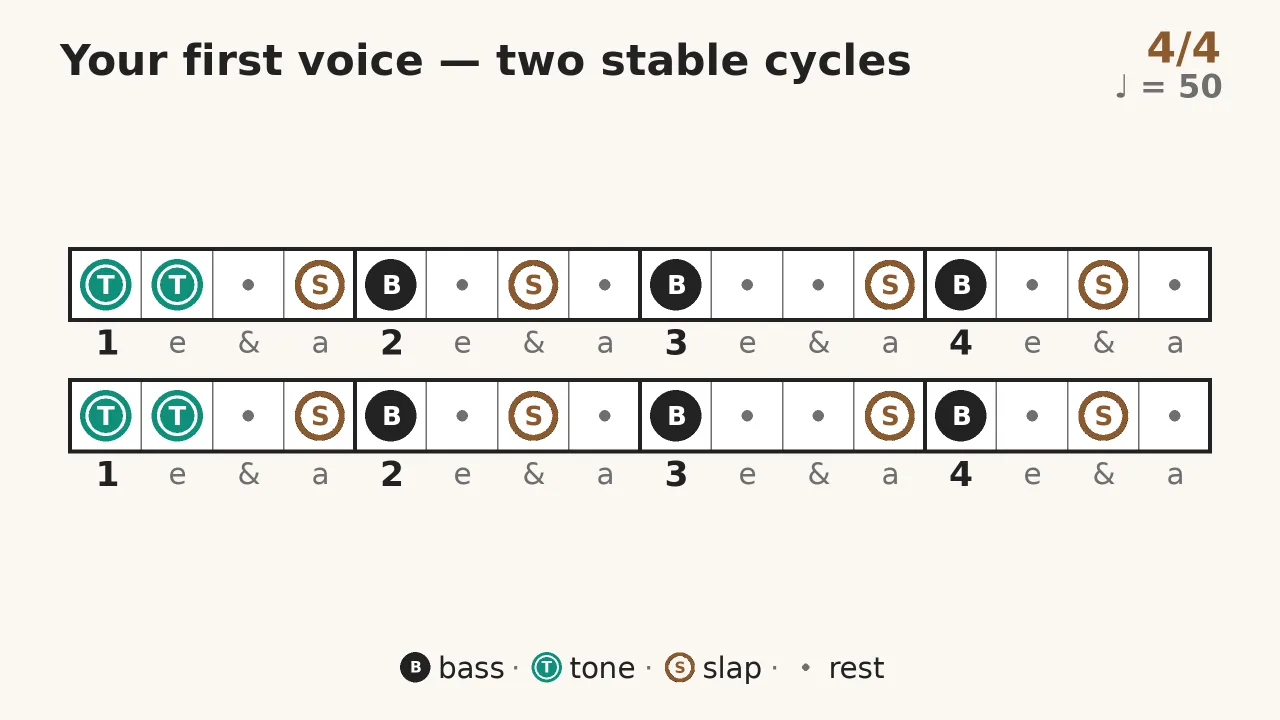
Your part repeats unchanged across both cycles. The other voice changes; both still meet on the next 1.

Bring the call back

Use the single-slap timing adaptation from Follow the Sinte Call. Listen through its last tone on 4 and the remaining e & a, then enter on the next 1 with your two tones.
The next clip supplies the cue and one cycle of your part. Continue for eight cycles yourself at 50 BPM. If a partner is available, they can repeat the documented two-cycle reference voice; keep both voices quiet enough to hear the shared beginning.

  1. Slap
  2. Rest
  3. Tone
  4. Tone
  5. Rest
  6. Tone
  7. Rest
  8. Tone
  9. Tone
  10. Rest
  11. Tone
  12. Rest
  13. Tone
  14. Rest
  15. Rest
  16. Rest
  17. Tone
  18. Tone
  19. Rest
  20. Slap
  21. Bass
  22. Rest
  23. Slap
  24. Rest
  25. Bass
  26. Rest
  27. Rest
  28. Slap
  29. Bass
  30. Rest
  31. Slap
  32. Rest
Adapted cue, then the first accompaniment cycle. Continue the familiar part after the clip ends.

In the app: a practice. Get the app

Check the sound as well as the score

The screen exercises check pad timing; they do not listen to your drum. On the instrument, keep bass, tone and slap distinct and leave the final a of 4 empty. A partner or recording can help you hear whether your return aligns.
When eight cycles at 50 BPM are comfortable, the optional final round extends the task to sixteen at 60 BPM, with no guide.

In the app: a self-check exercise. Get the app

Quick check

The other voice plays a tone run in its second cycle. What happens to your part?
Show the answer

Keep the same accompaniment and final rest. The contrasting voice changes while your first voice repeats unchanged.

1 more question in the app Get the app

Practise in the free Djembe app